- A solar panel warranty is three separate promises: product cover for defects, performance cover for output decline, and workmanship cover for the installation. The headline year usually describes only one of them.
- Product cover varies by model and market. REC Alpha Pure offers 20 years, the Qcells Q.TRON offers 25 years, the older Qcells Q.PEAK DUO-G8 offers 12 years, and Maxeon offers 40 years in select markets outside the United States and Canada.
- Performance floors also vary. At year 25, REC guarantees at least 92 percent, Q.TRON guarantees at least 90.58 percent, and Q.PEAK DUO-G8 guarantees at least 85 percent, each under its own test conditions.
Solar panel warranty: A set of written promises from the panel maker and the installer that covers defects, output decline, and installation work for different periods, with different claim routes and different exclusions for labour and transport.
The model code on the quote decides the warranty, and the headline on the brochure does not. A Qcells Q.TRON BLK M-G2+ datasheet from April 2026 lists a 25-year product warranty and a 25-year linear performance warranty, with at least 90.58 percent of nominal power at year 25. The older Qcells Q.PEAK DUO-G8 terms list a 12-year product warranty and a 25-year performance warranty reaching at least 85 percent at year 25. The REC Alpha warranty conditions list a 20-year product warranty, extendable by five years through the REC Certified Solar Professional Program, and a performance floor of at least 92 percent at year 25. A buyer who compares a single brand name across quotes without the model code will compare warranties that differ by 13 years of product cover and by more than five percentage points of guaranteed output.
Australian government guidance gives the plainest map of the three promises, and buyers in the United States should treat its typical lengths as guidance, because warranty terms are set by each maker for each market. The guidance describes a product warranty of 10 to 15 years for many panels, with some makers now offering 25 years or more, a performance warranty of 25 years on almost all panels, and a workmanship warranty of usually five years. It gives 90 percent up to 10 years and 80 percent up to 25 years as an example of a standard performance warranty, and it warns that performance warranties can be difficult to enforce, with the product warranty often the route that pays out when a panel fails. The example figures are a starting point for questions, and the maker document for the exact model on the quote is the only version that binds the seller.
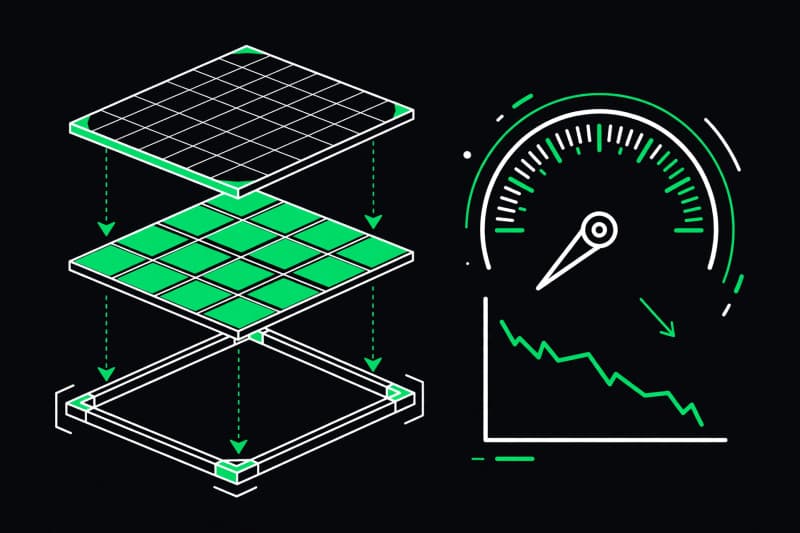
Three warranties sit inside every solar panel warranty quote
The product warranty covers defects in materials and workmanship in the panel itself. The performance warranty covers the rate at which output declines under normal use, measured under standard test conditions with a stated tolerance. The workmanship warranty covers the installation, including roof penetrations, wiring, and mounting. Each promise has its own clock, its own claimant route, and its own exclusions. REC states that its warranty does not cover on-site labour for removing a defective panel or reinstalling a replacement, and that transport to a REC-designated facility is covered except for air freight. Qcells states for the Q.PEAK DUO-G8 that dismantling and reinstallation costs are the owner responsibility. A panel that fails in year 15 can therefore leave the owner with a free replacement panel and a labour bill, and the quote should state who pays for removal, transport, and reinstallation before anyone signs. The guide to how solar panels work explains the cell, glass, and encapsulation layers that the performance warranty measures, and the Enphase vs SolarEdge comparison covers the inverter warranties that sit beside the panel warranty on the same quote.
| Warranty type | What it covers | Typical length in guidance and maker documents |
|---|---|---|
| Product | Defects in materials and workmanship in the panel | 12 years (Q.PEAK DUO-G8), 20 years (REC Alpha), 25 years (Q.TRON), 40 years combined (Maxeon, select non-US markets) |
| Performance | Output decline under normal use, measured at standard test conditions | 25 years for all four models in the table below, with floors from 85 to 92 percent |
| Workmanship | Installation quality, including roof and mounting work | Usually 5 years in Australian guidance; installer terms vary in the United States and must be checked on the contract |
Manufacturer terms for four named models show why the model code matters
The table below uses only the maker documents named in the sources. REC Alpha terms are valid as of 1 January 2019 in the document consulted, with a 2026 revision number, so buyers should confirm the current United States terms for the Alpha line before treating them as a 2026 offer. Q.TRON figures come from the April 2026 North America datasheet. Maxeon figures come from a February 2022 maker release that limits the 40-year combined warranty to most countries outside the United States and Canada, in select markets, for systems installed on or after 1 January 2022. United States Maxeon terms were not verified for this guide, and the 40-year figure must never be presented as a United States warranty.
| Model and document | Product warranty | Performance warranty at year 25 | Labour note |
|---|---|---|---|
| REC Alpha Pure series, warranty conditions Rev 8 | 20 years, extendable by 5 years through the certified installer programme | At least 92 percent, after 98 percent in year 1 and no more than 0.25 percent decline per year | On-site labour excluded; transport covered except air freight |
| Qcells Q.PEAK DUO-G8, warranty terms from 1 August 2019 | 12 years | At least 85 percent, after 98 percent in year 1 and no more than 0.54 percent decline per year | Dismantling and reinstallation at owner cost |
| Qcells Q.TRON BLK M-G2+, datasheet April 2026 | 25 years | At least 90.58 percent, after 98.5 percent in year 1 and no more than 0.33 percent decline per year | Full terms per the Qcells sales organisation for the country |
| Maxeon IBC line, maker release 3 February 2022 | 40 years combined with performance and services, select markets outside the United States and Canada | At least 88.3 percent at year 40, after 98 percent in year 1 and no more than 0.25 percent decline per year | Eligibility varies by market and is subject to registration |
What a 92 percent year-25 floor means for a 400-watt panel
The percentage points translate into watts a buyer can check on a monitoring app. On a 400-watt panel, a 92 percent floor allows at least 368 watts under standard test conditions at year 25, while a 90.58 percent floor allows at least 362 watts and an 85 percent floor allows at least 340 watts. The gap between the REC floor and the Q.PEAK DUO-G8 floor is 28 watts per panel at year 25 on this arithmetic, or 560 watts across a 20-panel array, before real-world temperature, soiling, and shading effects. The calculation uses the maker percentages and a 400-watt nameplate as a stated assumption, and standard test conditions differ from rooftop conditions on a hot afternoon. The point of the arithmetic is narrower: a warranty that looks generous at 25 years can guarantee materially less output than a rival warranty with the same headline year. Buyers should also ask how a claim is measured, who pays for the test, and what tolerance applies, because REC measures performance under IEC 61215 standard test conditions with a plus or minus 3 percent tolerance. Panel count and system size change the stakes, and the 50-state panel-count guide gives the array sizes that turn a per-panel gap into a household-scale gap.
Installer closure leaves parts and labour on different paths
No United States primary source was verified for this guide that states a general rule for what happens to a solar warranty when the installer closes, so this guide states only what the documents show and flags the gap. REC and Qcells route claims through the authorised distributor or seller where the panel was first purchased, with proof of purchase and serial numbers, and both documents exclude or assign on-site labour costs to the owner. That structure is consistent with parts cover continuing through the maker while labour cover depends on the installer contract, and it does not prove a universal rule. In the United Kingdom, the Microgeneration Certification Scheme requires installers to guarantee workmanship for a minimum of two years, transferable, and to insure that guarantee so it is honoured if the company ceases to trade, through an insurance-backed guarantee with maximum cover up to 10 years. That mechanism is United Kingdom only, and the common claim of a 10-year MCS workmanship warranty misreads the rule. The MCS minimum is two years, and 10 years is the maximum cover period for the insurance product. United States buyers should ask for the installer workmanship term in writing, ask whether it is backed by insurance or a third party, and keep the contract, the maker warranty document, proof of purchase, and serial numbers in one file. The California NEM 3.0 payback guide shows how a dead installer can also affect monitoring and export settings, which are separate from the panel warranty itself.
Claim checklist before signing and after a fault appears
Before signing, buyers should record the exact model code, the product and performance years, the year-25 percentage, the labour and transport exclusions, the installer workmanship years, and the claim route, all taken from the maker document and the contract. After a fault appears, the first step is the monitoring record, because a performance claim needs measured output against the warranty curve, under comparable conditions. The second step is the proof of purchase and serial numbers, because REC and Qcells both require them. The third step is a written claim to the distributor or seller named in the warranty document, with photographs and the monitoring export attached. Buyers should keep every reply in writing, because a verbal promise about labour cover is hard to enforce after the installer changes hands. Panasonic figures illustrate why the date matters: the EverVolt HK Black Series guaranteed at least 92 percent at year 25 in maker releases, while the VK Black Series guaranteed at least 84.8 percent, and Panasonic told North American partners in April 2025 that it would discontinue its solar and battery storage business while pledging to honour warranties, as reported in trade press. Historical figures belong in a guide with their dates attached, and current purchase decisions should use the maker documents for models still sold in the buyer market.
Sources: Australian Government energy.gov.au warranties and insurance guidance; REC Alpha warranty conditions (manufacturer document); Qcells Q.PEAK DUO-G8 warranty terms (manufacturer document); Qcells Q.TRON BLK M-G2+ datasheet, April 2026 (manufacturer document); Maxeon release, 3 February 2022; Microgeneration Certification Scheme insurance-backed guarantee products page.
Frequently asked questions
What does a 25-year solar panel warranty actually cover?
It usually describes the performance warranty, which guarantees a minimum output percentage at year 25. Product cover for defects and workmanship cover for installation sit under separate terms, with different years and different claim routes.
How long is the product warranty on a solar panel?
It varies by model. REC Alpha Pure offers 20 years, Q.TRON offers 25 years, Q.PEAK DUO-G8 offers 12 years, and Maxeon offers 40 years combined in select markets outside the United States and Canada. Always check the model code on the quote.
What output should a panel still produce after 25 years?
It depends on the maker floor. REC guarantees at least 92 percent, Q.TRON guarantees at least 90.58 percent, and Q.PEAK DUO-G8 guarantees at least 85 percent, each measured under standard test conditions with its own tolerance.
Who pays for labour when a panel is replaced under warranty?
Often the owner does. REC excludes on-site labour for removal and reinstallation, and Qcells assigns dismantling and reinstallation costs to the owner for the Q.PEAK DUO-G8. The contract should state the labour position before signing.
What should I keep to make a warranty claim?
Keep the maker warranty document, the contract, proof of purchase, serial numbers, and monitoring records showing output over time. Claims go through the distributor or seller named in the warranty document, and written records matter.