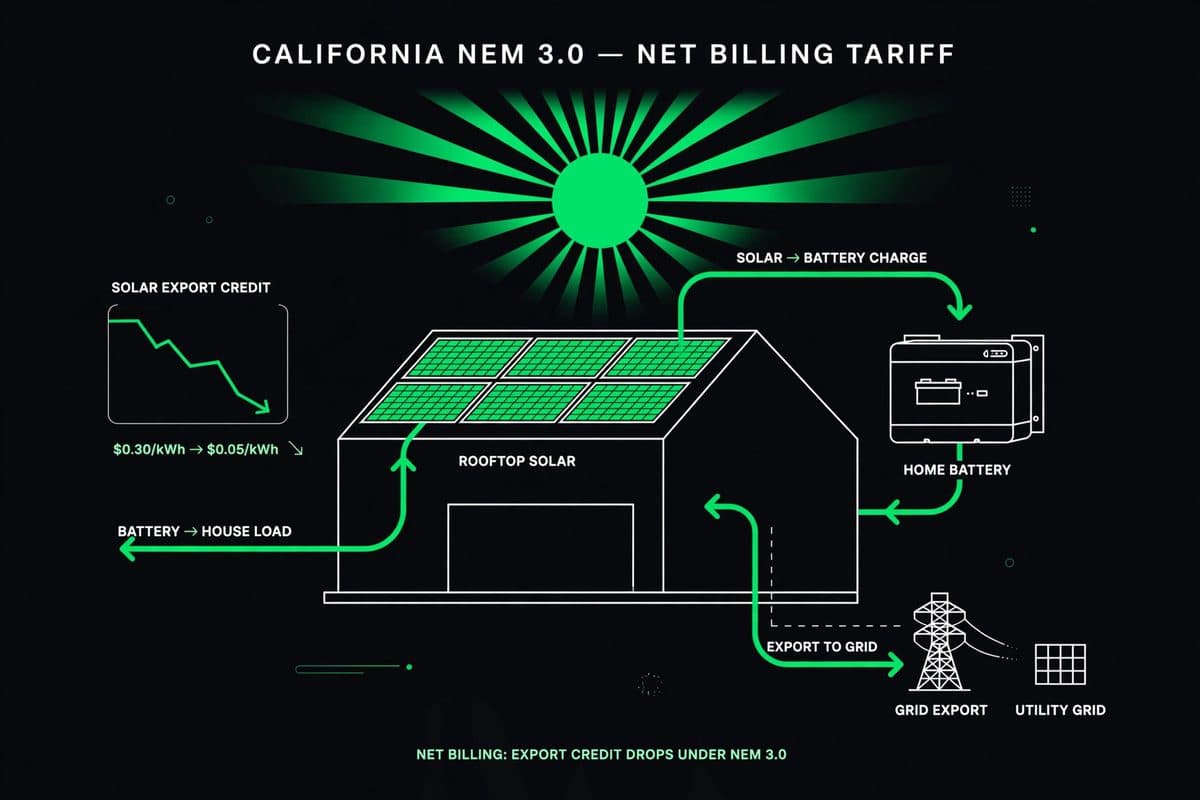
- NEM 3.0 (the Net Billing Tariff) cut California export credits by ~75–80% for SCE, PG&E, and SDG&E customers, but rooftop solar still pays back in 6–13 years depending on whether you add a battery and which utility serves you.
- The math is now a system-design problem, not a subsidy question: size the array to 80–100% of annual usage, shift loads into daylight hours, and add a battery to cover the 4–9 PM peak.
- Municipal utilities like LADWP still pay near-retail export rates, and with the 30% federal tax credit gone in 2026, the utility you belong to matters more than ever.
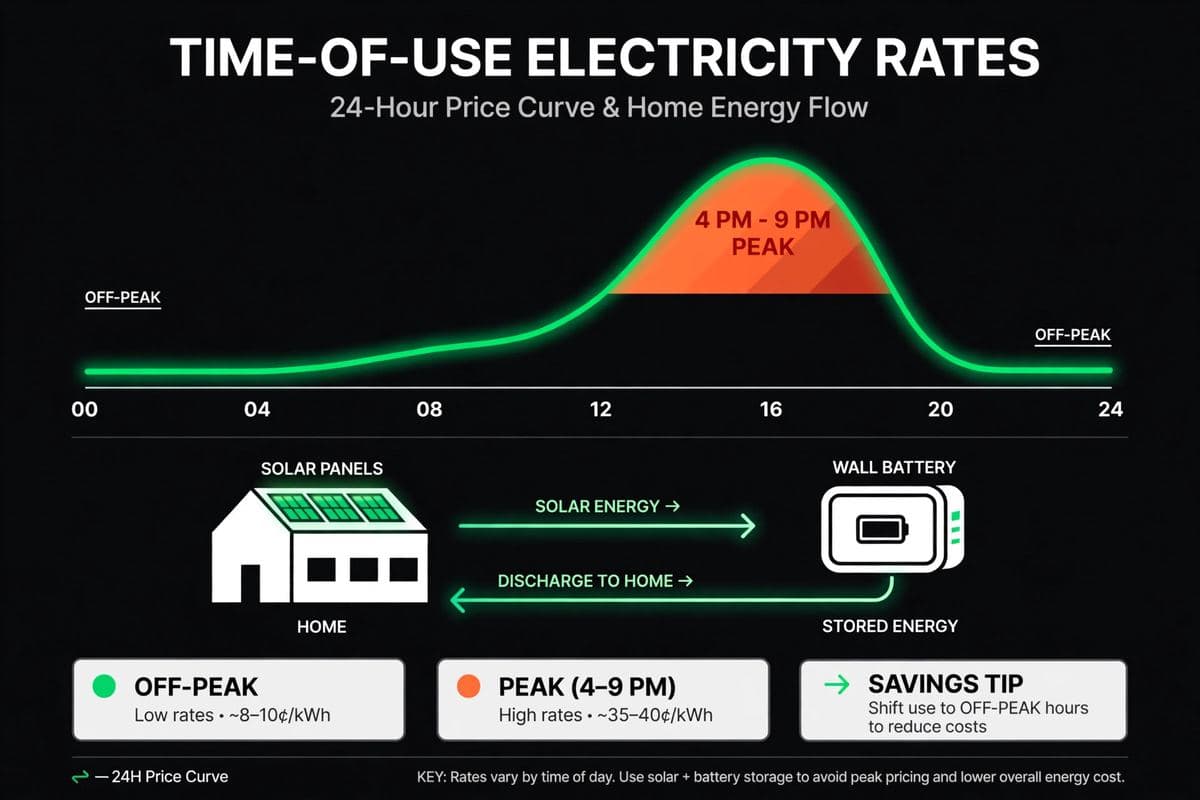
NEM 3.0 (Net Billing Tariff): California’s rule for compensating rooftop solar exports, in effect since April 2023 for new customers of the three big investor-owned utilities (SCE, PG&E, SDG&E). Instead of the one-for-one retail credit under the old net metering, exported electricity earns “avoided-cost” rates: typically 5–8¢/kWh by day and 15–25¢/kWh during the 4–9 PM peak window, a drop of roughly 75–80% from NEM 2.0 levels.
If you own a California home and have been wondering whether NEM 3.0 solar is still worth it, the honest answer is yes, but the version of solar that works has changed. The old game was to oversize your array and spin the meter backward at retail rates. Under the Net Billing Tariff, exported electricity is paid at avoided-cost rates of 5–8¢/kWh during the day, rising to 15–25¢/kWh in the 4–9 PM peak window under the CPUC’s export compensation schedule. That is a ~75–80% cut from the ~25–30¢/kWh retail credits under NEM 2.0. The winning strategy now is to use your own power, not sell it.
The policy is no longer up in the air, either. On June 10, 2026, the California Supreme Court declined to review the appellate ruling upholding the Net Billing Tariff, exhausting the industry’s legal challenge. For new customers of SCE, PG&E, and SDG&E, NEM 3.0 is the permanent framework.
Solar-only 8–13 years, plus battery 6–9: the 2026 payback ranges
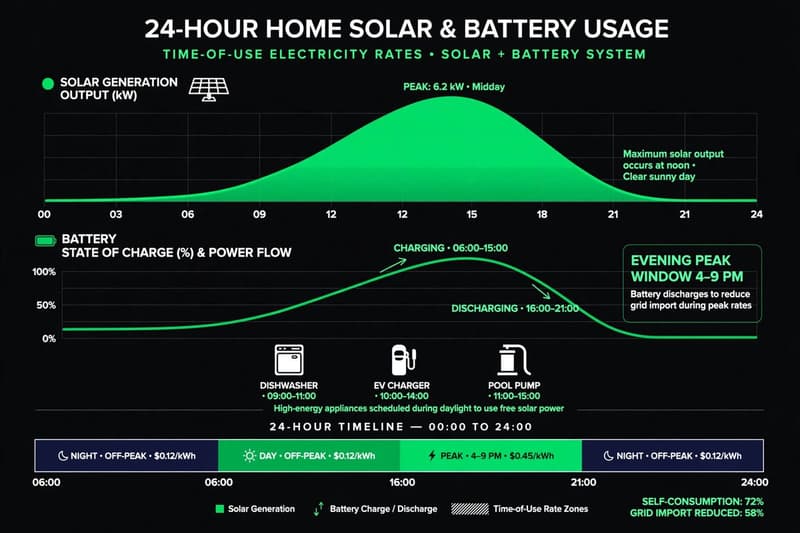
Start with costs. A typical 8 kW system at $2.50–$3.50 per installed watt runs $20,000–$28,000; adding a battery pushes the package to roughly $33,000–$45,000. Against SCE’s average residential rate of about 34–35¢/kWh, the payback numbers look like this: solar-only systems pay back in 9–13 years for households that use most electricity outside daylight hours, or 8–11 years for homes that consume heavily during the day. Add one battery and the picture sharpens to 6–9 years, because stored midday surplus displaces expensive 4–9 PM grid power instead of being exported for pennies.
Those ranges assume the 2026 reality that the federal 30% Investment Tax Credit is gone (it expired December 31, 2025), so there is no federal residential solar or battery credit for 2026 purchases. California’s SGIP residential battery rebate is waitlisted in 2026 with no guaranteed funding. One incentive that survives: the property-tax exclusion, which keeps the added home value from a solar system off your tax assessment.
NEM 3.0 design rules: use it, don’t sell it
Three design rules separate systems that pay from systems that don’t. First, size the array to 80–100% of your annual usage. The old habit of sizing to 120–130% now just exports surplus at 5–8¢/kWh, destroying returns. Second, shift flexible loads into daylight hours between 9 AM and 3 PM, when your panels produce the most and your self-consumed kilowatt-hours are worth the full retail rate. Third, add a battery so midday surplus covers the 4–9 PM peak window instead of buying grid power at the day’s highest prices.
Battery pricing is the hinge of the whole calculation. Installed prices run roughly $14,500–$18,500 for a Tesla Powerwall 3-class unit, $13,000–$15,500 for an Enphase IQ Battery 10C, and $16,000–$21,000 for a FranklinWH aPower 2. Whether a battery is worth buying with or without solar is the question that now decides the California payback, and a growing body of net metering analysis confirms that storage has moved from optional to central under export-rate regimes like this one.
The municipal exception most homeowners miss
Here is the fact that changes everything for some households: NEM 3.0 only applies to CPUC-regulated investor-owned utilities. If your home is served by LADWP, Pasadena PWP, Anaheim APU, Riverside RPU, Burbank, or Glendale, you are on a completely different tariff. LADWP still credits exports at roughly 26–31¢/kWh effective, essentially retail, which puts solar-only payback back at 6–9 years without needing a battery at all.
This two-speed California is the single most underappreciated fact in the state’s solar conversation. Two identical homes ten miles apart can face payback periods that differ by years, purely on account of which utility boundary they sit inside. Check your utility before you check anything else.
| Scenario | NEM 2.0 (grandfathered) | NEM 3.0 (SCE, PG&E, SDG&E) | LADWP (municipal) |
|---|---|---|---|
| Daytime export credit | ~25–30¢/kWh (retail) | 5–8¢/kWh | ~26–31¢/kWh effective (retail) |
| 4–9 PM peak export credit | ~25–30¢/kWh (retail) | 15–25¢/kWh | ~26–31¢/kWh effective (retail) |
| Self-consumed kWh value | Retail rate | Retail rate (34–35¢/kWh on SCE) | Retail rate |
| Solar-only payback | n/a | 8–13 years | 6–9 years |
| Solar + battery payback | n/a | 6–9 years | Battery optional |
Self-consumption is worth 4–7x the export credit
Compare the export values. Under NEM 2.0, a daytime-exported kilowatt-hour was worth about 25–30¢. Under NEM 3.0 it is worth 5–8¢. Same sunshine, one-fifth the export value. Yet the residential rate you avoid by self-consuming is 34–35¢. The ratio is the whole story: every kilowatt-hour you use yourself is worth four to seven times what you earn exporting it. That inversion is why the post-tax-credit solar case still works: the economic engine moved from the export credit to the avoided bill, and the avoided bill keeps getting bigger as rates rise.
Our take: NEM 3.0 turned California rooftop solar into a battery-backed self-consumption business. If you are on SCE, PG&E, or SDG&E, budget for storage and design for daytime use, and do not let a solar-only quote sized for the old rules anywhere near your roof. If you are on a municipal utility with retail export credits, the old rules still apply and solar-only remains the cheapest path. For a refresher on how solar panels actually generate power, start there, then run your own numbers before signing.
Frequently asked questions
Is solar still worth it in California under NEM 3.0 in 2026?
Yes, for most households, with payback of 6–13 years depending on your utility and whether you add a battery. The federal 30% tax credit is gone, so the math relies on California’s high retail rates (around 34–35¢/kWh) and self-consumption, not export credits.
What are the NEM 3.0 export rates?
Exported electricity earns avoided-cost rates of roughly 5–8¢/kWh during daytime hours and 15–25¢/kWh during the 4–9 PM peak window, down about 75–80% from the ~25–30¢/kWh retail credits paid under NEM 2.0.
Do I need a battery with solar under NEM 3.0?
If you are on SCE, PG&E, or SDG&E, a battery sharply improves the economics: solar-plus-battery paybacks of 6–9 years beat solar-only paybacks of 9–13 years, because stored power displaces evening grid electricity. If you are on LADWP or another municipal utility with retail export rates, a battery is optional.
Which California utilities still offer retail net metering?
NEM 3.0 applies only to the CPUC-regulated IOUs (SCE, PG&E, SDG&E). Municipal utilities, including LADWP, Pasadena PWP, Anaheim APU, Riverside RPU, Burbank, and Glendale, kept retail or near-retail net metering, so solar-only systems there pay back in roughly 6–9 years.
When does solar under NEM 3.0 NOT make sense?
If your roof is heavily shaded, your electricity usage is very low, or you expect to move within three to four years, the payback math may not work. An honest installer quote based on your actual usage history will tell you within the first page.