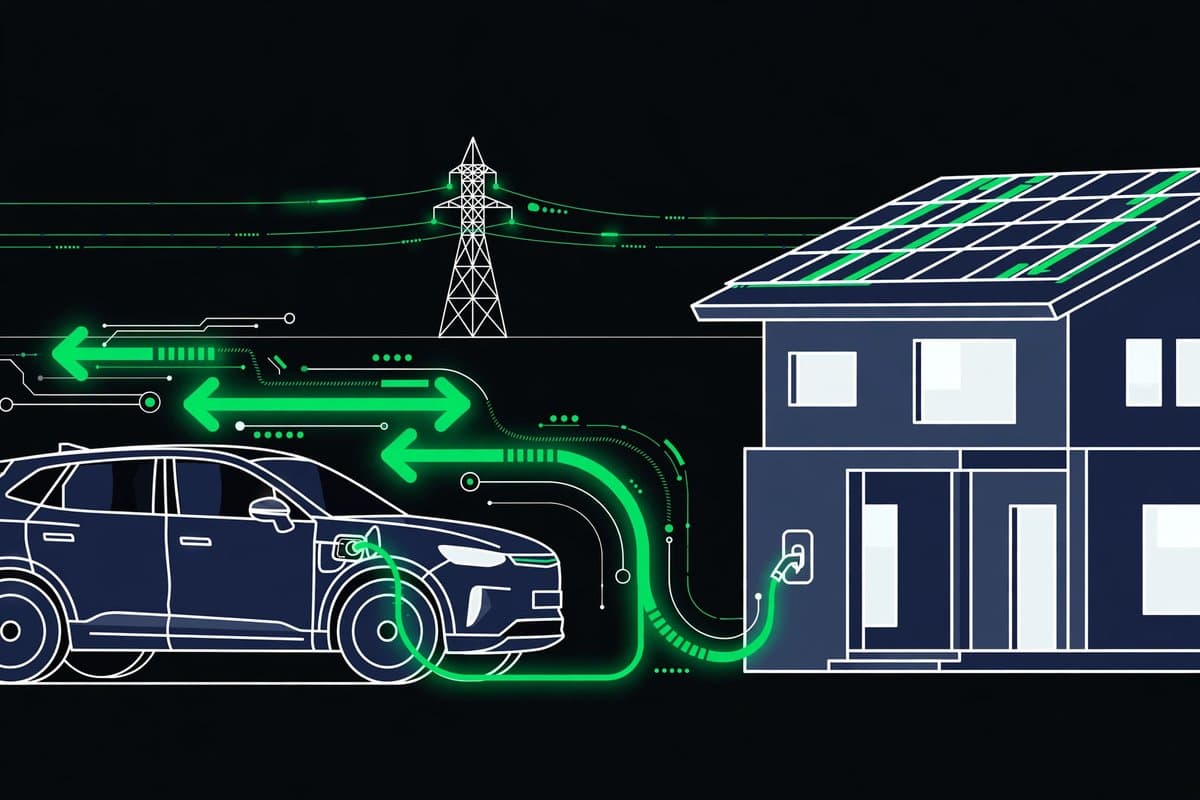
- Bidirectional charging lets a compatible EV send power back out, to appliances, a house, or the grid, instead of only taking power in.
- Only a small set of 2026 models can do it, and each one needs its own brand-approved charger and isolation hardware.
- A 131 kWh truck battery holds enough energy for about three days of normal home use, once a driving reserve and conversion losses are counted.
Bidirectional charging: Bidirectional charging lets an electric car send electricity from its battery back out through its charge port, to run appliances, feed a house, or export to the grid. A normal charger moves power one way, into the car. A bidirectional system adds hardware and software that reverse the flow with the car, the charger, and the utility in control.
Two numbers decide what a car battery can do for a house. The first is power, measured in kilowatts, which sets how many appliances can run at once. The second is energy, measured in kilowatt-hours, which sets how long they keep running. The electric trucks covered here hold 99.8 to 131 kilowatt-hours, several times the energy of a typical wall-mounted home battery. Those two numbers decide whether the feature is worth paying for.
The confusion starts with the labels. V2L, V2H, and V2G all describe the same battery sending power out, but they differ in where the power goes, how much can flow, and who has to approve the setup. Mixing them up is the most common mistake in this market, and it is also the most expensive one, because the charger that runs a campsite fridge cannot back up a house.
Contents
- How bidirectional charging moves power in both directions
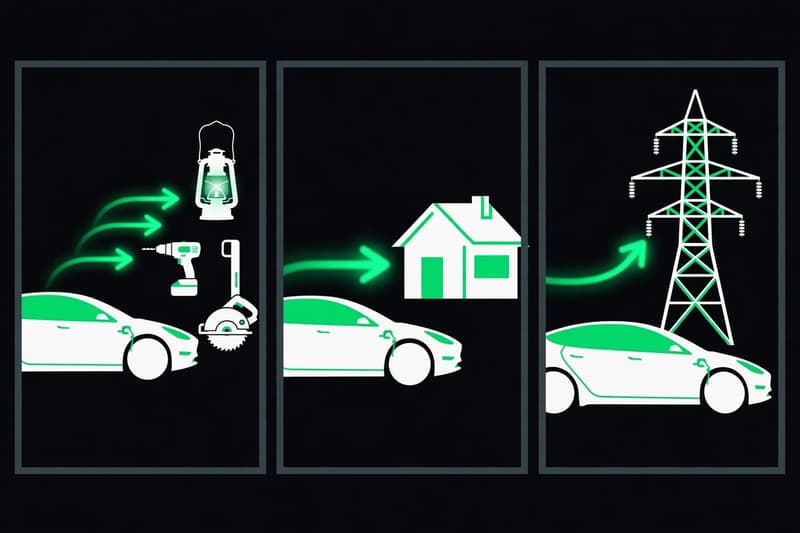
- V2L, V2H and V2G: three destinations for the same battery
- What 9.6 kW of V2H output covers during an outage
- Which EVs can power your home in 2026
- What a V2H setup costs before the first outage
- Queensland shows the rule book can block a car that already works
- How to check whether your EV can do it
- Frequently asked questions
How bidirectional charging moves power in both directions
Ordinary charging is a one-way street. Grid power flows through a wall charger into the car, where an onboard charger converts alternating current to the direct current the battery stores. Bidirectional charging adds a second direction to that street. The car needs either a bidirectional onboard charger that can invert direct current back to alternating current, or a direct-current discharge path through its fast-charging port to an external bidirectional charger that does the conversion. Either way, the hardware has to be designed into the car from the start. A software update cannot add it to a car that lacks the power electronics.
The car and the charger also have to agree on what is happening. For cars with a CCS fast-charging port, that conversation runs on ISO 15118-20, the communication standard that lets the car and the charger negotiate bidirectional power flow. Older CHAdeMO cars use that connector’s own protocol, which is why the Nissan Leaf, a CHAdeMO car, was doing vehicle-to-grid work years before most CCS cars. The standard matters because a charger that cannot talk to the car cannot discharge it safely, and a car that cannot verify the charger will refuse to release power.
Safety sits on top of the electronics. A system that feeds a house must disconnect the house from the grid first, through a transfer switch, gateway, or home hub, so that power from the car never flows back onto lines that repair crews believe are dead. That isolation step is called anti-islanding, and it is the reason vehicle-to-home charging always needs professionally installed hardware beside the electrical panel. A car battery stores far more energy than a wall battery, and the same capacity that makes it useful makes a wiring mistake dangerous. For a primer on how home batteries are sized and wired, see our guide to battery energy storage.
V2L, V2H and V2G: three destinations for the same battery
The three modes share one battery and one idea, then split on destination, power, and paperwork.
| Mode | Where the power goes | Typical maximum power | Hardware needed | Best use |
|---|---|---|---|---|
| V2L (vehicle-to-load) | Appliances plugged into the car | Up to 3.6 kW | Built-in inverter plus an outlet or adaptor | Camping, tools, a fridge during a short outage |
| V2H (vehicle-to-home) | The home electrical panel | 9.6 to 12 kW | Bidirectional charger plus isolation device, professionally installed | Whole-home or partial-home backup during an outage |
| V2G (vehicle-to-grid) | The public grid, through the home connection | Set by the charger and the utility program; a 7 kVA unit is typical for a single-phase home | Bidirectional charger plus utility interconnection approval and a tariff | Exporting power for payment during peak demand |
Vehicle-to-load is the easy one
V2L is the simplest mode and the most common. The car carries an inverter and one or more ordinary power outlets, and the driver plugs appliances straight in. Hyundai’s Ioniq 5 supplies up to 3.6 kW through its V2L system, enough for power tools, a kettle, or a refrigerator at a campsite. Hyundai’s own V2L guidance states the limit plainly and warns that V2L must never be connected to the electricity grid. It works like a portable generator, and Hyundai warns against backfeeding a house through an appliance outlet, a practice that carries a risk of electrocution or fire.
Vehicle-to-home is a house system, not a charger
Vehicle to home charging turns the car into a backup power source for the whole panel. The car feeds the house through a bidirectional charger and a device that isolates the house from the grid the moment the grid drops. Ford, Tesla, GM, and Kia each sell their own version of this system, and none of them is interchangeable with another brand’s car. A V2H setup delivers 9.6 to 12 kW, roughly the output of a large portable generator, and it starts automatically when the grid fails.
Vehicle-to-grid adds a buyer for the power
V2G goes one step further and exports power to the grid for payment. It needs everything V2H needs, plus a utility interconnection agreement and a tariff that pays for exports. That is why V2G electric cars remain rare in the United States even where the cars exist: the car, the charger, and the utility program all have to line up at the same address. Where a program does exist, the economics can work, and joining a virtual power plant is the closest comparison for what owners are paid to share stored energy.
What 9.6 kW of V2H output covers during an outage
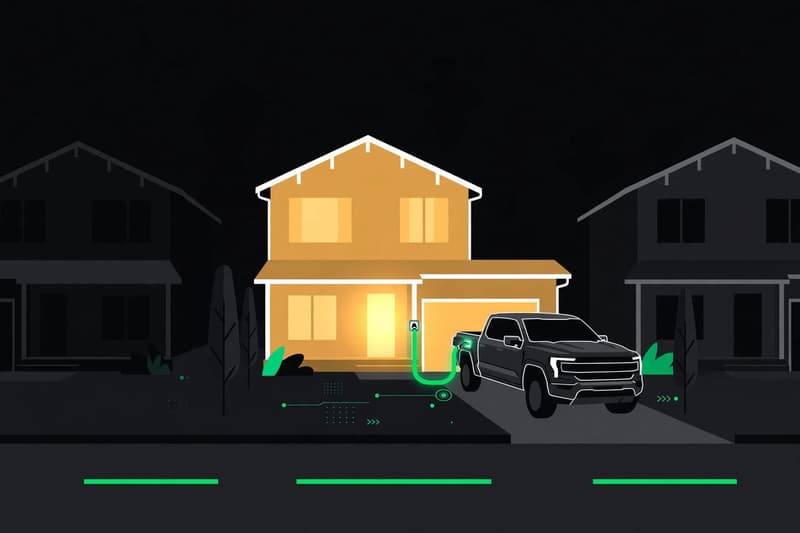
Power and energy answer different questions, and an outage tests both. The 9.6 kW figure is power: it sets the ceiling on what can run at the same moment. Lights, refrigeration, internet equipment, and phone charging together draw a small fraction of that ceiling. One large load, such as central air conditioning or an electric water heater, fits comfortably beside them. Two or three large loads running together do not, and the system will trip or shed loads. The practical rule is one big appliance at a time, plus the small ones.
Energy is the harder limit. The US Energy Information Administration reported that the average US residential customer bought 10,791 kWh of electricity in 2022, about 899 kWh a month. Dividing the annual figure by 365 days gives 29.6 kWh a day, and that is the benchmark for the calculation below. Our calculation applies two deductions before counting a day of backup. First, 20 percent of the battery stays reserved for driving, because a backup battery that leaves the owner stranded has failed at its second job. Second, about 10 percent is lost in conversion between the car battery and the house. That leaves 70 percent of the pack’s rated capacity available for the home.
| Vehicle | Battery (kWh) | Usable for the home at 70% (kWh) | Days at 29.6 kWh a day | Days at 10 kWh a day, essentials only |
|---|---|---|---|---|
| Ford F-150 Lightning, extended range | 131 | 91.7 | 3.1 | 9.2 |
| Kia EV9 | 99.8 | 69.9 | 2.4 | 7.0 |
| Hyundai Ioniq 5 | 77.4 | 54.2 | 1.8 | 5.4 |
| Nissan Leaf e+ | 62 | 43.4 | 1.5 | 4.3 |
The arithmetic lines up with what the carmakers claim. Ford says a fully charged Lightning with the extended-range battery powers an average home for up to three days, or as long as 10 days with rationing or solar support, based on 30 kWh a day of home use. Our calculation gives 3.1 days at full use and 9.2 days on an essentials-only diet of 10 kWh a day, which matches Ford’s figures once the driving reserve and conversion losses are counted. Tesla makes the same shape of claim for the Cybertruck, at over three days of backup on a 30 kWh a day assumption.
Two caveats change the result in real outages. First, the car has to be home and plugged in when the grid fails, and the battery has to be charged. A truck that arrives home at 30 percent charge holds a third of the energy in the table. Second, cold weather and air conditioning both raise daily use, so a summer outage in a hot climate can cut the full-use figure by a third or more. The table is a planning tool, and the owner’s own electricity bill is the number that should replace the national average. Our guide to sizing a home battery for a power outage walks through the same load math for wall batteries.
Which EVs can power your home in 2026
The short list is short. Most EVs on sale in 2026 still cannot send power back to a house or the grid, because they were built without the bidirectional hardware. The models below are the ones with a maker-backed system in the United States or Australia, and the table states exactly which mode each one supports.
| Vehicle | Mode | Maximum output | Home hardware | Status |
|---|---|---|---|---|
| Ford F-150 Lightning | V2H and V2L | 9.6 kW | 80-amp Charge Station Pro plus Home Integration System | On sale in the US |
| Tesla Cybertruck | V2H, V2L, and V2G grid support in certain areas | 11.5 kW | Powershare Gateway plus Universal Wall Connector | On sale in the US |
| Tesla Model 3 and Model Y, ordered in the US on or after 1 October 2026 | V2H with Powerwall 3 | Through the Powerwall 3 system | Powerwall 3 plus Wall Connector | Rolling out in the US |
| GM Ultium EVs: Silverado EV, Sierra EV, Blazer EV, Equinox EV, Hummer EV, LYRIQ, OPTIQ, VISTIQ, Escalade IQ, Celestiq, 2027 Bolt | V2H | 9.6 kW | GM Energy PowerShift Charger plus V2H Enablement Kit | On sale in the US |
| Kia EV9 | V2H | 12 kW | Wallbox Quasar 2 plus Power Recovery Unit | US rollout under way, limited states first |
| Hyundai Ioniq 5, Ioniq 6, and Kia EV6 | V2L only | 3.6 kW | Onboard outlet or adaptor | On sale |
| Nissan Leaf, 2013 and later, CHAdeMO | V2G and V2H | Set by the approved CHAdeMO charger | Fermata Energy FE-20 bidirectional charger | Fleet and dealer programs in the US |
| BYD Atto 3 and Sealion 7, Australia | V2G inside the Amber Electric program only | Program charger | StarCharge Halo bidirectional charger | Trial program, waitlist open |
Ford set the template for truck backup
The F-150 Lightning was the first high-volume EV in the US to offer home backup, with Intelligent Backup Power using the 131 kWh extended-range battery to deliver up to 9.6 kW to the home. The system needs the 80-amp Charge Station Pro and the Home Integration System, which holds the inverter, the transfer switch, and a small dark-start battery that brings the system online when the grid is down. The truck’s Pro Power Onboard outlets offer the same 9.6 kW for tools and appliances, but the outlets and the home backup system are different paths, and only the Home Integration System feeds the panel.
Tesla’s Powershare system lets the Cybertruck provide backup power to a home with up to 11.5 kW for over three days, based on an average US home using 30 kWh a day. The system detects an outage and starts providing power within one minute, using the Powershare Gateway and Universal Wall Connector. With a Powerwall in the house, Model 3 and Model Y can also extend backup duration, and Tesla says Model 3 and Model Y cars ordered in the US on or after 1 October 2026 support Powershare home backup with a Powerwall 3. In certain areas, Powershare Grid Support lets a Cybertruck sell stored energy back to the grid during high-demand periods.
GM covers the widest model range
GM’s V2H system pairs the PowerShift Charger, which charges at up to 19.2 kW, with the V2H Enablement Kit, which holds the home hub, a 9.6 kW inverter, and a dark-start battery. GM lists the kit for whole-home or partial-home backup on services up to 200 amps, and states that the bundle is not compatible with battery systems from other manufacturers. The eligible list runs from the Silverado EV and Sierra EV trucks through the Blazer EV, Equinox EV, Hummer EV, and the Cadillac LYRIQ, OPTIQ, VISTIQ, Escalade IQ, and Celestiq, plus the 2027 Bolt.
Kia and Hyundai split V2H from V2L
Kia’s EV9, with its 99.8 kWh battery, supports vehicle to home charging through the Wallbox Quasar 2 bidirectional charger and its Power Recovery Unit, at up to 12 kW. Wallbox opened pre-orders for the Quasar 2 and Power Recovery Unit in March 2025 at US$6,440 before taxes and installation, initially for eligible EV9 owners in California, Texas, Florida, New York, Washington, New Jersey, and Illinois. Hyundai says V2H is coming to the Ioniq 9 and the Kia EV6, but for now the Ioniq 5, Ioniq 6, and EV6 offer V2L only, at 3.6 kW through the onboard outlet.
The Leaf is the veteran of V2G
The Nissan Leaf remains the only mass-produced EV in the US with a long V2G record, because its CHAdeMO port was built for two-way flow from the start. Nissan has approved the Fermata Energy FE-20 bidirectional charger for use with the Leaf, and the charger carries UL 1741-SA certification and supports IEEE 2030.5 for operation under California Rule 21. More than 30 V2G installations in the US run Fermata chargers with Leaf vehicles, and Leaf models from 2013 and later can send energy back to the grid in certain states. The Leaf e+ carries a 62 kWh battery, the figure used in the backup table above.
BYD proves the model in Australia, inside one program
In Australia, BYD’s Atto 3 and Sealion 7 support V2G only inside Amber Electric’s vehicle-to-grid program, where BYD stands behind the battery warranty for participants. Amber and BYD expanded the program to the Sealion 7 on 18 September 2026, and the program is scaling toward 1,000 chargers with backing from the Australian Renewable Energy Agency. Amber reported a fleet of 64 sites by the end of October 2026, with more than 8,000 people on the waitlist. Outside that program, no BYD sold in Australia has vehicle-to-home or vehicle-to-grid switched on as a feature any owner can use.
What a V2H setup costs before the first outage
The car is only the first purchase. Each maker sells its own hardware bundle, and installation is extra on every price below. A buyer who prices the car and forgets the hardware has priced half the system.
| System | Hardware | Hardware price | Notes |
|---|---|---|---|
| Tesla Powershare, Cybertruck | Universal Wall Connector plus Powershare Gateway | US$1,970 | Professional installation required and not included |
| Kia EV9 V2H | Wallbox Quasar 2 plus Power Recovery Unit | US$6,440 | Pre-order price from March 2025, before taxes and installation |
| GM Energy V2H Bundle | PowerShift Charger plus V2H Enablement Kit | US$8,998 | List price before installation; promotions cut it at times |
| Ford Intelligent Backup Power | Charge Station Pro plus Home Integration System | US$3,895 for the Home Integration System hardware at launch | Charge Station Pro was a US$1,310 option for standard-range buyers at launch |
| Amber Electric V2G program, Australia | StarCharge Halo bidirectional charger, installed | A$2,990 (Australian dollars) | For eligible BYD owners joining the program |
Installation varies by home: panel capacity, distance from the panel to the charger, and local permit rules all move the quote. A Level 2 charger install is the closest comparison for the electrical work involved, and our breakdown of Level 2 EV home charger installation cost in 2026 shows how those line items add up. Get the electrician’s quote before buying the car for this feature, because a panel upgrade can cost more than the charger itself.
Queensland shows the rule book can block a car that already works
The newest proof that rules matter as much as hardware comes from Queensland, Australia. Grant Schmidt, a BYD Sealion 7 owner in Mount Cotton, charges his car from 13.2 kW of rooftop solar and wants to send power from the car back into the grid at night. Energex rejected his application to install a bidirectional charger because his existing hybrid solar inverter already reaches the 10 kVA limit on inverter capacity for a single-phase connection. The house can have the solar inverter or the V2G charger, but it cannot connect both.
Schmidt launched a petition to the Queensland Parliament asking energy minister David Janetzki to let households with hybrid inverters rated at up to 10 kVA install an approved bidirectional V2G charger as well, and to expand the dynamic connections framework so it can hold both. The petition had 682 signatures when The Driven reported it on 11 November 2026, and it carries the backing of former energy minister Mick de Brenni. The limit is already costing Schmidt a place in a subsidised trial: he was invited to join Amber Electric’s V2G trial after BYD approved the Sealion 7 for the trial in September 2026, but he cannot install the charger. He spent A$2,000 (Australian dollars) on a Zaptec bidirectional charger last year that still is not approved for V2G, and he is prepared to spend another A$3,000 (Australian dollars) on the approved StarCharge Halo charger.
South Australia shows the fix. It also caps hybrid solar inverters at 10 kVA, but it treats chargers as batteries and lets a house on a single-phase connection install an additional 10 kVA of battery or V2G inverter capacity. The Queensland case is a warning for US buyers too: the car, the charger, and the warranty can all be ready while the network rules say no. Check the interconnection rules with the local utility before ordering hardware.
Standards and warranties decide what is safe to install
Three layers of rules govern a bidirectional install. The charger itself carries certification, such as the UL 1741-SA listing on the Fermata FE-20, and grid interconnection follows the IEEE 1547 standard. The car and charger negotiate over ISO 15118-20 on CCS cars, while SAE J3072 covers the alternating-current bidirectional path. The warranty is the third layer, and it is the one buyers forget. BYD keeps battery warranty cover for Sealion 7 and Atto 3 owners who use V2G inside Amber’s official trial, and only inside it. Tesla’s Australian owner’s manual warns against using the vehicle battery as a stationary power source and states that doing so voids the warranty. In November 2026, Australian Tesla owners also reported that software version 2026.38 stopped third-party vehicle-to-home equipment from discharging their cars, a change Tesla has not publicly confirmed. The lesson holds in every market: use the maker’s approved equipment and program, and get the warranty position in writing before the install.
How to check whether your EV can do it
The check takes an hour and saves a costly mistake. Work through it in order, and stop at the first no.
- Find the maker’s list for your exact model year and trim, and confirm which mode it supports. A V2L outlet does not mean the car can do V2H, and V2H does not mean it can do V2G.
- Confirm the approved charger and isolation hardware for that car. Each maker names its own equipment, and a charger built for one brand will not run another brand’s car.
- Ask the local utility or network operator about interconnection approval, export limits, and any inverter capacity cap, such as the 10 kVA single-phase limit in Queensland.
- Ask the dealer for the warranty position in writing, including whether trial-only cover applies, as it does for BYD owners in Amber’s program.
- Get a licensed electrician to quote the install, including panel capacity and permits, before buying the car for this feature.
- Check whether a utility program exists that pays for exports. Without a tariff, V2G is backup power with extra paperwork.
Frequently asked questions
What is bidirectional charging?
Bidirectional charging lets a compatible electric car send electricity from its battery back out through its charge port, to run appliances, feed a house, or export to the grid. The car needs bidirectional power electronics built in, plus a bidirectional charger and, for home or grid use, an isolation device that disconnects the house from the grid during an outage.
Which EVs support V2G?
The list is short. The Nissan Leaf supports V2G through its CHAdeMO port with an approved charger such as the Fermata FE-20. In Australia, the BYD Atto 3 and Sealion 7 support V2G inside Amber Electric’s program only. Tesla’s Cybertruck offers grid support in certain US areas through Powershare. Most CCS cars are still waiting on certified ISO 15118-20 chargers and utility programs, so check the maker’s list for your exact model year before assuming a car qualifies.
Can my EV power my house?
It can only if the maker lists vehicle-to-home support for your exact model year and trim, and only with the maker’s approved bidirectional charger and isolation hardware, professionally installed. A V2L outlet alone cannot power a house, and connecting V2L to the home wiring is dangerous. The cars with maker-backed home backup in the US are the Ford F-150 Lightning, the Tesla Cybertruck, GM Ultium EVs, the Kia EV9, and newer Tesla Model 3 and Model Y cars paired with a Powerwall 3.
How long can an EV power a house during an outage?
It depends on the battery size, the charge level when the outage starts, and how much the house uses. Our calculation, holding back 20 percent of the battery for driving and counting about 10 percent conversion loss against the EIA average of 29.6 kWh a day, gives about 3.1 days for a 131 kWh Ford F-150 Lightning, 2.4 days for a 99.8 kWh Kia EV9, and 1.5 days for a 62 kWh Nissan Leaf e+. On an essentials-only diet of 10 kWh a day, those figures rise to 9.2, 7.0, and 4.3 days.
Does bidirectional charging damage the EV battery?
Extra discharge cycles add wear, which is why carmakers manage V2G through approved programs with discharge limits and warranty terms. BYD keeps warranty cover for owners who use V2G inside Amber’s official trial. Unapproved third-party discharge equipment can affect warranty cover, and Tesla’s manual warns that using the battery as a stationary power source voids the warranty. Use the maker’s approved equipment and program.
Sources
- Tesla Powershare, Tesla Support, accessed 16 November 2026
- Tesla Powershare Home Backup Bundle, Tesla Shop, accessed 16 November 2026
- GM Energy V2H Bundle, GM Energy, accessed 16 November 2026
- How much electricity does an American home use?, US Energy Information Administration, updated 8 January 2024
- Queensland EV owner calls for rule change after V2G charger rejected, The Driven, 11 November 2026
- E-Petition: Vehicle-to-Grid bidirectional EV chargers, Parliament of Queensland, 2026
- Hyundai IONIQ 5 V2L, Hyundai New Zealand, accessed 16 November 2026
- Wallbox Opens Quasar 2 Pre-Orders for EV9, The EV Report, 4 March 2025
- Nissan LEAF Gains Enhanced Bidirectional Charger, The EV Report, 29 August 2024
- BYD expands Amber Electric V2G program to Sealion 7, EVShift, 18 September 2026
- Ford F-150 Lightning goes on a Power Play, Pickup Truck Talk, updated 19 August 2026
- Vehicle-to-Home Charging: How the Kia EV9 and Hyundai Ioniq 9 Keep Your House Running, Autoblog, 2 December 2025
- Aussies who want to use their Tesla to drive down their power bills get some bad news, WhichCar, 10 November 2026
- Bidirectional Charging and V2G in Australia Explained, EV Roadside, accessed 16 November 2026