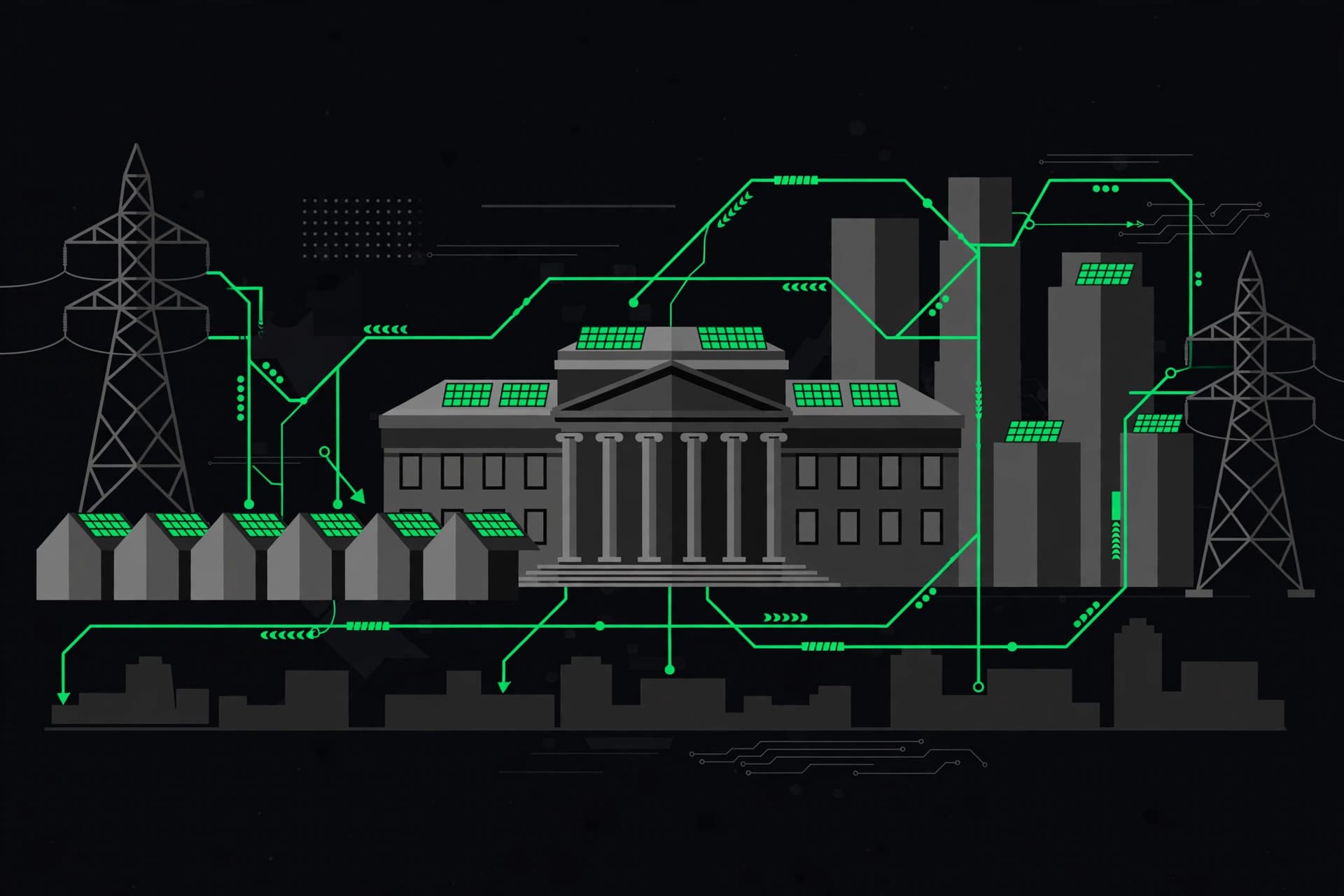
- Community choice aggregation lets a city or county buy electricity for its residents while the old utility keeps delivering it, reading the meter, and sending the bill. About 5.7 million US customers bought 14.6 billion kWh through CCAs in 2022, across 10 states.
- Enrollment is automatic. Once a community joins a CCA, residents are enrolled unless they opt out, and the opt-out request goes to the CCA itself, with at least two notices in the 60 days before the switch.
- Solar owners keep net metering under a CCA. The California regulator confirms net metering stays available to CCA customers, and the CCA replaces only the generation half of the bill, while delivery, billing, and outage response stay with the utility.
Community choice aggregation: a program, also called municipal aggregation, that lets a local government buy electricity on behalf of its residents, businesses, and municipal accounts from an alternative supplier, while the existing utility continues to deliver the power and send the bill.
Two halves make up an electricity bill, and a CCA changes only one of them. The generation half pays for the power itself, and the delivery half pays for the wires, the meter, and the crew that restores service after a storm. Under a CCA, the city or county takes over the generation half, buying power in bulk for everyone inside its borders. The utility keeps the delivery half, and it keeps sending the single consolidated bill. Nothing about the wires changes, and the lights stay on through the same utility.
The part that surprises people is the price of leaving the old arrangement behind. California’s regulator charges CCA customers a Power Charge Indifference Adjustment, a fee that covers generation the utility already bought before the customer switched. The fee changes every year and depends on the year the customer joined, so two neighbours on the same CCA can pay slightly different delivery charges. It is the cost of the utility’s old contracts, and it is the reason a CCA’s lower generation rate does not always translate into a lower total bill.
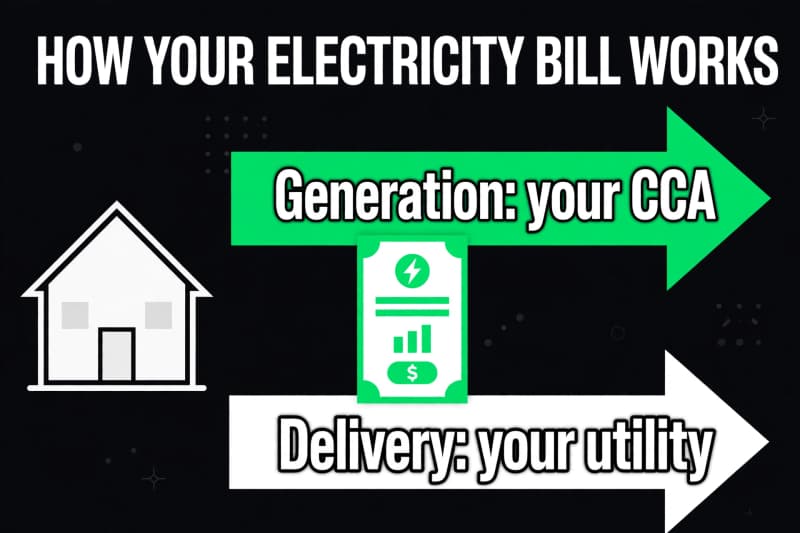
How community choice aggregation splits your electricity bill
The US Environmental Protection Agency describes the split plainly. The CCA procures power from an alternative supplier while the existing utility provides transmission and distribution service. Customers continue to receive the same delivery and maintenance services from their local utility, with a single utility bill that reflects the change in supplier. The only changes for customers are the sources and prices of electricity generation. The California Public Utilities Commission adds the detail that the utility collects payments on behalf of the CCA and passes them on, so the household still pays one bill.
CCAs can also offer tiers. Most run a standard option that customers are enrolled in unless they opt out, plus an opt-in greener option at a price premium, with a higher share of renewable power or power from local sources. The EPA notes that CCA prices may run lower than the residential retail price, sometimes by 15 to 20 percent, because a whole community buying together negotiates better rates than a single household. That saving depends on market prices, the CCA’s contracts, and the exit fee described above.
| Part of the bill | Who provides it under a CCA | What changes for the customer |
|---|---|---|
| Electricity generation | The CCA, buying in bulk for the community | New supplier, new generation rate, possibly greener mix |
| Transmission and distribution | The existing utility | Nothing; same wires, same delivery charges |
| Metering and billing | The existing utility | Nothing; one consolidated bill from the utility |
| Outage response and maintenance | The existing utility | Nothing; same crews, same phone number |
| Power Charge Indifference Adjustment | The utility, as part of delivery charges | New charge covering the utility’s generation bought before the switch |
| Net metering for solar owners | Still available through the utility | Nothing; solar programs remain open to CCA customers |
The 10 states where CCAs operate
CCAs exist only where state law allows them. The EPA lists 10 states with enabling legislation: Massachusetts (1997), Ohio (1999), California (2002), Rhode Island (2002), New Jersey (2003), Illinois (2009), New York (2014), New Hampshire (2019), and Maryland (2021), plus Virginia, where the law dates to 1999 with opt-out provisions added in 2004, though no residential community choice programs have formed there. A local government in one of these states must hold public hearings and pass a law authorising the CCA before it can begin.
California holds the largest programs. Clean Power Alliance, the state’s largest CCA, serves more than 3 million residents and about 1 million customers across 38 communities in Los Angeles and Ventura counties, and 67 percent of its customers are enrolled in its 100 percent Green Power option, according to its 2025 Impact Report. The US Department of Energy’s National Laboratory of the Rockies ranked it the number one green power provider in the United States for the third year running, with 4,881,737 MWh of green power sales in the 2024 rankings. It is the fourth largest electricity provider in California, which shows how far the model has grown from its 2002 origins in Assembly Bill 117.
| State | Year established | Program name | Enrollment |
|---|---|---|---|
| Massachusetts | 1997 | Community choice aggregation | Opt-out |
| Ohio | 1999 | Governmental energy aggregation | Opt-in or opt-out |
| California | 2002 | Community choice aggregation | Opt-out |
| Rhode Island | 2002 | Community choice aggregation | Opt-out |
| New Jersey | 2003 | Government energy aggregation | Opt-out for residential customers |
| Illinois | 2009 | Municipal aggregation | Opt-out |
| New York | 2014 | Community choice aggregation | Opt-out |
| New Hampshire | 2019 | Community choice aggregation | Opt-out |
| Maryland | 2021 | Community choice energy pilot | Opt-out |
| Virginia | 1999, opt-out 2004 | Municipal aggregation | No residential programs formed |
The national scale is large and still small beside the whole grid. The EPA reports that about 5.7 million customers procured about 14.6 billion kWh of electricity through CCAs in 2022. Dividing one figure by the other gives about 2,561 kWh per customer per year, which is Joule Post arithmetic from the EPA figures. That average sits far below a typical US household’s annual use, because the 5.7 million count includes businesses and municipal accounts as well as homes, and because many CCA customers buy only part of their power through the program. Read the figure as a measure of the program’s reach, since it averages homes together with businesses and municipal accounts.
What a CCA means for solar owners under net billing
Solar owners ask the sharpest questions about CCAs, and the answers are mostly reassuring. The California regulator states that net metering, the California Solar Initiative, and other solar programs remain available to CCA customers, and that energy-efficiency rebates, low-income discounts, and balanced payment plans stay available as well. A solar owner who joins a CCA keeps the same net-metering arrangement, and the CCA replaces only the generation charges on the power the household imports from the grid.
The confusion comes from the bill itself. A solar household’s bill under a CCA shows generation charges from the CCA, delivery charges from the utility, and the Power Charge Indifference Adjustment, all on one page from the utility. Export credits for surplus solar power still flow through the net-metering arrangement, which the regulator lists among the services that stay with the utility. Anyone comparing a CCA rate with the utility’s rate should use the joint rate comparison each utility and CCA must publish, which shows the two options side by side. The generation line alone gives an incomplete picture.
For the generation side of the story, see how solar panels work, our guide to the technology on the roof, and how many solar panels a home needs, which uses 50-state data to size a system. Storage changes the calculation again, and our guide to battery energy storage explains how a home battery shifts solar power from midday to the evening peak. The cost of the power itself is a separate question, covered in our analysis of utility-scale solar farm cost per MW.
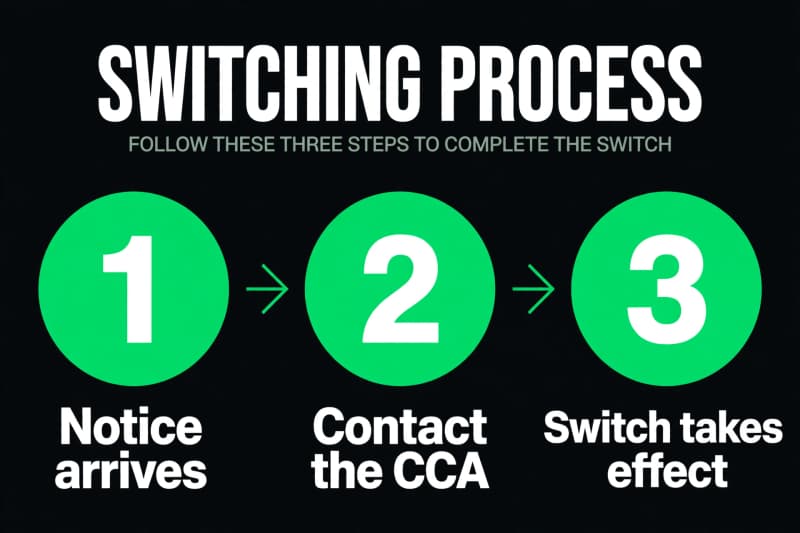
How to opt out of a CCA, and what it costs to leave
Opting out is a right, and the process is deliberately simple, but it has a deadline that matters. State law requires customers to be enrolled unless they choose to opt out, and the California regulator requires at least two notices during the 60 days before service starts, explaining how to opt out. The opt-out request goes directly to the CCA. Each CCA must publish an opt-out link on its website, and the utility cannot process the request. Opt-outs take effect at the end of the current billing cycle, so a customer who opts out still receives one final bill with CCA charges, and one who files less than five days before the meter-read date may see an additional month of CCA charges.
Leaving late has a consequence. A customer who opts out after the first 60 days of CCA service must remain with the utility’s bundled service for one year before rejoining a CCA, and rejoining requires contacting the CCA directly. Moving into a CCA area works the same way in reverse: a new customer is enrolled by default and receives two notifications with opt-out instructions during the first 60 days. The one-year rule is the CCA’s defence against customers switching back and forth with the seasons, and it is the detail most often missed by people who opt out in haste and change their minds.
Why cities keep choosing the CCA model
Cities choose CCAs for three reasons, and the EPA lists all three: more local control over electricity sources, more green power than the default utility offers, and lower prices. Aggregating a whole community’s demand gives a small city the buying power of a large customer, and a locally governed board can choose a greener mix than the utility’s default portfolio. Clean Power Alliance shows the scale this can reach: 67 percent of its customers chose its 100 percent Green Power option, and it signed 157 MW of new renewable energy contracts in its 2025 reporting year.
The challenges are real too. The EPA lists administrative costs, the confusion of opt-in versus opt-out rules, and push-back from utilities in traditionally regulated states that would face new competition. A CCA also inherits the market: if wholesale prices rise, its rates rise, and the exit fee means the first year can look worse than the brochure promised. The model works best where the community wants greener power and is willing to read the joint rate comparison before judging the result, and worst where residents first learn about it from a bill they did not expect.
Frequently asked questions
What is Community Choice Aggregation?
Community choice aggregation is a program that allows a city, county, or other local government to buy electricity on behalf of its residents, businesses, and municipal accounts from an alternative supplier. The existing utility continues to deliver the electricity, read the meter, and send the bill. It is also called municipal aggregation.
How are customers enrolled in a CCA program?
Customers are enrolled automatically once their city or county joins a CCA, unless they opt out. State law requires the enrollment to be opt-out in most CCA states, and customers receive at least two notices in the 60 days before service starts, explaining how to opt out. Some CCAs phase enrollment in over time.
Can I opt out of a CCA program?
Yes. Submit the opt-out request directly to the CCA, through the opt-out link on its website or by contacting it directly. The utility cannot process an opt-out. The change takes effect at the end of the current billing cycle, and opting out after the first 60 days of service means staying with the utility for one year before rejoining.
Does a CCA change my solar net metering?
No. The California regulator confirms that net metering and other solar programs remain available to CCA customers. The CCA replaces only the generation charges on imported power, while the utility keeps handling delivery, billing, and the net-metering arrangement.
Will my bill go down with a CCA?
It may. The EPA notes CCA prices can run 15 to 20 percent below the residential retail price, because bulk buying wins better rates. The Power Charge Indifference Adjustment, which covers generation the utility bought before the switch, can offset part of that saving, so the joint rate comparison published by the utility and the CCA is the document to check.
Sources
- US Environmental Protection Agency, Community Choice Aggregation
- California Public Utilities Commission, Consumer Information on CCAs, Frequently Asked Questions
- Clean Power Alliance, 2025 Impact Report, published 23 February 2026
- Clean Power Alliance, Ranked Number One Green Power Provider in the United States for Third Year in a Row, published 4 February 2026