- Measured wind turbine noise outside homes 124 to 330 metres from a turbine runs 38 to 50 decibels, close to a refrigerator hum at 40 decibels and well below the 70 decibel level where the CDC says prolonged exposure can damage hearing.
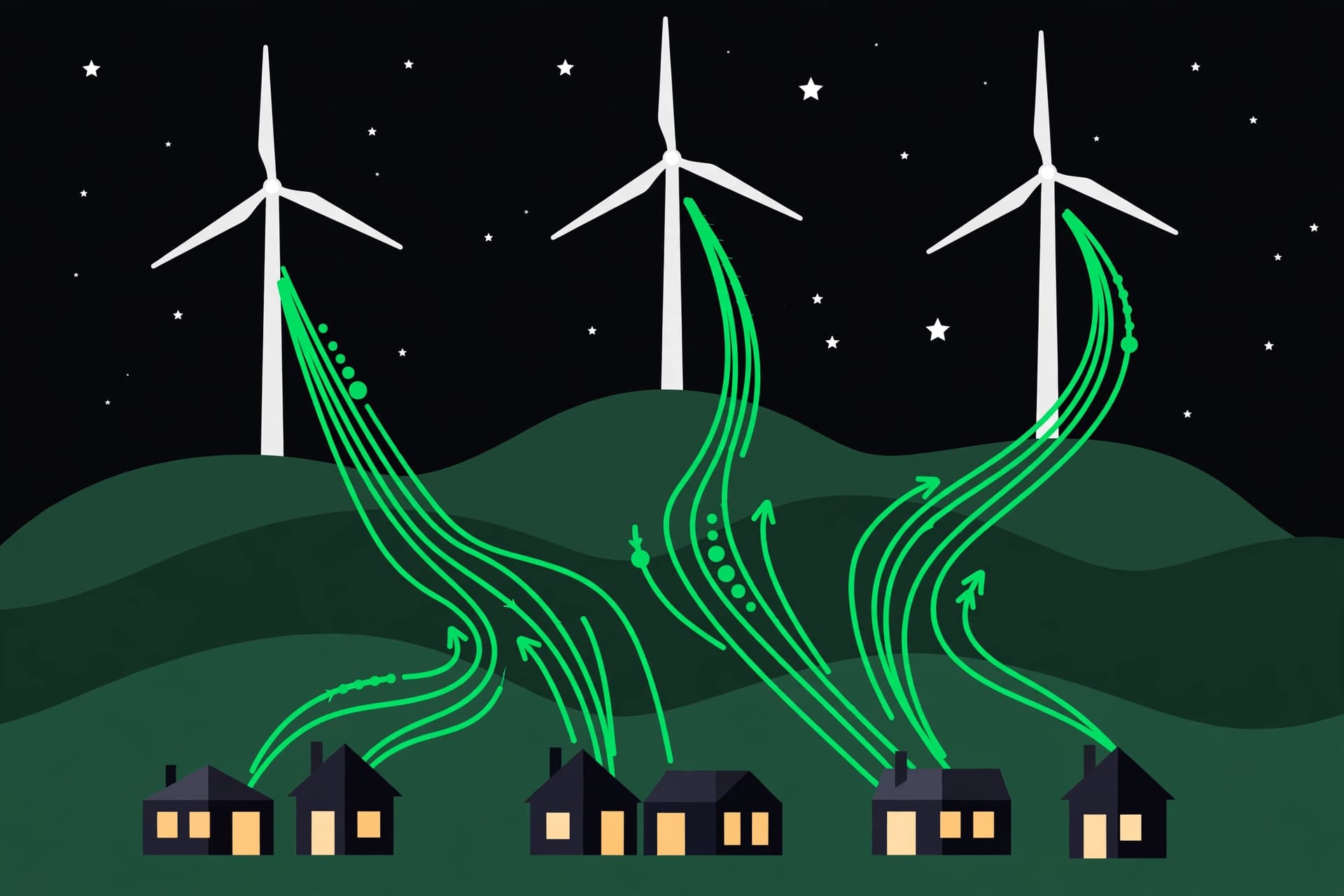
- The number that matters most to neighbours is not the average but the swing: amplitude modulation makes the sound rise and fall with each blade pass, and a year-long study found it happens 2 to 5 times more often at night than during the day.
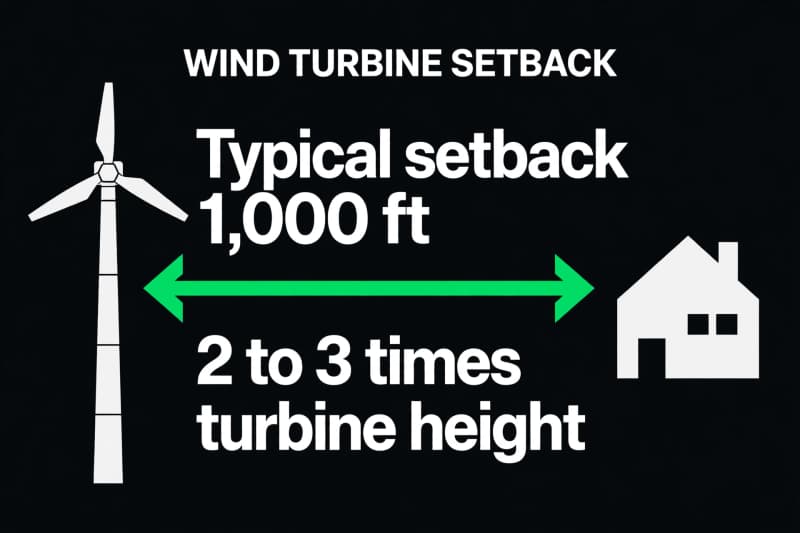
- Setbacks do most of the work. The most common US county rule keeps turbines 2 to 3 times their height from homes, or about 1,000 feet, and a home at that distance from a typical 537-foot turbine sits near the far edge of the band where researchers measured 38 to 50 decibels.
Wind turbine noise: the sound a wind turbine makes as its blades move through the air and its machinery turns, measured in A-weighted decibels (dBA), a scale that matches how the human ear hears different pitches. At the distances neighbours live, it is usually a low swishing sound.
The gap between the measured numbers and the complaints is the real story of wind turbine noise. The decibel readings at a neighbour’s wall look modest, yet planning hearings still fill with people who say they cannot sleep. Both sides are describing something real. The average level is low, and the character of the sound, a rhythmic rise and fall that grows stronger after dark, is what the average hides. Understanding the noise means holding both facts at once: the level and the pattern.
That pattern has a name, amplitude modulation. Each blade passing the tower changes the sound level for a moment, producing the swish or whoosh people describe. A long-term study published in Measurement in 2021 tracked this modulation for a full year at three wind farms and found that it occurred 2 to 5 times more often at night than during the day, and that the depth of the modulation was greater indoors than outdoors. Listening tests have also shown that reducing the depth of the modulation cuts annoyance even when the overall level stays the same, which is why two sites with identical decibel readings can feel very different to the people living near them.
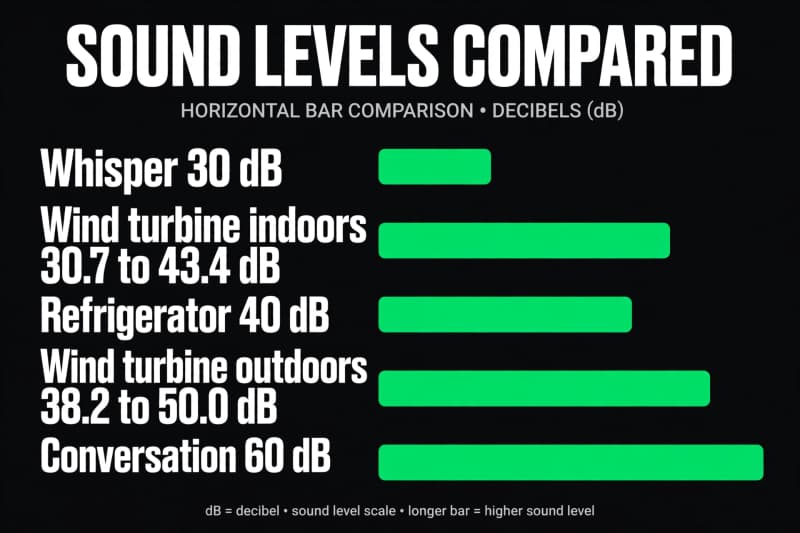
Measured wind turbine noise at 124 to 330 metres
The clearest field measurements come from a 2021 study by Chiu and colleagues, summarised by the Sabin Center for Climate Change Law. Inside buildings 124 to 330 metres from a turbine, noise measured 30.7 to 43.4 decibels. Outside at the same distance, it measured 38.2 to 50.0 decibels in summer and 38.9 to 44.6 decibels in winter. For scale, the same summary puts a soft whisper at 30 decibels, a refrigerator hum at 40 decibels, and a typical conversation at 60 decibels. A turbine at neighbour distance therefore sounds roughly like a refrigerator heard from the next room, outdoors, on a summer evening.
A second reference point comes from the US Department of Energy. Its 2021 environmental impact statement for the 120-turbine, 500 MW Rail Tie Wind Project in Wyoming found that noise from site operations would likely not exceed 55 A-weighted decibels, except in a worst-case scenario where it might reach slightly above 55 dBA. The department’s comparison puts 60 dBA beside a residential air conditioner heard from 20 feet away, and 50 dBA beside the same unit from 50 feet away. Modern turbines are quieter than the geared machines of a generation ago, because designers have insulated the mechanical noise from gearboxes, leaving the aerodynamic sound of the blades as the main source.
| Sound | Level in decibels | Source |
|---|---|---|
| Soft whisper | 30 | Sabin Center summary of Chiu et al. 2021 |
| Wind turbine, indoors, 124 to 330 metres | 30.7 to 43.4 | Chiu et al. 2021 |
| Wind turbine, outdoors, 124 to 330 metres, winter | 38.9 to 44.6 | Chiu et al. 2021 |
| Wind turbine, outdoors, 124 to 330 metres, summer | 38.2 to 50.0 | Chiu et al. 2021 |
| Refrigerator hum | 40 | Sabin Center summary |
| Residential air conditioner at 50 feet | 50 | US Department of Energy, Rail Tie EIS 2021 |
| Typical conversation | 60 | Sabin Center summary |
| Prolonged exposure threshold for annoyance and hearing damage | 70 | US Centers for Disease Control and Prevention |
Why the sound rises and falls at night
Night brings two changes that work in the same direction. The air near the ground cools and steadies after sunset, so sound carries further and the modulation deepens, and background noise from traffic, voices, and daytime activity falls away, leaving the turbine as the loudest thing in the soundscape. The 2021 modulation study found the nighttime prevalence of amplitude modulation ran 2 to 5 times the daytime rate, and earlier work on Dutch wind farms measured the swing growing from about 2 decibels in neutral air to about 4.8 decibels in very stable night air. A 5-decibel swing is clearly audible even when the average level stays near 40 decibels, because the ear notices change more than it notices a steady hum.
This is also why a single decibel number in a planning document can mislead. Two turbines can both average 42 decibels at a house while one holds steady and the other pulses. The pulsing one draws complaints, and the steady one goes unnoticed. Regulators are beginning to catch up: some permits now add a penalty to the measured level when strong modulation is present, and developers can fit serrated trailing edges and other blade treatments that soften the pulse at its source.
Setback distances decide how loud a turbine sounds at your wall
No US federal setback rule exists, so the distance between a turbine and a home is set county by county. The Center for Rural Affairs surveyed every wind ordinance in Iowa, Minnesota, Nebraska, and South Dakota and found the most common rule keeps turbines 2 to 3 times their height from occupied dwellings, or about 1,000 feet. The median setback ranges were 1,000 to 1,250 feet in Iowa, 750 to 1,000 feet in Minnesota, 1,000 to 2,640 feet in Nebraska, and 1,000 to 2,000 feet in South Dakota. Property lines usually sit closer, at 1.1 times turbine height, and waivers from neighbouring landowners can shorten any of these distances.
The arithmetic of the standard rule is worth spelling out. The Center for Rural Affairs puts the average 2022 turbine height at 537 feet, hub height 321 feet plus a 216-foot blade. Two times that height is 1,074 feet, or about 327 metres, and three times is 1,611 feet, or about 491 metres. A home at the common 2-times-height setback therefore sits about 328 metres from the turbine, at the far edge of the 124 to 330 metre band where Chiu and colleagues measured 38 to 50 decibels outdoors. That is Joule Post arithmetic from the Center for Rural Affairs height and setback figures and the Chiu measurement distances. A shorter setback moves the home into the louder part of the band, and a longer one moves it out, which is why setback fights dominate wind farm hearings.
| State | Median dwelling setback range | Most common rule |
|---|---|---|
| Iowa | 1,000 to 1,250 feet | 2 to 3 times turbine height, or 1,000 feet |
| Minnesota | 750 to 1,000 feet | 2 to 3 times turbine height, or 1,000 feet |
| Nebraska | 1,000 to 2,640 feet | 2 to 3 times turbine height, or 1,000 feet |
| South Dakota | 1,000 to 2,000 feet | 2 to 3 times turbine height, or 1,000 feet |
For the full picture of the machines themselves, see how wind turbines work, our guide to the 280-metre giants now being installed, and floating offshore wind turbines, which explains why the largest new machines are moving out to sea, where setbacks stop being a neighbourhood question.
What 45 decibels means for health and sleep
The World Health Organization addressed wind turbine noise directly for the first time in its 2018 Environmental Noise Guidelines for the European Region. It conditionally recommends reducing average wind turbine noise below 45 dB Lden, a day-evening-night average that adds a 5-decibel penalty for evening noise and a 10-decibel penalty for night noise, because studies found 10 percent of people highly annoyed at that level. The recommendation is conditional because the WHO rated the underlying evidence as low quality, and it made no recommendation at all for average night exposure, for the same reason. The guideline is a health-protective target. No US state has adopted it as law.
The measured numbers sit close to that line. Winter outdoor readings of 38.9 to 44.6 decibels fall just below 45, while summer readings reach 50.0 decibels at the top of the range. The comparison needs care, because Lden is a weighted annual average and a seasonal reading is a different metric, yet the overlap is real: a home near the loud end of the measured band lives at or above the level where the WHO found one person in ten highly annoyed. That is the quantitative core of the neighbour objection, and it survives contact with the data.
On hearing damage, the evidence is clearer. The CDC sets 70 decibels as the level where prolonged exposure can cause annoyance and hearing damage, and wind turbine readings at neighbour distances run 20 to 30 decibels below that. The health question for wind farms is therefore about sleep and annoyance, and hearing loss is not the issue at these levels. The research on sleep remains thin. The WHO review found six studies on sleep disturbance and rated them low quality, with inconsistent results, which is why its 2018 document declined to set a night limit at all.
What to check before a wind farm is approved near you
Three documents decide whether a proposed wind farm will be quiet enough at your wall. The noise assessment in the planning application states the predicted level at each nearby home, usually as a long-term average, and it should state the turbine model, the hub height, and the distance to each receptor. The local ordinance states the setback and the noise limit, and the Center for Rural Affairs found the average ordinance limit runs 45 to 60 decibels at the setback distance. The permit conditions state what happens if the real noise exceeds the prediction, and the strongest permits require post-construction measurement and curtailment, slowing or stopping a turbine, when limits are breached.
Four questions sharpen any of those documents. First, does the assessment report modulation, or only the average level, since the average alone misses the feature neighbours complain about. Second, are the predictions for night conditions, when stable air deepens the modulation and background noise falls. Third, is the limit measured at the outside wall of the home, as Wisconsin’s siting rule requires, with 50 dBA by day and 45 dBA at night, or at the property line, where the number means something different. Fourth, does the permit require the developer to measure after construction and act on the results, since a prediction without a remedy is a promise without a price.
The numbers say a modern wind turbine is not loud in the way a highway or a factory is loud. They also say the sound is real, measurable, and worst at night, when people are trying to sleep. A fair hearing gives both facts their weight, and the setback and the permit conditions are where that judgement is written down. For the offshore side of the same question, where turbines stand far from any bedroom, see our report on the RWE and KKR financing for the 2.8 GW Vanguard offshore wind farms.
Frequently asked questions
How much noise do wind turbines make?
Outside homes 124 to 330 metres from a turbine, measured noise runs 38 to 50 decibels in summer and 38.9 to 44.6 decibels in winter, according to Chiu and colleagues in 2021. Indoors at the same distance, it runs 30.7 to 43.4 decibels. That is close to a refrigerator hum at 40 decibels and far below a conversation at 60 decibels.
Do wind turbines cause noise pollution?
They produce measurable sound that some neighbours find annoying, especially at night, when amplitude modulation makes the level rise and fall with each blade pass. The World Health Organization conditionally recommends keeping average wind turbine noise below 45 dB Lden, and found 10 percent of people highly annoyed at that level. The sound does not reach the 70 decibel level where the CDC says prolonged exposure can damage hearing.
How loud is a wind turbine?
At the distances neighbours live, a wind turbine measures roughly 38 to 50 decibels outdoors. The US Department of Energy found a 500 MW wind project would likely stay below 55 A-weighted decibels, and put 50 decibels beside a residential air conditioner heard from 50 feet away.
How far must a wind turbine stand from a house?
There is no US federal rule. The most common county rule in Iowa, Minnesota, Nebraska, and South Dakota keeps turbines 2 to 3 times their height from occupied homes, or about 1,000 feet, with median ranges from 750 to 2,640 feet depending on the state. Waivers from neighbouring landowners can shorten the distance.
Can wind turbine noise affect sleep?
It can disturb sleep for some people, mainly because amplitude modulation grows stronger at night, occurring 2 to 5 times more often than during the day in a year-long study. The World Health Organization reviewed six studies on sleep disturbance and rated the evidence too weak to set a night noise limit, so the research picture is still incomplete.
Sources
- Sabin Center for Climate Change Law, Are Wind Turbines Noisy?, via Skeptical Science, updated 26 October 2024
- Center for Rural Affairs, Utility Scale Energy Siting Recommendations
- Hayes McKenzie, WHO Environmental Noise Guidelines 2018, published 10 October 2018
- Wisconsin Legislature, Administrative Code PSC 128, wind energy system siting and noise criteria
- Long-term quantification and characterisation of wind farm noise amplitude modulation, Measurement 2021