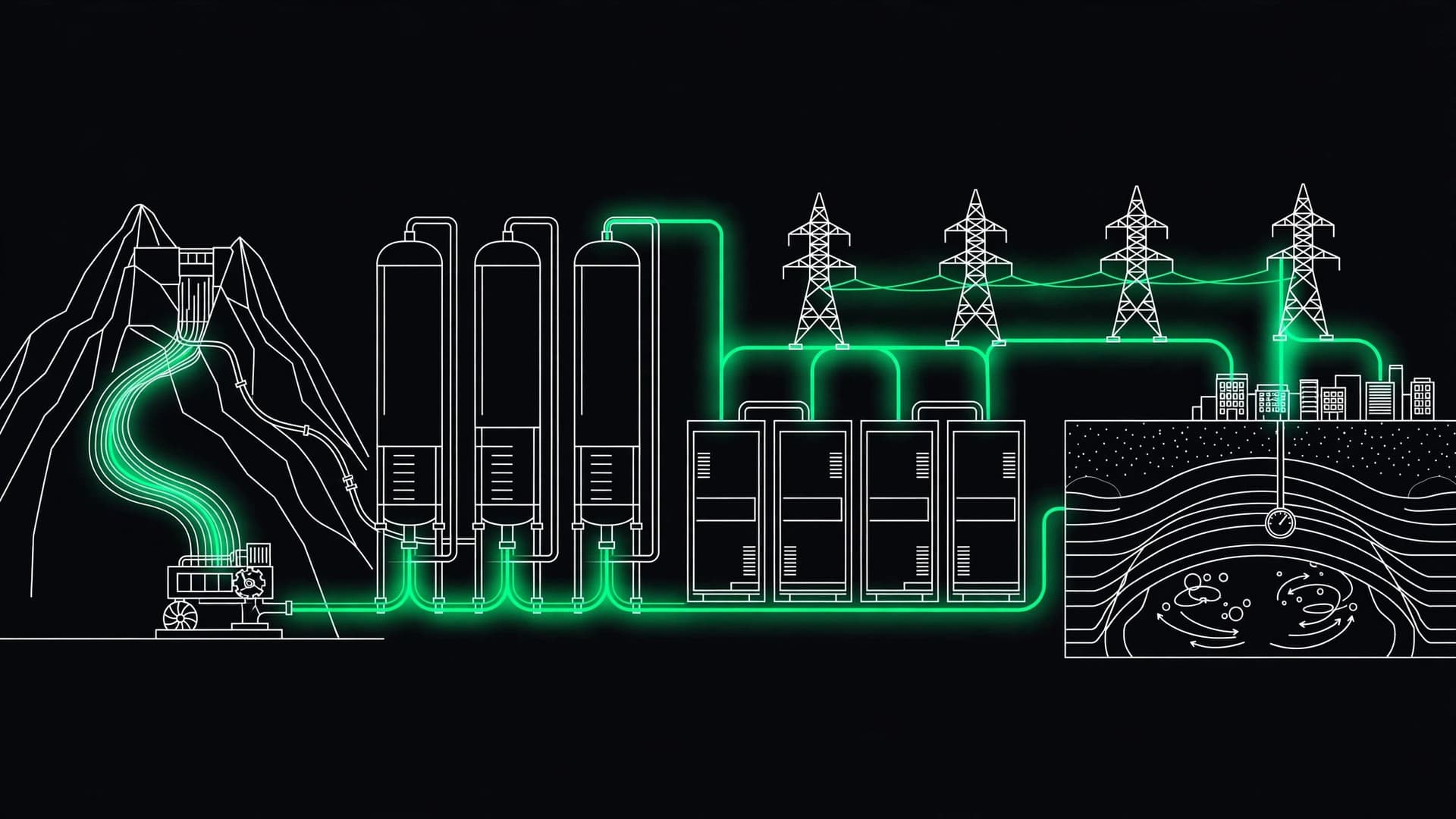
- Global data centers will draw 565 TWh of electricity in 2026, up 26.4% on 2025, according to Gartner, while the International Energy Agency puts the 2025 total at 485 TWh and projects about 950 TWh by 2030.
- AI-optimized servers are the fastest-growing slice, rising from 95 TWh in 2025 to 175 TWh in 2026, and Gartner expects them to overtake conventional servers in 2027.
- In the United States, data centers used 192 TWh in 2024, or 4.7% of national electricity, and Lawrence Berkeley National Laboratory projects 649 TWh by 2030 in its reference case.
AI data center: a warehouse-scale computing facility built to train and run large artificial intelligence models. Rows of accelerator chips, the specialized processors that handle AI workloads, draw far more power per rack than the general-purpose servers in an older data center, and the cooling systems that keep them running add a large load of their own.
The question of how much energy an AI data center uses has three different answers, and the confusion between them is the reason the numbers sound impossible. A single facility is measured in megawatts. A country is measured in terawatt-hours. The world is measured against the electricity use of entire nations. Global data centers will draw 565 TWh in 2026, according to Gartner, up 26.4% from 447 TWh in 2025. The International Energy Agency puts the 2025 total higher, at 485 TWh, and projects about 950 TWh by 2030, roughly the electricity consumption of Japan today. Both agencies agree on the direction. They disagree on the size, and the size of the disagreement is itself part of the story.
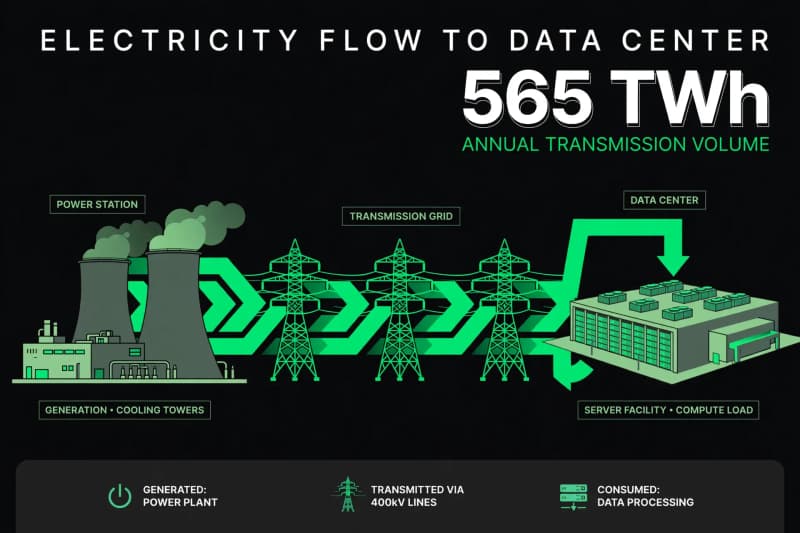
The global total: 565 TWh in 2026
Data centers used about 415 TWh of electricity worldwide in 2024, roughly 1.5% of global electricity, according to the IEA’s Energy and AI report of April 2025. The agency’s follow-up, Key Questions on Energy and AI, published in April 2026, recorded 485 TWh in 2025, a 17% rise in a year when global electricity demand grew about 3%. AI-focused data centers grew faster still, up 50% in 2025. The IEA’s central projection has total data center demand roughly doubling from 485 TWh in 2025 to 950 TWh in 2030, about 3% of world electricity, with AI-focused sites tripling to about 465 TWh over the same period.
Gartner’s June 2026 forecast is more aggressive. It puts global data center consumption at 565 TWh in 2026 and more than 1,200 TWh by 2030, against the IEA’s 950 TWh. The two forecasters start from different 2025 estimates, 447 TWh for Gartner against 485 TWh for the IEA, and they count AI load differently. Gartner splits the total by workload and expects AI-optimized servers to use 175 TWh in 2026, up 84% from 95 TWh in 2025, reaching 258 TWh in 2027, when they overtake conventional servers. Cooling and other infrastructure add another 195 TWh in 2026, about as much as all conventional servers combined. Total power demand, the capacity data centers need available at any moment, rises from 104 GW in 2025 to 132 GW in 2026 and 290 GW by 2030 on Gartner’s numbers.
| Forecaster | 2024 | 2025 | 2026 | 2030 |
|---|---|---|---|---|
| IEA, Energy and AI (April 2025) and Key Questions (April 2026) | 415 TWh | 485 TWh | n/a | About 950 TWh |
| Gartner (June 2026) | n/a | 447 TWh | 565 TWh | More than 1,200 TWh |
| AI-optimized servers, Gartner | n/a | 95 TWh | 175 TWh | n/a |
| Cooling and infrastructure, Gartner | n/a | 159 TWh | 195 TWh | n/a |
All figures are forecasts or modelled estimates. No country meters data center electricity at global scale, so every total is built from server shipments, power draw per device and facility overhead.
One campus, one gigawatt, about 830,000 homes
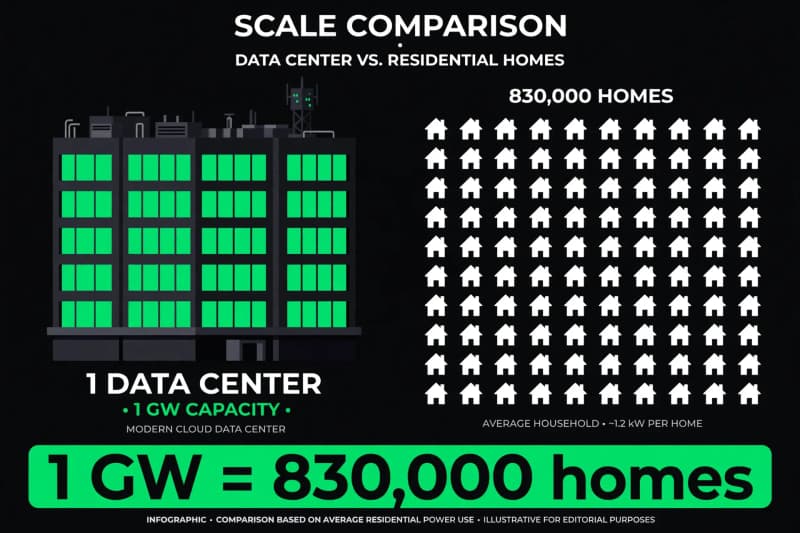
The global totals hide the scale of a single building. A campus drawing a full gigawatt around the clock would use 8.76 TWh of electricity in a year, by simple multiplication of 1,000 MW by 8,760 hours. The US Energy Information Administration puts the average American household at about 10,500 kWh of electricity a year. Dividing one by the other gives about 830,000 homes for a single 1 GW campus running flat out, by Joule Post arithmetic. A 100 MW campus, the size of a large facility, matches about 83,000 homes on the same basis. A 1 MW server hall matches about 830 homes.
| Facility size, running flat out | Electricity per year | Average US homes matched |
|---|---|---|
| 1 MW server hall | 8,760 MWh | About 830 |
| 100 MW campus | 876 GWh | About 83,000 |
| 1 GW campus | 8.76 TWh | About 830,000 |
| Virginia data centers, all sites (JLARC, 2024) | n/a | About 2 million Virginia households |
Treat the homes comparison as a scale illustration. Real campuses rarely run at full load around the clock, and a household figure averages across climates and home sizes. Virginia’s own auditors give a grounded version of the same comparison: the state’s data center sites drew about 5,050 MW in 2024, the power for about 2 million Virginia households, according to the Joint Legislative Audit and Review Commission’s December 2024 report. The same report warns that unconstrained statewide electricity demand could double within a decade, mainly because of data centers.
Three loads make up a data center’s electricity use. The servers do the computing. The cooling removes the heat the servers produce. Power distribution, lighting and the rest of the building take the remainder. In an AI facility the balance tilts toward the servers, because accelerator chips draw several times the power of a general-purpose server and run hot enough to need liquid cooling in the newest designs. Gartner’s split for 2026 puts AI-optimized servers at 175 TWh, conventional servers at about 195 TWh, and cooling plus other infrastructure at 195 TWh. AI servers are 31% of the total on that split, up from about 20% in 2025.
The IEA adds a counterweight to the growth story. Energy use per AI task has fallen by at least a factor of ten a year in recent years, the agency says in its 2026 update, as models, chips and software all improve. Total demand keeps rising anyway, because the number of tasks grows faster than the efficiency of each one. The same dynamic shows up in the spending figures: the largest technology companies spent more than US$400 billion on data center capital expenditure in 2025, and the IEA expects that to jump by another 75% in 2026. AI factories, the cutting-edge data centers built specifically for AI, have more than tripled in capacity in 18 months, according to the agency’s satellite-based tracking.
The United States carries nearly half the load
The United States accounted for about 45% of global data center electricity use in 2024, according to the IEA, with China at about 25% and Europe at about 15%. Lawrence Berkeley National Laboratory, the federal lab that produces the standard US estimate for the Department of Energy, puts American data center use at 192 TWh in 2024, or 4.7% of all US electricity, in its 2025 Update published in June 2026. The same series counted 58 TWh in 2014 and 176 TWh in 2023, so use roughly tripled in a decade and then rose another 14% in a single year. The lab’s reference case reaches 464 TWh by 2028 and 649 TWh by 2030, or 11.8% of US electricity, inside an uncertainty range of 521 to 843 TWh. Cryptocurrency mining is excluded from these figures.
| US data center electricity (LBNL) | TWh | Share of US electricity |
|---|---|---|
| 2014 | 58 | n/a |
| 2023 | 176 | 4.4% |
| 2024 | 192 | 4.7% |
| 2028, reference case projection | 464 | n/a |
| 2030, reference case projection | 649 | 11.8% |
The 2030 figures are projections, not measurements, and the range matters as much as the middle. The lab’s 2025 Update raised the central estimate and widened the uncertainty at the same time: the previous report’s range for 2028 was 6.7% to 12.0% of US electricity, while the new range for 2030 runs 9.5% to 15.3%. The IEA’s central case for the United States is lower, at about 426 TWh by 2030, which shows how much depends on which announced projects actually get built. LBNL’s Queued Up study counts about 2,061 GW of generation and storage waiting in US interconnection queues at the end of 2025, a queue that now decides the pace of the build-out as much as chip supply does. The strain is already visible in market rules: US regulators suspended an emergency PJM auction meant to secure power for data centers until 2027, as Joule Post reported, while technology companies sign nuclear and battery deals to secure supply, including Google’s nuclear agreement with Constellation, a 600 MW battery tolling deal for Microsoft, and GM’s sodium-ion battery investment aimed at data centers. QuantumScape’s solid-state battery for data centers and our long-duration storage cost comparison cover the storage side of the same problem.
Why the forecasts disagree by hundreds of terawatt-hours
A forecast gap of 250 TWh by 2030, the difference between the IEA’s 950 TWh and Gartner’s 1,200 TWh-plus, looks like an error. It is mostly a difference in assumptions. The IEA builds from server shipments and efficiency trends, and its central case assumes bottlenecks in grids, chips and construction slow the fastest scenarios. Gartner counts announced capacity and AI server shipments more aggressively, and its power-demand figures count the capacity data centers request from grids, which exceeds the electricity they end up using. LBNL’s own work shows the gap between the two: US data centers use about 50% of their interconnection capacity on average, so a gigawatt of requested grid capacity produces a much smaller metered load. Nameplate megawatts overstate metered use, and every forecaster handles that gap differently.
Three numbers decide which forecast proves closer. The first is how many announced campuses get built, which the interconnection queues and the permitting record will show. The second is the efficiency curve, which the IEA says is improving faster than any energy technology in history. The third is where the power comes from, because a data center that cannot get a grid connection cannot run at its nameplate rating whatever its servers could draw. Watch the queues, the connection agreements and the capacity auctions rather than the press-release megawatts. Those are the numbers that turn a forecast into metered electricity.
Frequently asked questions
How much energy does an AI data center use?
A large AI campus draws hundreds of megawatts, and the largest reach a gigawatt. A 1 GW campus running flat out would use 8.76 TWh a year, about the electricity of 830,000 average US homes. Globally, all data centers will use 565 TWh in 2026 on Gartner’s forecast, with AI-optimized servers taking 175 TWh of that total.
How much of the world’s electricity do data centers use?
About 1.5% in 2024, or 415 TWh, according to the IEA. The agency’s central case has that share roughly doubling to about 3% by 2030, or about 950 TWh. Gartner’s forecast is higher, at more than 1,200 TWh by 2030.
Why do AI data centers use so much more power than older ones?
AI workloads run on accelerator chips that draw several times the power of general-purpose servers, and training a large model keeps thousands of them running at full load for weeks. Gartner expects AI-optimized server electricity use to rise 84% in 2026 alone, from 95 TWh to 175 TWh, and to overtake conventional servers in 2027.
Do data centers really use all the power they request from the grid?
Lawrence Berkeley National Laboratory estimates US data centers use about 50% of their interconnection capacity on average. Requested megawatts state a ceiling, and metered use sits well below it. That gap is one reason forecasters disagree by hundreds of terawatt-hours.
What is being done about data center power demand?
Efficiency is improving fast: the IEA says energy use per AI task has fallen by at least a factor of ten a year recently. Hyperscalers are also signing nuclear power deals and battery storage contracts to secure supply, and grid operators are rewriting connection and capacity rules for large loads.
Sources
- Energy and AI, Executive Summary, International Energy Agency, April 2025
- Key Questions on Energy and AI, Executive Summary, International Energy Agency, April 2026
- Gartner Says Data Center Electricity Consumption to Grow 26% in 2026, Gartner, 10 June 2026
- United States Data Center Energy Usage Report: 2025 Update, Lawrence Berkeley National Laboratory, June 2026
- Data Centers in Virginia, Joint Legislative Audit and Review Commission, 9 December 2024
- Electricity Use in Homes, US Energy Information Administration