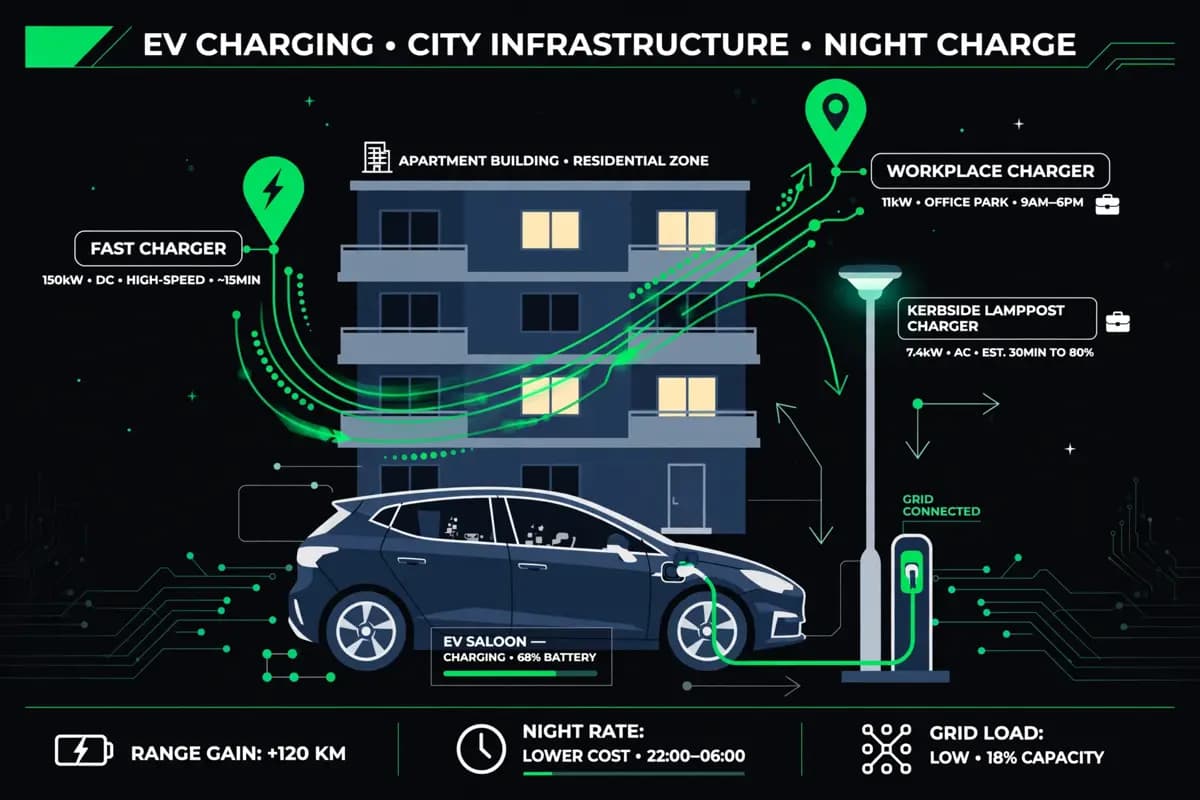
- Apartment EV ownership in 2026 rests on a charging mix: workplace, public Level 2, and occasional DC fast charging cover most weekly mileage.
- At 200 miles per week, an all-public DC fast charging week costs about $1,334 a year, against about $503 a year on a home rate.
- Eleven states give renters some right-to-charge protection, but the tenant usually pays installation, insurance, and removal costs.
Apartment EV charging: Charging an electric car without a private driveway or garage, using shared building chargers, workplace chargers, public Level 2 chargers, kerbside chargers, or DC fast chargers, instead of a dedicated home wall box.
The weekly mileage number decides the answer before any charger discussion. An average EV driver covers under 200 miles per week, and the average real-world EV range is now about 237 miles, so many apartment drivers need only one or two charging sessions per week. A driver covering 350 miles or more per week faces a different calculation, where home charging convenience matters far more.
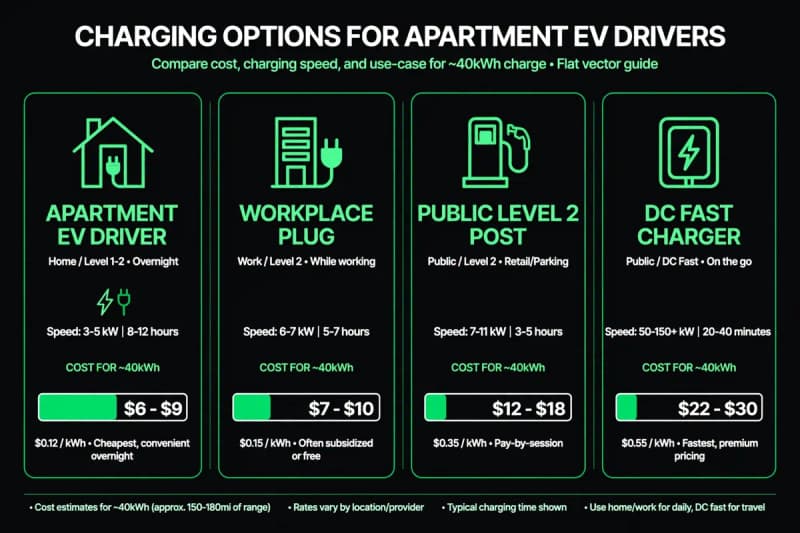
How apartment EV charging without a home charger works in practice
The working pattern is a mix, and drivers who treat it as a mix report the least friction. Workplace charging covers the commute for drivers whose employers offer it. Public Level 2 charging at supermarkets, gyms, and retail parks covers errands, and some locations offer short free charging periods. Community charging apps let drivers rent driveway space, and lamppost or kerbside chargers cover residential streets where they exist. DC fast charging is the backup for long weeks.
One London flat dweller cited in an Octopus EV guide covered about 35,000 miles in a year entirely on the public network, using 15-minute top-ups on the way home. That example is extreme, and it proves the upper bound rather than the typical case. The typical case is quieter: a weekly shop charge, a workplace charge, and a fast charge before a long trip.
Building parking changes the starting point. If the building already has chargers, the question is whether they are reserved, free, shared, or first-come-first-served, and the answer should be confirmed with the leasing office in writing. If the building has a garage but no chargers, a tenant request or a landlord proposal is the next step. If there is no designated parking at all, the public and workplace mix is the whole plan, and the apartment search itself should weight nearby charger density.
What apartment EV charging costs in 2026
The table below uses stated assumptions: 200 miles per week, 3.5 miles per kWh efficiency, or 57 kWh per week. Prices are 17 cents per kWh for a home rate, 30 cents for public Level 2, and 45 cents for DC fast charging, drawn from renter guides that publish building charging rates of $0.20 to $0.45 per kWh and flat fees of $30 to $100 per month.
| Charging mix | Blended price per kWh | Weekly cost | Annual cost |
|---|---|---|---|
| Home charger (comparison baseline) | $0.17 | $9.69 | $503 |
| Workplace free 50%, public Level 2 30%, DC fast 20% | $0.18 | $10.26 | $533 |
| Public Level 2 only | $0.30 | $17.10 | $889 |
| DC fast charging only | $0.45 | $25.65 | $1,334 |
| Building flat fee $65 per month (comparison) | Flat fee | $15.00 | $780 |
The table carries a clear conclusion. A driver with any workplace charging pays close to the home-charger baseline, while a driver dependent on DC fast charging pays about $831 a year more than the home baseline. That gap is the real apartment penalty, larger than any car purchase price effect. It also explains why the first question for an apartment buyer is not which car, but which chargers sit within two miles of home and work.
Level 1 charging from a standard 120-volt outlet deserves a note. Where an assigned parking spot has an outlet, it adds roughly 30 miles overnight, which covers a short commute without any installation. It is slow, and it is not a plan for a 200-mile week on its own, but as one layer of the mix it reduces the number of paid sessions.
What right-to-charge laws give renters in 2026
As of 2026, 11 states have right-to-charge laws that prevent landlords from blocking reasonable EV charger installation requests at the tenant’s expense: California, Colorado, Florida, Hawaii, Illinois, New Jersey, New York, Oregon, Virginia, Washington, and Massachusetts. A separate count that includes owner-only protections reaches 15 states plus Washington, DC, so the exact number depends on whether renters are covered.
The protection is narrower than the name suggests. The landlord cannot flatly refuse a written request, but the tenant usually pays equipment, installation, insurance, and restoration on move-out, and must use a licensed installer and follow reasonable building guidelines. In California, the model law most others copied, the tenant pays 100% of costs and restores the space unless the landlord agrees to keep the charger. Few renters exercise the right at full cost, which is why shared building chargers, installed once for many residents, often beat individual tenant installs.
New construction is changing the baseline. From January 1, 2026, California’s CALGreen building code requires every assigned parking space at new multifamily construction to include a low-power Level 2 receptacle. That rule does not retrofit existing buildings, but for apartment hunters in California it turns a building-code question into a useful filter. Other states are watching the model, and similar mandates are expected to follow.
Related reading: our Level 2 home charger installation cost guide covers what a dedicated install costs, our Level 1 charging guide tests the 120-volt case, and our EV battery lifespan guide answers the degradation question every used buyer asks.
Frequently asked questions
Can you own an EV in an apartment without a home charger?
Yes, for most weekly mileages, using a mix of workplace, public Level 2, and occasional DC fast charging. Drivers covering under 200 miles per week need only one or two sessions per week on an average-range EV.
How much does apartment EV charging cost?
On the stated 200-mile week, a mixed pattern with workplace charging costs about $533 a year, public Level 2 only costs about $889, and DC fast charging only costs about $1,334. A home charger baseline is about $503 a year at 17 cents per kWh.
Can my landlord refuse an EV charger installation?
It depends on the state. In the 11 right-to-charge states, a landlord cannot flatly refuse a reasonable written request, but the tenant usually pays all costs and restoration. Outside those states, the lease and the landlord control.
Is Level 1 charging enough for an apartment driver?
For a short commute, yes as one layer: a standard outlet adds roughly 30 miles overnight. For a 200-mile week, Level 1 alone is not enough, and public or workplace charging must cover the balance.
What should I check before signing a lease as an EV driver?
Ask whether chargers exist, whether they are reserved or shared, what the per-kWh or monthly price is, how far the nearest public chargers are, and whether the employer offers workplace charging. Get the building charging terms in writing before signing.