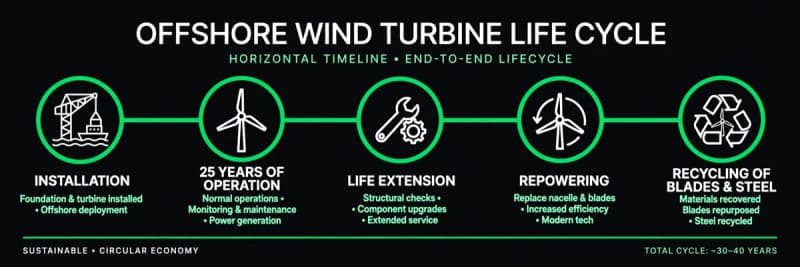
- Most offshore turbines are designed for about 25 years, extendable to 30 or 40 years with maintenance.
- At the end of design life, owners choose life extension, repowering, or full removal and site restoration.
- Up to 90% of a turbine is recyclable, but blades are hardest to reuse, and removal must be funded before construction.
Offshore wind turbine lifespan: the period an offshore turbine keeps generating safely and economically, from first power to retirement, repowering or removal. Most machines are designed for about 25 years, and maintenance can stretch that to 30 or 40 years.
The offshore wind turbine lifespan is decided by accumulated fatigue, corrosion, and the evidence in the maintenance record. Engineers compare recorded site loads against design loads, inspect blades, foundations, bolts and cables, and check whether parts, permits and vessel access still support safe operation. Funding is settled early: in Australia, a developer must submit a decommissioning plan and demonstrate financial security before receiving a commercial licence to build, according to the Clean Energy Council fact sheet on offshore wind recycling and decommissioning.
Salt spray, humidity, wave loading and narrow weather windows for offshore repairs wear on a machine in ways a sheltered site avoids. A turbine at a turbulent site with patchy records will struggle to make a life-extension case, while a well-maintained machine with complete records may earn extra years. Maintenance slows deterioration, but a formal assessment decides whether continued operation is safe.
What sets the offshore wind turbine lifespan
Modern turbines are typically designed around a 20 to 25 year assumption about wind climate, fatigue loads, materials and operating cycles, according to Gridinta’s guide to wind turbine lifespan. That figure shapes financing and warranty terms. Service life is separate: how long a particular machine keeps running. It can run shorter when condition, safety, parts, permits or economics fail, or longer when inspections and repairs support continued use.
The Clean Energy Council puts the offshore figure at around 25 years, extendable to 30 to 40 years with maintenance. The parts that age fastest offshore are predictable: coatings and steelwork in salt air, blade edges eroded by rain and spray, bolted joints at the foundation, and export cables. For the machines themselves, see our guide to how wind turbines work.
Three choices at the end of design life
Once a turbine passes its design-life milestone, the owner weighs condition, expected output and cost. WindEurope describes three options: extend the lifetime with repairs and minor upgrades, decommission fully and restore the site, or repower with new, more efficient turbines.
| End-of-life option | What happens | When it suits the owner | Main cost or constraint |
|---|---|---|---|
| Wind turbine life extension | Existing turbines keep running under inspection and repair conditions | Sound structure, parts available, output covers costs | Inspection and repair bills rise with age |
| Wind turbine repowering | Old turbines replaced with fewer, larger machines on the same site | Strong wind and grid capacity, and new machines fit the site | New consent and construction cost; old foundations too small |
| Full decommissioning | Turbines dismantled, foundations and cables removed, seabed restored | Extension is unsupported or repowering is uneconomic | Specialist vessels and restoration duties |
Wind turbine life extension is usually cheapest when the engineering case holds, because it avoids new construction. Wind turbine repowering offers the largest output gain: WindEurope reports that repowering nearly triples a wind farm’s output while reducing turbine numbers by a quarter, on the same site. That gain is harder offshore, because turbines installed decades ago sit on small foundations, and new machines small enough to fit them may no longer be available. Owners should therefore start the lifespan review well before year 20.
What offshore wind decommissioning involves, step by step
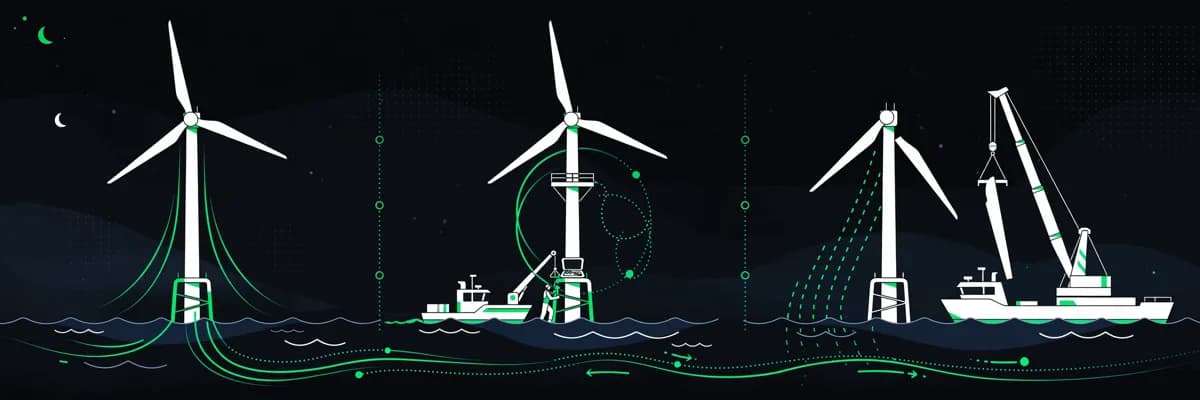
Offshore wind decommissioning starts with surveys and permits, then moves to heavy marine work. A jack-up or crane vessel holds position beside each turbine while crews remove blades, nacelle and tower. Foundations are cut or broken down on site, cables are recovered, and components are shipped to port for reuse, recycling or disposal. Operators must then restore the seabed, although plans sometimes leave structures in place where an ecosystem has formed around them.
The world’s first offshore wind farm shows how the sequence works. Vindeby, off Denmark, ran 11 turbines of 450 kW each from 1991 until decommissioning in 2017. Contractors dismantled blades, nacelle and tower individually with a mobile crane onto a jack-up vessel, broke down the foundations with hydraulic shears, and shipped everything to Nyborg Harbour. Leif Winther, Senior Lead Business Developer at DONG Energy, said at the time: “This is the first time we’re dismantling an offshore wind farm.” Some blades went to research at DTU Risø, others became noise barriers, and one turbine went to the Danish Museum of Energy, according to NS Energy’s report on the Vindeby dismantling.
Vindeby’s lifetime output gives a sense of scale for early offshore technology. The farm generated 243 GWh over about 25 years, averaging 9.72 GWh per year (243 divided by 25). Against a maximum possible 43.36 GWh per year for a 4.95 MW farm (4.95 MW multiplied by 8,760 hours), that is a capacity factor of about 22.4% (9.72 divided by 43.36). Modern machines reach far higher capacity factors, one reason repowering a proven site can transform output.
What 1,480 MW a year of retirements would mean for ports and vessels
The retirement wave is still small, because the offshore fleet is young, but the arithmetic shows where it leads. Europe had about 37 GW of offshore wind installed, according to figures reported alongside WindEurope data. If that fleet retired evenly over a 25 year life, roughly 1,480 MW would reach end of life each year (37,000 MW divided by 25). That is illustrative only, since build-out was uneven and many projects will extend or repower instead. Even so, each year the equivalent of about one hundred 15 MW turbines would need inspection decisions, vessel bookings and port slots.
WindEurope’s outlook for all wind power in Europe, onshore and offshore combined, expects more than 13 GW to be decommissioned between 2023 and 2030, against only 9 GW of repowered capacity in the same period. Removal work competes for the same heavy-lift ships and harbour space as new construction, so early planners face shorter queues. Because removal money must be secured before construction, the end of a wind farm’s life is priced into its beginning.
What happens to the steel, cables and blades
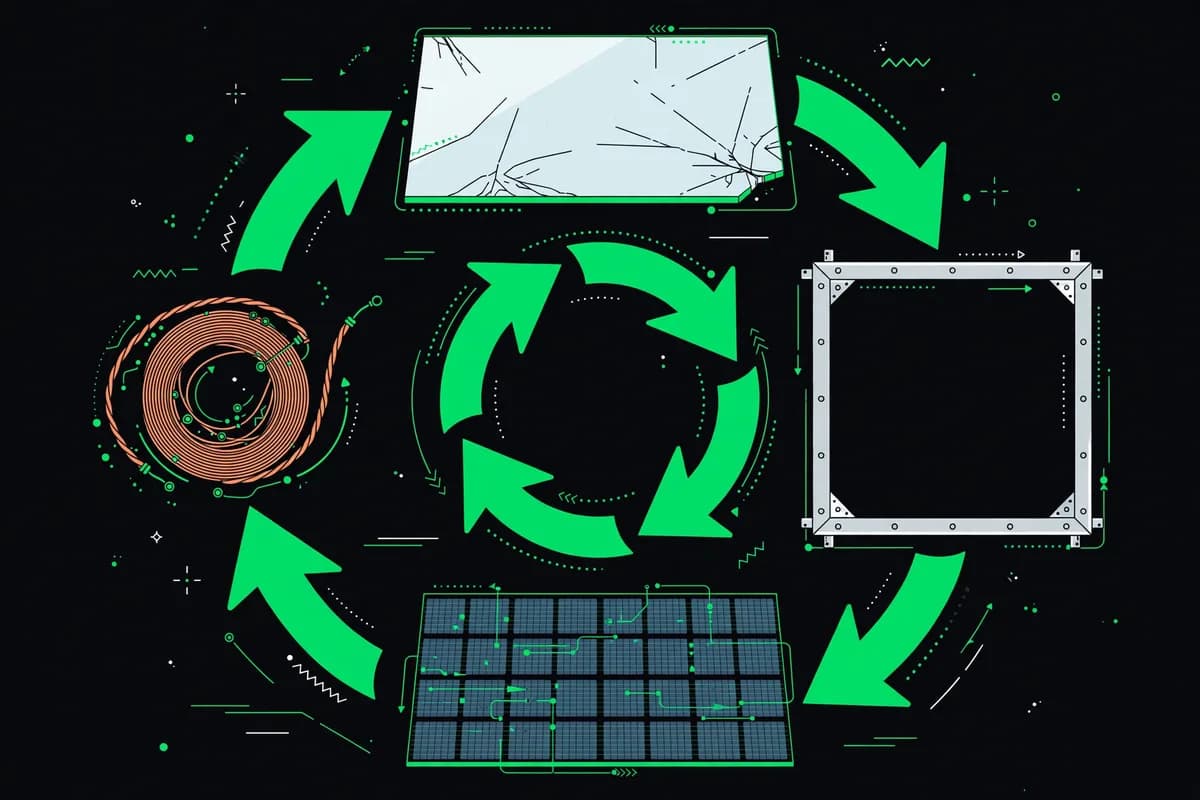
Offshore wind recycling starts with the easy materials. Towers and nacelles are mostly steel and aluminium, which established metal recycling routes melt down and reuse. WindEurope puts the recyclable share of a turbine at 85 to 90%, and the Clean Energy Council puts it at up to 90%. Cables yield copper, and concrete foundations can be crushed for aggregate.
Blades are the exception. They are built from glass and carbon fibre composites set in resin, which resist the shredding and melting routes that work for metals. Current routes include mechanical recycling into filler, chemical recycling to recover fibres, cement co-processing into greener cement, and repurposing into noise barriers, playgrounds and skate parks. In 2021 the European wind industry called for a Europe-wide ban on landfilling blades and committed to reuse, recycle or recover 100% of decommissioned blades, according to WindEurope’s repowering analysis. That capacity must scale with retirements, or blades will pile up at ports waiting for a route.
Households face a different version of the same maths, since installation cost per kilowatt is far higher for a single small machine: see our analysis of whether home wind turbines pay off in 2026.
Frequently asked questions
How sustainable are offshore wind turbines to build, and how long do they last?
Offshore turbines carry a large upfront material footprint in steel, concrete, composites and copper, repaid over a long operating life. Most are designed for about 25 years, extendable to 30 to 40 years with maintenance, and up to 90% of turbine materials can be recycled, with blades the main unsolved stream.
What happens to offshore wind turbines at the end of their lifespan?
Owners choose life extension under an engineering assessment, repowering with newer machines, or full decommissioning with removal and seabed restoration. The choice depends on condition, output, permits, grid capacity and cost, and should be made years before design life expires.
What does the decommissioning of an offshore wind turbine involve?
Decommissioning involves dismantling blades, nacelle and tower with specialist vessels, removing foundations, recovering cables, restoring the seabed, and recycling components. The developer pays all costs, and in Australia the plan and financial security must be approved before construction.
Can offshore wind turbine blades be recycled?
Blades can be recycled, but the routes are newer and costlier than steel recycling. Mechanical and chemical recycling, cement co-processing and repurposing into noise barriers all exist today, and the European industry has committed to reuse, recycle or recover 100% of decommissioned blades. Scaling those routes to match retirement volumes remains the main challenge.