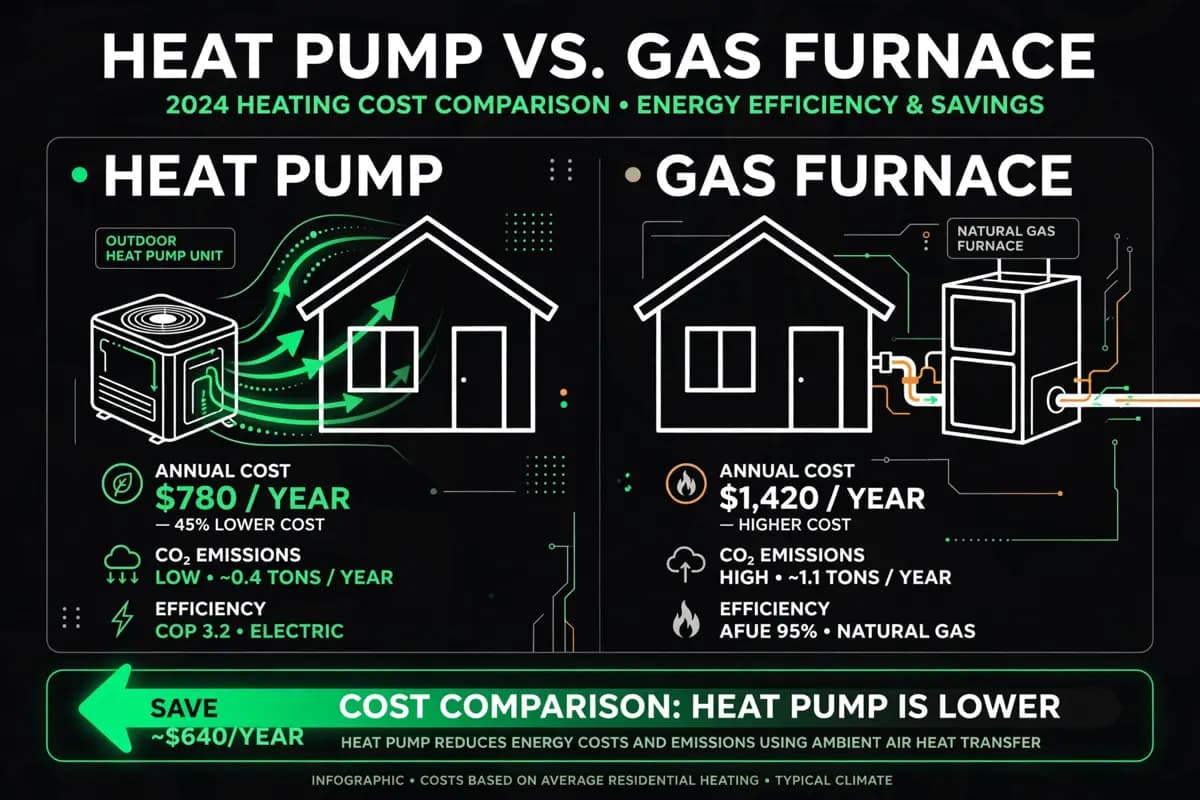
- At Sacramento utility rates, a heat pump delivers one therm of heat for about $1.75, against $2.20 for a 95% AFUE gas furnace.
- Over 10 years of heating, that gap is worth about $2,730 in fuel cost on a 60 MMBtu annual heating load, before any rebate.
- The furnace still wins where gas is cheap, winters are severe, or the panel cannot take a heat pump circuit without a costly upgrade.
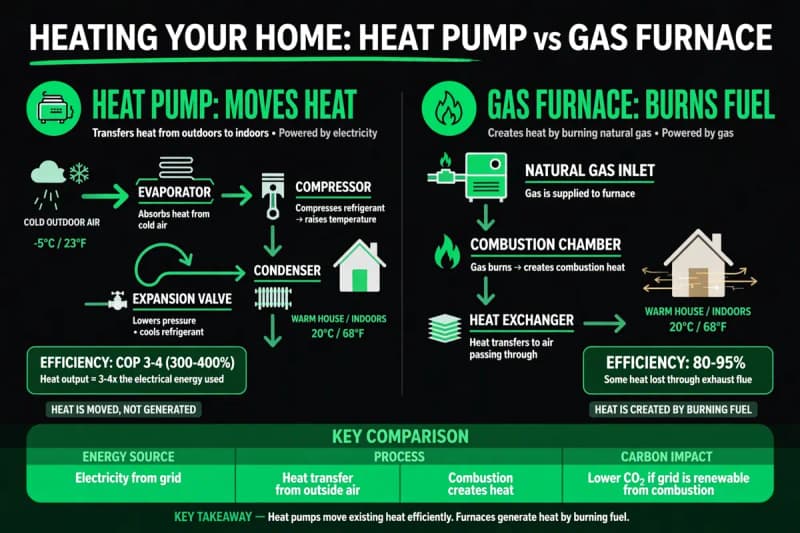
Heat pump: An electric system that moves heat from outdoor air into a home in winter and reverses to cool in summer, instead of burning fuel to create heat. A gas furnace burns natural gas and needs a separate air conditioner for cooling.
The breakeven point is lower than most shoppers expect. A heat pump only needs a seasonal coefficient of performance (COP) above about 1.8 to beat a 95% AFUE furnace on fuel cost per unit of heat at Sacramento Municipal Utility District (SMUD) rates, and above about 1.5 to beat an 80% furnace. ENERGY STAR sets a cold-climate floor of 1.75 at 5 degrees Fahrenheit, so a unit that merely meets that floor already sits close to the breakeven line in a mild climate.
How heat pump vs gas furnace cost in 2026 is calculated
The fair unit is one therm of heat delivered into the ducts, or 100,000 Btu of warmth, whichever system produces it. Pricing each system by its sticker price alone misleads, because a furnace is a heater only and a heat pump replaces both the furnace and the air conditioner. Pricing by fuel cost per therm, then adding equipment cost separately, keeps the two decisions visible.
SMUD publishes a residential Fixed Rate of $0.1371 per kWh in the non-summer period, from October 1 to May 31, and $0.2189 in summer, with a $27 monthly System Infrastructure Fixed Charge. California residential natural gas averaged $20.33 to $22.96 per thousand cubic feet in the 2026 months published so far by the US Energy Information Administration (EIA), which converts to roughly $1.96 to $2.22 per therm at the meter using the EIA heat content figure of 1,036 Btu per cubic foot.
| System | Assumption | Cost per therm of heat delivered |
|---|---|---|
| Gas furnace, 80% AFUE | $2.09 per therm of gas (midpoint) | $2.61 |
| Gas furnace, 95% AFUE | $2.09 per therm of gas (midpoint) | $2.20 |
| Heat pump, seasonal COP 2.3 | SMUD Fixed Rate, non-summer $0.1371 per kWh | $1.75 |
| Heat pump, seasonal COP 2.3 | SMUD Time-of-Day off-peak $0.1285 per kWh | $1.64 |
| Heat pump, seasonal COP 2.3 | SMUD Time-of-Day peak $0.1776 per kWh, weekdays 5 to 8 PM | $2.26 |
| Heat pump, COP 3.0 in mild weather | SMUD Fixed Rate, non-summer $0.1371 per kWh | $1.34 |
The table comes from SMUD rate and EIA gas price figures compiled in a 2026 Sacramento installer guide that cites both sources directly. The one cell where gas wins is the weekday evening peak on the Time-of-Day plan. A thermostat schedule that pre-warms the house before 5 PM answers that cell without changing the system choice.
What the $1.75 per therm figure means for a 10-year bill
Take a home that needs 60 MMBtu of delivered heat per year, or 600 therms. At the table rates, the 95% furnace costs about $1,321 per year in gas for heating, while the heat pump at COP 2.3 costs about $1,048 per year in electricity. The annual gap is $273, and over 10 years it totals $2,730, assuming rates and efficiency stay flat. That assumption is generous to gas: California residential gas rose from about $12.9 per thousand cubic feet in 2019 to about $22.0 in 2025 on EIA figures, while the heat pump number already uses a fixed rate that excludes any future solar offset.
Equipment cost runs the other way. SMUD reports a median gas-to-electric heat pump installation of $18,804 before rebates in its program, and the same installer guide reports 2026 ducted installs from $9,500 to $20,000. A furnace alone usually costs less than a heat pump alone, but the honest comparison adds an air conditioner to the furnace side, since Sacramento summers require cooling either way. Shoppers should get both quotes on the same scope, then subtract the rebate that applies only in the gas-to-electric direction: SMUD pays $3,000 for a variable-stage conversion and $2,000 for a two-stage conversion.
The federal picture changed at the start of 2026. The 25C energy efficient home improvement credit expired on December 31, 2025, so utility and state rebates now carry the incentive load. That shift matters for timing: a quote that still shows a federal credit is using expired math, and the rebate line should be checked against the utility program page before signing.
When a gas furnace still wins the comparison
Three cases flip the result. First, cheap gas regions: where residential gas costs under about $1.20 per therm and electricity costs over 25 cents per kWh, the breakeven COP climbs above 3.0, a level only a strong variable-speed unit holds through winter. Second, severe cold: a furnace delivers full output at any outdoor temperature, while a standard heat pump leans on electric resistance strips on hard-freeze mornings, which erases the efficiency advantage for those hours. Third, the panel: a furnace swap rarely touches the electrical panel, while a heat pump conversion sometimes needs a panel upgrade, and that electrician bill belongs in the heat pump column.
Dual-fuel splits the difference for a home with a healthy furnace and a dying air conditioner. The heat pump replaces the air conditioner and takes over heating on mild days, while the furnace stays wired in as backup. The tradeoff is that the gas appliance stays, so the SMUD gas-to-electric rebate does not apply. For a home where the furnace also has years left, dual-fuel is often the rational middle path, and it avoids retiring working equipment early.
Comfort is a real factor that the cost table cannot price. Manufacturers describe furnace heat as intense and dry and heat pump air as warm with gentler airflow. Households that prefer hot supply air may choose the furnace knowingly and pay the fuel premium. That is a preference, and it should be recorded as one rather than dressed up as a cost argument.
How to run the comparison for your own home
Start with your own bills, not a national average. Find your delivered gas price per therm and your electricity price per kWh from the last 12 months of bills, including fixed charges only if a conversion would let you close the gas account. Then apply the breakeven test: divide your gas price per therm by your electricity price per kWh and by 29.3, the kWh of heat in one therm. If the resulting number sits below the seasonal COP your installer quotes for your climate, the heat pump wins on fuel. If it sits above, the furnace wins, or dual-fuel earns a closer look.
Ask the installer for three items in writing: the seasonal COP assumption for your climate zone, the rebate amount with the program page cited, and whether a panel upgrade is included in the quote. A quote that gives only a monthly payment hides all three. The same discipline applies to the furnace side: a furnace quote should state AFUE, and an air conditioner quote should state its seasonal rating, so the combined system can be compared with the single heat pump system.
Related reading: our guide to hydrogen home heating against heat pumps and boilers covers the efficiency case in more depth, and our time-of-use rates guide explains how peak windows change the value of shifting load. For the storage side of an all-electric home, see whether a home battery pays without solar panels.
Three regions, three different heat pump answers
The Sacramento math does not travel unchanged. The same equipment produces a different winner when gas and electricity prices swap places, and the breakeven COP test shows why without needing a new dataset for each city. The rate pairs below are illustrative, used only to show how the threshold moves, and any real quote should use the home’s actual bills.
| Illustrative region | Gas per therm | Electricity per kWh | Breakeven COP vs 95% furnace | Likely winner |
|---|---|---|---|---|
| Mild climate, mid-price power (Sacramento pattern) | $2.09 | $0.1371 | 1.8 | Heat pump |
| Cheap gas, mid-price power | $1.00 | $0.15 | 3.2 | Furnace or dual-fuel |
| Expensive gas, cheap power | $2.50 | $0.10 | 1.2 | Heat pump, clearly |
| Cold climate, expensive power | $1.80 | $0.25 | 3.4 | Furnace, with heat pump for shoulder seasons |
The pattern is simple: the heat pump case strengthens as gas gets expensive relative to electricity, and weakens as that ratio reverses. Cold climate adds a second penalty, because seasonal COP falls as outdoor temperature falls, so the breakeven COP and the achieved COP move against each other at the same time. A home in a cold, expensive-power region can still use a heat pump profitably for shoulder-season heating, when outdoor temperatures are mild and COP is high, while the furnace covers deep winter. That is the dual-fuel logic applied by season rather than by equipment failure.
Cooling value also differs by region, and it belongs in the comparison even though the table above prices heating only. In Sacramento, a heat pump replaces an air conditioner that would otherwise be bought, maintained, and replaced on its own cycle. In a mild coastal climate where cooling is rarely needed, that replacement value shrinks, and the furnace-plus-nothing comparison tightens. In a hot, humid climate, the heat pump’s cooling efficiency and dehumidification become part of the value, and a furnace-plus-AC comparison should price the air conditioner at its full replacement cost, not as a sunk cost.
Insulation changes the answer in a third way. A well-insulated home needs less heat in total, which shrinks the annual fuel saving in dollars even when the per-therm saving is large. That does not make the heat pump wrong, but it lengthens the payback period on the equipment premium, and it makes the rebate more important to the decision. Conversely, a leaky home with high heating load produces a large annual saving, which can justify the premium quickly, provided the ductwork and airflow are fixed first. Installing a high-efficiency system on leaky ducts wastes part of the efficiency gain before it reaches the rooms.
Frequently asked questions
Is a heat pump worth the cost over a gas furnace in 2026?
In mild climates with electricity under about 20 cents per kWh and gas above about $1.80 per therm, yes on fuel cost, and the gap grows if a utility rebate applies. In cheap-gas, cold-climate homes, the furnace or a dual-fuel setup usually wins.
What does a heat pump installation cost in 2026?
SMUD reports a median of $18,804 before rebates for gas-to-electric conversions in its program, with installer ranges from $9,500 to $20,000 for ducted systems and $4,300 to $14,300 for ductless systems. Local quotes vary with ductwork, panel work, and refrigerant line length.
Does the federal heat pump tax credit still exist?
No. The 25C credit expired on December 31, 2025. Utility rebates such as SMUD’s $3,000 variable-stage conversion payment and state programs are now the main incentives, and they vary by utility.
Do heat pumps work in cold weather?
Modern cold-climate units are tested at 5 degrees Fahrenheit, where ENERGY STAR requires a COP of at least 1.75. Output falls as temperature falls, and resistance backup can engage on the coldest mornings, but in climates where winter lows sit in the high 30s, that penalty is small.
Should I replace a working furnace with a heat pump?
Usually no, unless the air conditioner is also failing. Replacing both boxes at once is where the heat pump case is strongest. If only the furnace is failing and the air conditioner has years left, price a like-for-like furnace swap alongside the heat pump quote and compare the full 10-year totals.