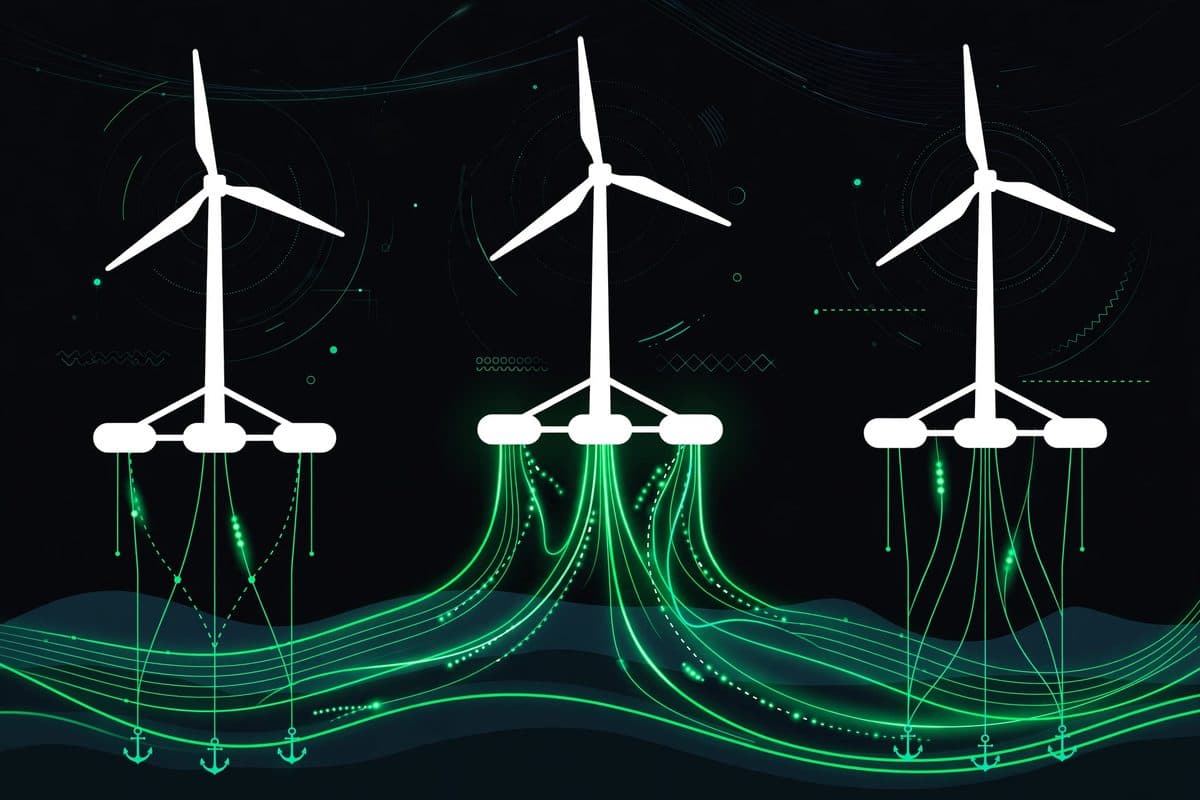
- Fixed-bottom turbines stop at about 60 m depth; floating platforms work in 60 to 100 m and deeper.
- Three floating farms operate today: Hywind Scotland 30 MW, WindFloat Atlantic 25 MW, Hywind Tampen 88 MW.
- Floating wind costs US$90 to US$160 per MWh, about 1.5 times fixed-bottom wind, yet the UK awarded floating projects £216.49 per MWh (pounds sterling) in January 2026.
Floating offshore wind: wind turbines mounted on floating platforms anchored to the seabed with mooring lines, instead of foundations fixed into the seabed, so they can generate power in deep water where fixed turbines cannot stand, opening ocean areas with stronger and steadier winds.
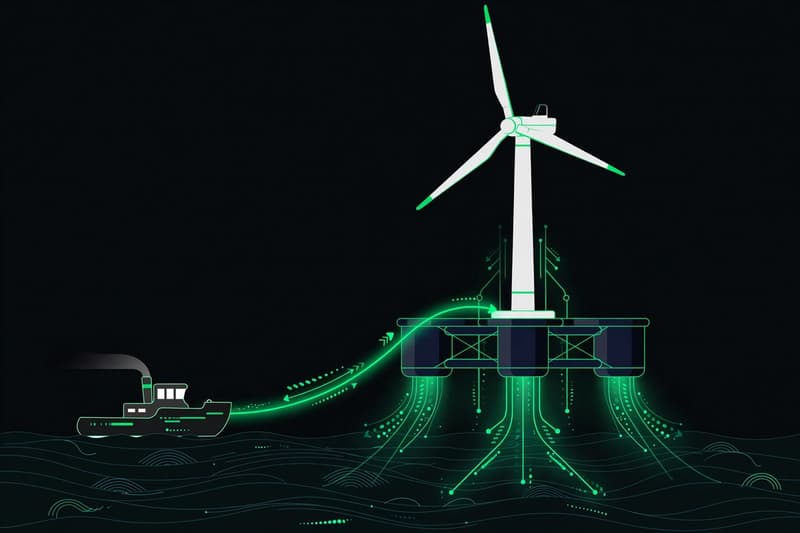
A floating wind turbine is assembled on land, towed out to sea, and held in place by mooring lines while it generates power. The tower and blades use the same technology as fixed offshore turbines, and the new engineering sits below the waterline: a buoyant hull that keeps the turbine upright, anchors that stop it drifting, and a flexible cable that carries power to shore while the platform moves with the waves.
That design removes the main limit on offshore wind: the depth of water a steel foundation can reach. Coastlines with strong, steady winds often drop away quickly, leaving little shallow seabed to build on. Floating platforms open those sites, along with the deep waters off the west coast of the United States, Japan, and much of southern Europe. The basics of the machine itself are covered in our guide to how wind turbines work.
Floating offshore wind starts where fixed foundations stop
Fixed-bottom offshore turbines stand on foundations driven or pinned into the seabed, and that approach works to a water depth of about 60 m. Beyond that depth the steel and installation cost grows faster than the energy gained. Floating platforms use mooring lines anchored to the seabed instead, and they operate in 60 to 100 m of water and deeper. Turbines are assembled in port, towed to site, and connected by dynamic cables that flex with platform motion.
The global fleet is still small. Global floating installed capacity stands at about 260 MW, against about 40 GW of offshore wind installed in 2025 excluding China. That comparison is Joule Post arithmetic from the figures reported by Offshore Magazine and Spinergie: 260 divided by 40,000 gives 0.65 percent. Floating wind is therefore about 0.65 percent of installed offshore wind outside China.
Three platform designs hold the turbine steady
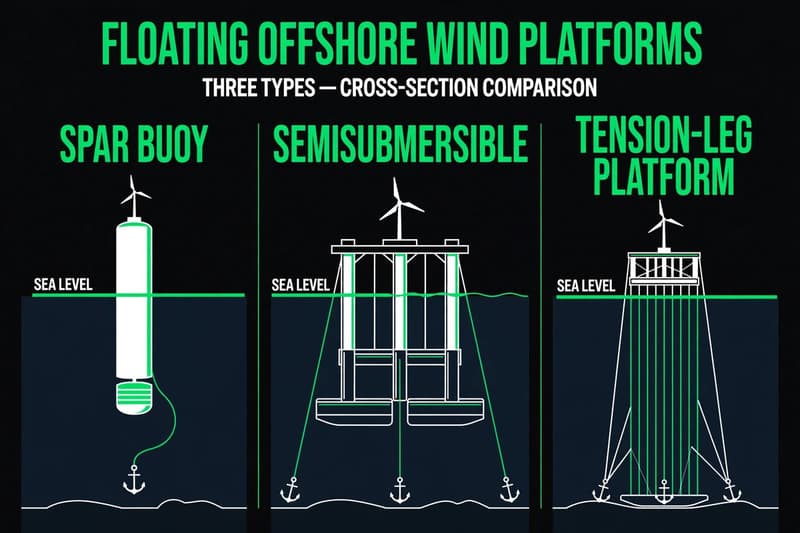
Three platform types dominate floating wind design. The spar is a deep, vertical cylinder ballasted at the bottom, like a fishing float stood on end. Its low centre of gravity keeps it stable in heavy seas; Hywind Scotland uses spar-buoy hulls. The drawback is draft: a spar needs deep water at the quayside, which limits the ports that can build it.
The semisubmersible spreads its buoyancy across several columns joined by pontoons, which keeps the draft shallow enough for ordinary ports. WindFloat Atlantic uses semisubmersible platforms designed by Principle Power. It is the most widely used design in the current pipeline because more ports can build it, though it moves more in waves than a spar.
The tension-leg platform uses taut mooring lines to pull the buoyant hull down below its natural waterline, and the tension restricts vertical motion almost completely. It needs precise anchor installation and heavy-lift vessels to set the tendons. All three face higher cost than fixed foundations and maintenance that sometimes means towing the unit back to port.
Three floating wind farms prove the concept
Hywind Scotland was the first commercial floating wind farm, commissioned in 2017 off Peterhead in Scotland with 30 MW of capacity on spar-buoy platforms. Its five turbines sit in water about 100 m deep, and the project proved floating turbines could operate through North Sea winters at commercial scale.
WindFloat Atlantic followed in Portugal, reaching full operation in July 2020 with 25 MW from three 8.4 MW turbines on semisubmersible platforms, 20 km off Viana do Castelo. It was the first semi-submersible floating wind farm in the world; Principle Power reports it delivered 320 GWh in its first four years, above expectations.
Hywind Tampen in Norway raised the scale again. The 88 MW farm uses 11 turbines on spar-buoy hulls in water 260 to 300 m deep, 140 km off the Norwegian coast, and it supplies up to 35 percent of the electricity demand of the Snorre and Gullfaks oil and gas platforms. It was the largest floating wind farm in the world when completed.
What the £216.49 CfD strike price says about floating wind costs
A peer-reviewed harmonisation of 2018 to 2024 literature by Koondhar and colleagues puts the levelised cost of energy at US$30 to US$55 per MWh for onshore wind, US$60 to US$100 per MWh for fixed-bottom offshore wind, and US$90 to US$160 per MWh for floating offshore wind. Floating wind costs 1.5 times fixed-bottom wind at the low end of both ranges, since 90 divided by 60 equals 1.5, and 1.6 times at the high end, since 160 divided by 100 equals 1.6. That is Joule Post arithmetic from the published ranges.
| Technology | Water depth | Levelised cost, US$ per MWh | Maturity |
|---|---|---|---|
| Onshore wind | Land | US$30 to US$55 | Mature |
| Fixed-bottom offshore wind | Up to about 60 m | US$60 to US$100 | Commercial scale |
| Floating offshore wind | 60 to 100 m and deeper | US$90 to US$160 | Demonstration scale |
The UK Contracts for Difference auction in January 2026 priced the gap. Allocation Round 7 awarded two floating projects totalling 192.5 MW at a strike price of £216.49 per MWh in 2024 prices (pounds sterling), while fixed-bottom projects cleared at £91.20 per MWh in England and Wales and £89.49 per MWh in Scotland. Floating wind therefore cleared at about 2.4 times the Scottish fixed-bottom price: 216.49 divided by 89.49 equals 2.42, which is Joule Post arithmetic from the figures published by the Department for Energy Security and Net Zero. The winners were the 100 MW Erebus project in the Celtic Sea and the 92.5 MW Pentland project off Scotland.
The premium has a reason. Floating projects pay for hulls, mooring systems, dynamic cables, and port work that fixed projects avoid, and they build at volumes too small for factory-scale savings. The peer-reviewed literature gives floating wind the strongest long-term cost-reduction potential of the three technologies, because floating turbines reach superior wind resources further offshore. Whether that potential arrives depends on the pipeline converting into built projects.
Where floating wind goes next
The next test for floating wind is industrial rather than technical. Ports need deeper quays and heavier cranes to assemble hulls and turbines at volume, and installation vessels are scarce. Heavy maintenance that requires towing a unit back to port adds downtime. Fixed-bottom projects face their own cost pressures, as our report on the final turbine at Revolution Wind shows, yet the floating premium remains wide.
Storage will shape the value of floating wind as it scales: output from far offshore is strong yet variable, and pairing it with storage smooths delivery to the grid, as our guide to battery energy storage explains.
The technology has crossed the proof stage. Three farms in three countries run today, and governments are leasing deep-water seabed at scale. The remaining question is cost, and the answer will come from the next projects: if Erebus and Pentland build on schedule, the 1.5 times premium over fixed-bottom wind should narrow.
Frequently asked questions
How do floating wind turbines work?
A floating wind turbine sits on a buoyant platform anchored to the seabed with mooring lines. A flexible dynamic cable carries the power to shore while the platform moves with the waves. The turbine and platform are assembled in port, towed to site, and connected to anchors and export cable.
What is floating wind?
Floating wind is offshore wind in water too deep for fixed foundations, generally deeper than about 60 m. Turbines float on spar, semisubmersible, or tension-leg platforms held by mooring lines. Global floating capacity is about 260 MW.
Why does floating wind cost more than fixed-bottom wind?
Floating wind pays for hulls, mooring systems, dynamic cables, and specialist port work that fixed projects avoid, and builds at demonstration volumes without factory-scale savings. Published levelised costs run US$90 to US$160 per MWh for floating wind against US$60 to US$100 per MWh for fixed-bottom wind.
How deep can floating wind turbines go?
Floating wind turbines operate in 60 to 100 m of water and deeper. Hywind Tampen runs in water 260 to 300 m deep, 140 km off Norway. Practical limits are mooring design, cable length, and anchor installation cost.
Sources
- Offshore Magazine / Spinergie, What Is Floating Wind?, 21 April 2026
- Koondhar et al., International Journal of Energy Research, published 19 March 2026, DOI 10.1155/er/9999516
- Principle Power, WindFloat Atlantic project page, 25 MW, operating since 2020
- Equinor, Offshore Wind Adventure: Hywind Tampen, 88 MW
- UK Department for Energy Security and Net Zero, Contracts for Difference Allocation Round 7 Results, 14 January 2026