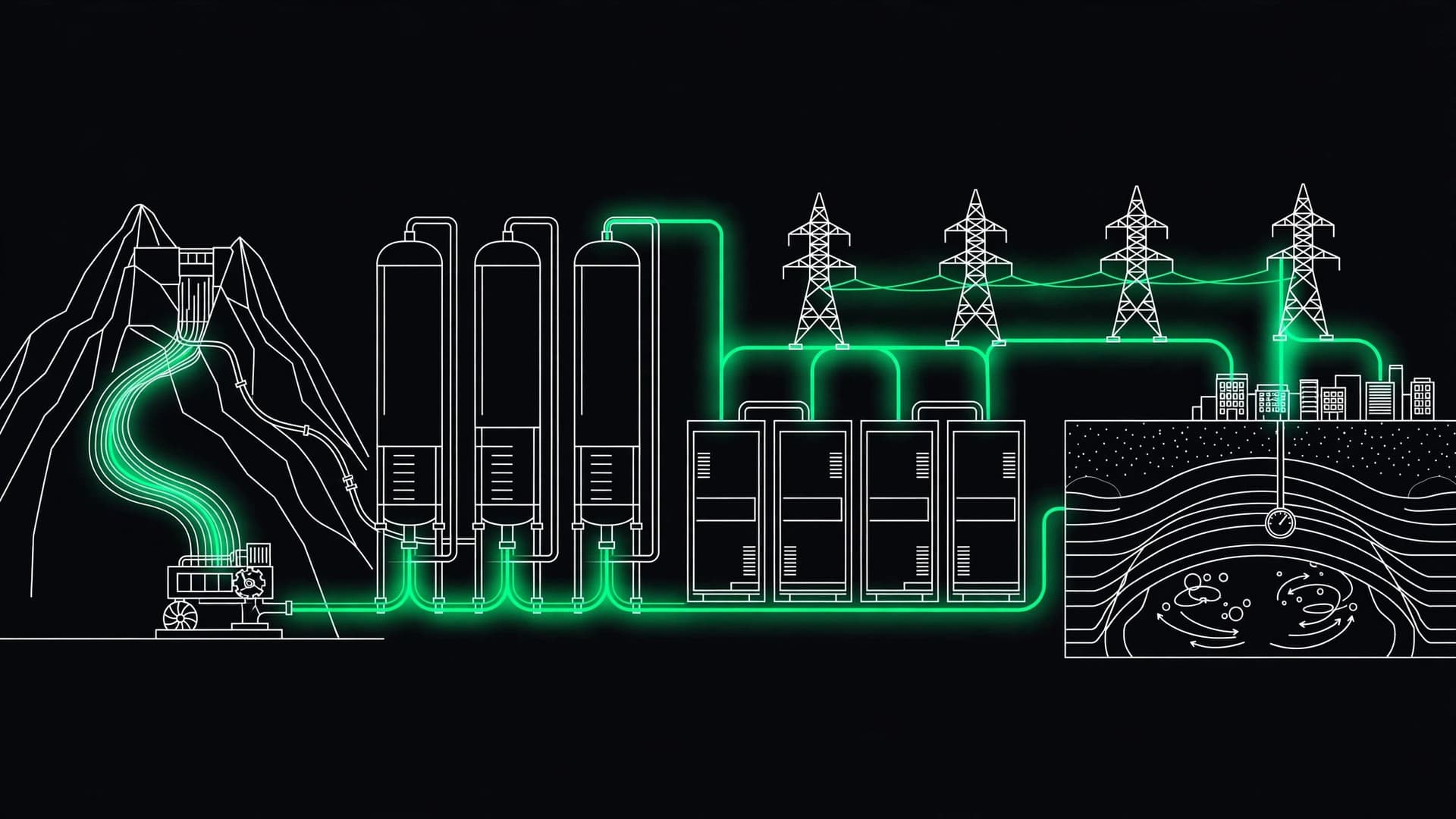
- Ten-hour storage cost US$119 to US$399 per kWh in the US Department of Energy’s 2020 assessment, depending on technology, with compressed air cheapest and vanadium flow batteries dearest.
- Form Energy’s iron-air battery targets a fully installed cost below US$20 per kWh by the end of the decade, and Google’s reported US$1 billion Minnesota project implies about US$33 per kWh today (Joule Post calculation).
- Pumped hydro still provides 93% of US grid-scale storage capacity, but the growth is in technologies that do not need a mountain or a cavern.
Long-duration energy storage (LDES): Storage that can discharge at full power for 10 hours or more, covering multi-day gaps in wind and solar output that four-hour lithium-ion batteries cannot. Technologies include pumped hydro, flow and iron-air batteries, compressed air, thermal storage, and hydrogen.
Contents
- The 10-hour line that separates long-duration storage from lithium-ion
- Pumped hydro still holds 93% of US grid storage capacity
- Flow batteries decouple power from energy
- Iron-air batteries target US$20 per kWh for 100-hour storage
- Compressed air and thermal storage fill the middle
- The US$119 to US$399 per kWh spread, technology by technology
- What 100-hour storage does to a wind-heavy grid
- Frequently asked questions
The spread comes from a structural split. Some technologies buy energy cheaply and power dearly, or the reverse, and the balance flips as duration grows. For a lithium-ion battery, doubling the duration roughly doubles the cost, because every extra hour needs more cells. For a flow battery or a pumped-hydro plant, extra hours need bigger tanks or a larger reservoir while the power equipment stays the same size. That single difference decides which technology wins at four hours and which wins at 100 hours, and it explains why the cheapest 10-hour system in the US Department of Energy’s assessment costs less than a third of the dearest one.
Grid operators learned the shape of the problem the hard way. Wind and solar output does not just dip for an evening. It can stay low for days or weeks in a dunkelflaute, the German word for dark doldrums, when a high-pressure system parks over a region and the wind drops while the sun stays weak. Four-hour batteries ride out the evening peak. They cannot carry a grid through a windless week. That gap is the market long-duration energy storage exists to fill, and the technologies competing for it could hardly be more different: water pumped up a mountain, rusting iron, liquid chemicals in tanks, air squeezed into caverns, and hydrogen stored underground for months.
The 10-hour line that separates long-duration storage from lithium-ion
The US Department of Energy draws the line at 10 hours. Its Long Duration Storage Shot, launched in 2021, targets a 90% cost reduction by 2030 for technologies that can provide 10 or more hours of storage, measured against a 2020 lithium-ion baseline. The goal is a levelized cost of storage of US$0.05 per kWh by 2030, which is the average price each unit of delivered energy would need to fetch to cover all project costs, including charging, financing, and maintenance.
Other countries draw the line elsewhere. The UK government defines long-duration storage as anything from four hours to years, while the regulator Ofgem uses eight hours and upwards. Sir Chris Llewellyn Smith, emeritus professor of physics at Oxford and lead author of a Royal Society report on large-scale electricity storage, told Carbon Brief that for his team long duration means storage that can last “not just into seasons, but into years and into decades.” The definitions differ because the job differs. Eight hours covers an overnight lull. One hundred hours covers a winter storm. Seasonal storage covers a windless February.
Lithium-ion keeps stretching toward the line. In the UK, grid batteries built with lithium-ion have typically offered one to four hours of storage, and the sector grew from almost nothing in 2015 to more than 6 GW. Carbon Brief reports that lithium-based grid batteries now often offer 8 to 12 hours. That stretches the definition of long duration, but it does not solve the cost problem. A lithium-ion system sized for 100 hours carries 25 times the cells of a four-hour system, and the cells dominate the bill. The technology that wins a four-hour auction on cost can lose a 100-hour auction by an order of magnitude, which is why the long-duration field is crowded with chemistries and machines that look nothing like a phone battery.

Pumped hydro still holds 93% of US grid storage capacity
Pumped-storage hydropower is the oldest technology in the field and still the largest by a wide margin. A November 2025 review by Pacific Northwest National Laboratory found that pumped hydro provides 93% of grid-scale storage capacity in megawatts and 99% of electrical energy storage in megawatt-hours in the United States. The principle is simple: surplus electricity pumps water to an upper reservoir, and the water flows back down through turbines when power is needed. No chemistry is involved, and the storage medium is water.
The UK illustrates the scale. Its 2.8 GW of long-duration storage consists of four pumped-hydro plants in Scotland and Wales, the largest being Dinorwig in North Wales, a 1,728 MW station opened in the 1980s that manages short-term surges in demand. Pumped hydro plants last a long time. Carbon Brief notes a lifespan of more than 50 years, which spreads the high upfront cost over decades of service and brings the lifetime cost per kWh down even when the construction bill looks large.
The constraint is geography. A pumped-hydro plant needs two reservoirs at different heights, and the best sites were developed decades ago. No new pumped-hydro projects have been built in the UK since the 1980s. In the United States, new projects face long permitting timelines and local opposition over land and water use. Pumped hydro will remain the backbone of long-duration storage, but it cannot grow fast enough on its own to cover the storage that wind-heavy grids need by 2030. That gap is what the newer technologies are racing to fill.
Flow batteries decouple power from energy
A flow battery stores energy in liquid electrolytes held in tanks and pumped through an electrochemical cell. Power depends on the size of the cell stack. Energy depends on the size of the tanks. To add hours, a developer buys bigger tanks while the cell stack stays the same size, so the cost per kWh falls as duration rises. That decoupling is the core economic advantage over lithium-ion, where power and energy scale together.
Vanadium is the most established flow chemistry. In May 2026 the UK’s largest vanadium flow battery site opened at Uckfield in East Sussex, co-located with a 3 MW solar farm. The site consists of 90 vanadium flow batteries storing 21 MWh, roughly enough electricity to power 3,000 homes for a day, and it stores surplus daytime solar generation for use in the evening and overnight. The same chemistry sits at the expensive end of the Department of Energy’s 2020 cost assessment, at US$399 per kWh for a fully installed 100 MW, 10-hour system, which shows how far flow batteries still have to travel on cost even where the physics favors them.
Cheaper flow chemistries are in development. Iron-based and zinc-based flow batteries use abundant materials, and the Department of Energy’s 2024 analysis found that flow batteries are among the technologies whose innovation portfolios could reach the US$0.05 per kWh Storage Shot target by 2030. The same analysis put lithium-ion, lead-acid, and zinc batteries on a path to approach the target at less than US$0.10 per kWh. Flow batteries already serve the multi-hour niche that lithium-ion is leaving behind as it stretches toward 8 to 12 hours, and their economics improve with every hour added to the duration.
Iron-air batteries target US$20 per kWh for 100-hour storage
Form Energy of Massachusetts builds a battery out of iron, water, and air. During discharge the iron rusts, releasing electrons. During charging, current reverses the reaction and turns the rust back into metallic iron. The company’s first commercial product stores and discharges energy for up to 100 hours, which is more than four full days of continuous output. The chemistry is deliberately low-tech. Iron is one of the cheapest and most abundant metals on Earth, the electrolyte is water-based and non-flammable, and the system uses no lithium, nickel, or cobalt.
The cost target is what makes the technology stand out. Form Energy chief executive Mateo Jaramillo told Heatmap in February 2026 that the company remains committed to a fully installed system cost below US$20 per kWh by the end of the decade. That figure is a target for the end of the decade. No iron-air system sells at that price today. The first large-scale test of where the cost actually stands is the Minnesota project announced in February 2026, when Google and utility Xcel Energy agreed to deploy a 300 MW, 30 GWh iron-air system at Pine Island to power a new Google data center alongside 1,400 MW of wind and 200 MW of solar. It is the largest battery by energy capacity announced anywhere.
Industry reporting put Google’s commitment at roughly US$1 billion. Dividing that figure by 30 GWh gives about US$33 per kWh, a Joule Post calculation that covers the battery system and associated integration rather than the cells alone. The gap between US$33 and the US$20 target is the distance manufacturing scale is supposed to close over the rest of the decade. The same arithmetic shows why the duration matters so much. A 100 MW system sized for 100 hours holds 10,000 MWh. At the US$20 target that costs US$200 million. The same 10,000 MWh built with lithium-ion LFP at the US$356 per kWh figure in the Department of Energy’s 2020 assessment would cost US$3.56 billion, a Joule Post calculation. Iron-air gives up round-trip efficiency for that cost advantage, returning far less of the energy put in than lithium-ion, so the economics work only where charging power is cheap surplus renewable output. For a battery that discharges 10 to 25 times a year during multi-day weather events, that trade usually pays.
Compressed air and thermal storage fill the middle
Compressed-air energy storage was the cheapest technology in the Department of Energy’s 2020 assessment, at US$119 per kWh for a fully installed 100 MW, 10-hour system. Surplus electricity compresses air into underground caverns, and the air drives a turbine when released. The catch is siting. The low cost depends on naturally occurring caverns, usually salt formations or disused gas wells, and the assessment projected compressed air would remain the most cost-effective system in 2030 on the same basis. Where the geology exists, it is hard to beat. Where it does not, the technology cannot be built at all.
New York is testing a variant that avoids the cavern constraint. On November 6, 2026, the New York State Energy Research and Development Authority awarded nearly US$13 million to 15 energy storage projects through its Power Generation and Storage Innovation program. The awards include more than US$590,000 to Aestus Energy Storage to test about 35 kWh of alumina-silica ceramic heat-sink materials for a 20 MWh advanced compressed-air system, and more than US$2.4 million to Inlyte Energy to deploy an iron-sodium battery that discharges for more than 10 hours at a substation. The program funds product development and demonstration of technologies that last more than 10 hours at rated power. Our report on the NYSERDA energy storage awards has the full list.
Thermal storage takes a different route. It heats a material such as gravel or molten salt with surplus electricity and keeps it in an insulated store, then uses the heat to make steam or warm water. The storage medium is cheap, and the duration can stretch into seasons, which is why hydrogen and thermal storage are the two candidates for storing energy for months rather than days. Hydrogen made from surplus wind and solar can sit in underground salt caverns until it is burned as fuel or run through a fuel cell. The Department of Energy’s 2024 analysis found hydrogen storage had the widest range of projected costs after innovation, a sign that the data is thin and the technology is early. China added a 100 MW compressed carbon-dioxide storage plant to its grid in 2026, showing that the mechanical storage family keeps growing beyond the familiar technologies.
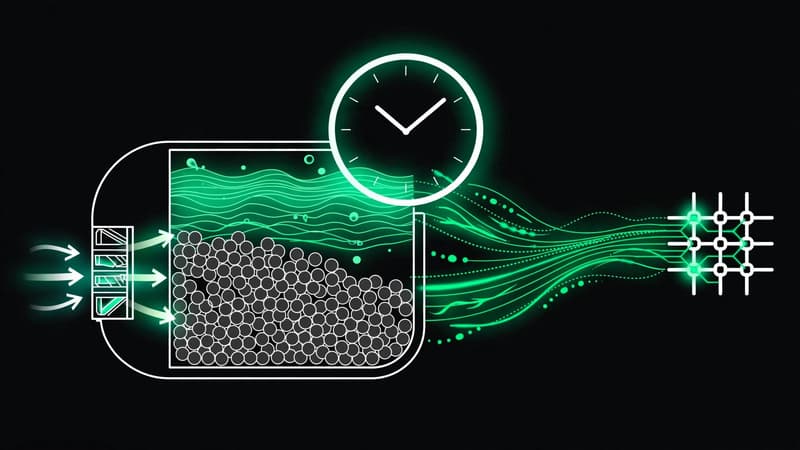
The US$119 to US$399 per kWh spread, technology by technology
The table below uses the Department of Energy’s 2020 Grid Energy Storage Technology Cost and Performance Assessment, which priced fully installed 100 MW, 10-hour systems. The iron-air row is different. It shows Form Energy’s stated target for the end of the decade, and it is marked as such because it is a target rather than a 2020 installed cost.
| Technology | Typical duration | Installed cost, US$ per kWh | Key constraint |
|---|---|---|---|
| Compressed air | Hours to days | US$119 | Needs suitable underground caverns |
| Pumped hydro | Hours to days | US$262 | Needs two reservoirs at different heights |
| Lithium-ion LFP | Hours, now 8 to 12 | US$356 | Cost rises with every extra hour |
| Lead-acid | Hours | US$356 | Short cycle life at deep discharge |
| Lithium-ion NMC | Hours | US$366 | Cost rises with every extra hour |
| Vanadium flow | Hours to days | US$399 | Vanadium electrolyte cost |
| Iron-air (Form Energy target) | 100 hours | Below US$20 (target) | Low round-trip efficiency |
The spread between the cheapest and dearest 2020 technologies is a factor of 3.35, a Joule Post calculation from US$399 divided by US$119. The iron-air target sits 6 times below even the cheapest 2020 figure, which is why the technology draws so much attention despite its efficiency penalty. For context, the Tesla Megapack costs US$278 per kWh and stores 5 MWh per unit, a lithium-ion benchmark for shorter durations that sits inside the 2020 range but above pumped hydro and compressed air.
Installed cost per kWh is only half the story. The other half is how many times the system cycles and how long it lasts. A pumped-hydro plant that runs for more than 50 years spreads its US$262 per kWh over decades of service. A lithium-ion battery that cycles daily wears out faster. The Department of Energy’s preferred yardstick is the levelized cost of storage, which folds in charging costs, financing, maintenance, and lifetime. Its 2024 analysis found that the projected baseline 2030 levelized cost of every technology still exceeds the US$0.05 per kWh target, but innovation portfolios could cut levelized costs by 12% to 85%, to a range of US$0.026 to US$0.255 per kWh. Pumped storage, compressed air, and flow batteries were the three families whose innovation portfolios could reach the target.
What 100-hour storage does to a wind-heavy grid
The case for long-duration storage rests on a simple observation about wind. Wind output is lumpy. A wind-heavy grid can run a surplus for days, then produce almost nothing for a week. Short batteries shave the daily peaks. They cannot move a windy weekend’s surplus into the following week’s calm, so grid operators either build excess wind capacity that gets curtailed or keep gas plants on standby for the gaps. Australia showed the scale of the waste in 2026, when 41 GWh of solar went unused while batteries set records. Our report on the Australian battery record and solar curtailment has the numbers.
One hundred hours of storage changes the arithmetic. A 100-hour battery can absorb a four-day wind surplus and return it during the four-day calm that follows. That turns curtailment into revenue and lets a grid retire gas peakers that exist only for rare weather events. Battery storage is already cheaper than gas peakers in 43 markets, according to research we covered in our report on battery storage beating gas peakers on cost, and long-duration systems extend that advantage from hours to days. The US$6 billion that solar and storage saved Texas and California in 2026 came mostly from short-duration batteries. Multi-day storage targets the remaining costs: the standby gas plants and the curtailed weekends.
Policy is moving in the same direction. The UK set a target of 4 to 6 GW of long-duration storage by 2030, alongside 23 to 27 GW of short-duration batteries, and its National Electricity System Operator projects 3.8 to 5.3 GW by 2030 and 13.2 to 16.6 GW by 2050. The UK’s cap-and-floor scheme, announced in 2024, guarantees a minimum revenue for storage operators and caps their profits, and 171 projects totalling 52.6 GW applied in 2025, of which 77 projects totalling 28.7 GW were deemed eligible. Analysis by LCP Delta cited by Carbon Brief puts the saving to the UK energy system at more than £24 billion (British pounds) between 2030 and 2050. In the United States, FERC Order 2222 opened wholesale markets to aggregated home solar and batteries, which lets small systems sell the flexibility that long-duration storage provides at scale. Our explainer on FERC Order 2222 covers how that market access works.
Julia Souder, chief executive of the industry group the LDES Council, told Carbon Brief that a handful of technologies will do the heavy lifting over the next decade, and the projects winning support through the UK’s cap-and-floor mechanism show which ones. Pumped hydro still dominates installed capacity. Flow batteries and iron-air are the challengers with the clearest path to low cost at long duration. Compressed air wins wherever the geology allows it. The diversity is the point. No single technology covers every duration, every site, and every budget, and a grid that needs 10 hours in one place and 100 hours in another will buy both. The cost spread in the table above is not a ranking to be settled once. It is a menu, and the cheapest item on it depends on how long the lights need to stay on.
Frequently asked questions
What is LDES?
Long-duration energy storage is storage that can discharge at full power for 10 hours or more, the threshold used by the US Department of Energy. It covers technologies from pumped hydro to iron-air batteries, and its job is to carry grids through multi-day gaps in wind and solar output that four-hour lithium-ion batteries cannot cover.
What types of LDES are available?
The main families are mechanical (pumped hydro and compressed air), electrochemical (flow batteries, iron-air, sodium, and long-duration lithium-ion), chemical (hydrogen stored in salt caverns), and thermal (heated gravel or molten salt). Pumped hydro provides 93% of US grid-scale storage capacity today, while flow and iron-air batteries are the fastest-growing alternatives.
How much does long-duration energy storage cost?
The Department of Energy’s 2020 assessment priced fully installed 100 MW, 10-hour systems at US$119 per kWh for compressed air, US$262 for pumped hydro, US$356 for lithium-ion LFP, and US$399 for vanadium flow batteries. Form Energy targets below US$20 per kWh for its 100-hour iron-air system by the end of the decade. The Department of Energy’s goal is a levelized cost of US$0.05 per kWh by 2030.
Why can’t lithium-ion batteries cover multi-day gaps?
Lithium-ion cost scales with duration because every extra hour needs more cells. A 100-hour lithium-ion system costs roughly 25 times a four-hour system of the same power. Flow batteries, pumped hydro, and iron-air systems add energy far more cheaply than they add power, so their cost per kWh falls as duration rises while lithium-ion’s stays flat or rises.
How much LDES will grids need?
The UK targets 4 to 6 GW by 2030, and its system operator projects 13.2 to 16.6 GW by 2050. The US Department of Energy has not set a capacity target, but its Storage Shot aims to cut long-duration storage costs by 90% by 2030 so that the technology can scale wherever wind and solar dominate generation.
Sources
- US Department of Energy, Achieving the Promise of Low-Cost Long Duration Energy Storage, August 2024
- US Department of Energy, Grid Energy Storage Technology Cost and Performance Assessment (2020), reported by pv magazine USA, December 22, 2020
- Form Energy, Battery Technology (iron-air system, up to 100 hours)
- Heatmap, Inside Form Energy’s Big Google Data Center Deal, February 24, 2026
- NYSERDA, $13 Million Awarded To Advance Innovative Energy Storage Technologies In New York State, November 6, 2026
- Carbon Brief, Q&A: What is long-duration energy storage and why does the UK need it?, 2026
- Pacific Northwest National Laboratory, Emerging Technologies Review: Pumped Storage Hydropower, November 18, 2025