
- Perovskite solar panel lifespan is capped by a 10-year warranty on the only shipping tandem module, Oxford PV’s Centaur 2, against 25 years for mainstream silicon panels.
- Lab results point further: an NREL-led team held degradation to 2 percent after 2,100 hours at 65C, and a Princeton test predicts 30 years of outdoor operation for a capped perovskite cell.
- The 15-year warranty gap is a financing problem as much as a durability problem, and manufacturers are closing it with glass-glass encapsulation and a 15-year warranty on the 2026 Centaur 3.
Perovskite solar panel: A solar panel built from perovskite, a crystal-structured material that absorbs sunlight far more efficiently than silicon in thin layers. Most commercial designs stack a perovskite layer on top of a silicon cell to make a tandem panel. The technology promises higher efficiency, and its open question is how long the perovskite layer survives outdoors.
Perovskite solar panel lifespan is the number that decides whether the most efficient solar technology ever built in a lab can become a product a bank will finance. A solar project is funded against 25 years of output, and a panel warranted for only 10 years leaves 15 years of revenue uncovered, which is why lenders discount perovskite projects even while the efficiency records keep climbing. The gap is closing from both ends: Oxford PV’s next module carries a 15-year warranty, and laboratory stability tests now run into thousands of hours with only single-digit percentage losses.
The efficiency prize explains why buyers care. A perovskite layer stacked on silicon captures parts of the spectrum that silicon misses, and Oxford PV’s commercial tandem modules already convert 25 percent of sunlight into electricity, against roughly 21 to 23 percent for a standard silicon panel. That extra output matters most where roof space is limited. The question is whether the advantage survives 25 summers of heat, rain and ultraviolet light.
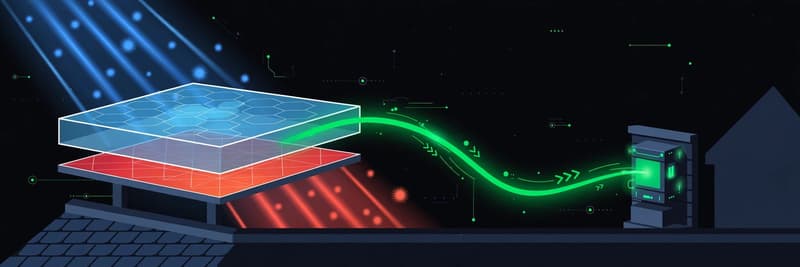
Perovskite Solar Panel Lifespan in One Number: 10 Years on Paper
The only perovskite product shipping in volume today is Oxford PV’s tandem module, and its warranty is 10 years. Oxford PV states on its own technology page that its module products carry a lifetime warranty of 10 or more years today. The company’s first commercial modules shipped in September 2024 at 24.5 percent efficiency to utility customers in the United States, and current Centaur 2 modules are rated at 25 percent efficiency with the same 10-year warranty. Volume production is planned from 2027.
Ten years is the floor, and the roadmap climbs from there. Oxford PV’s Centaur 3, scheduled for market release in 2026, is rated at 550 W and 26 percent efficiency with a 15-year warranty. A further step planned for 2027 targets 27 percent efficiency with a 20-year warranty, and the company sees 35 percent module efficiency by 2035. Each step adds five years of warranted life, which is the metric that matters to a project developer.
For context, mainstream silicon panels carry 25-year performance warranties as standard, and some premium makers now offer 30 years. The comparison is direct: a buyer who installs Oxford PV’s current module gets 15 fewer warranted years than a buyer who installs silicon. Our guide to solar panel warranties sets out the three separate clocks in a silicon warranty: product cover, performance cover and installer workmanship.
Why Perovskite Layers Degrade: Moisture, Heat, Oxygen and UV
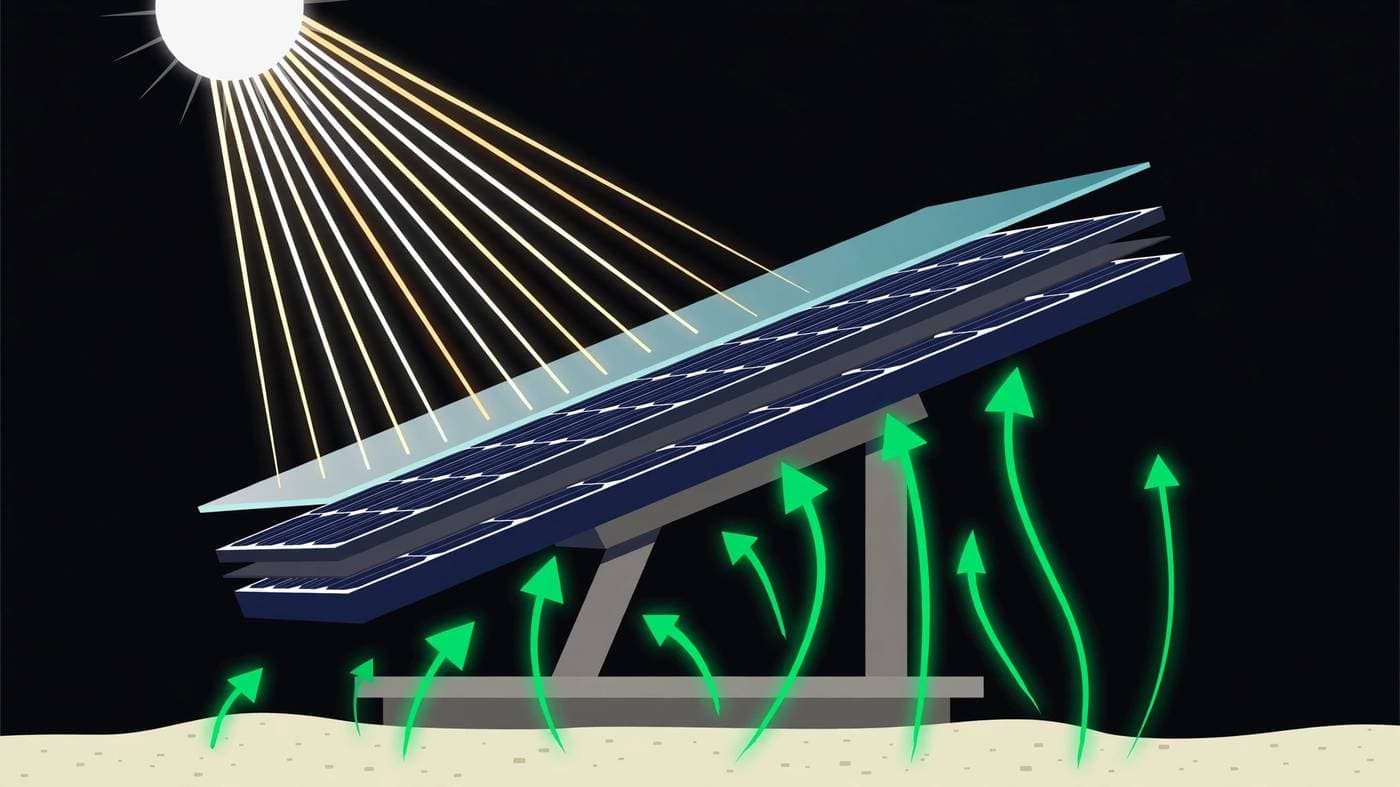
Perovskite crystals are vulnerable to the four stresses every rooftop delivers. Moisture seeps into the crystal structure and breaks it down, heat accelerates chemical reactions inside the cell, oxygen reacts with the material under light, and ultraviolet radiation damages the layers over time. Silicon faces the same stresses, and it survives them because decades of engineering produced glass, encapsulant and edge seals that keep water and air out for 25 years or more. Perovskite has not yet had those decades.
The lab record shows how far the material has come. Perovskite solar cells in the laboratory last on average a few hundred or a few thousand hours rather than years, according to the American Ceramic Society, against the 25-year field life of silicon. The weak point is often the interface between layers rather than the perovskite itself: in inverted cells, the electron transport layer made from buckminsterfullerene, known as C60, forms weak molecular interfaces that degrade under heat and light.
What the Lab Results Show
Two recent studies show the two paths to a longer perovskite life. The first comes from Princeton University and Linkoping University in Sweden, where researchers built an accelerated aging test that combines constant full-spectrum illumination with temperatures up to 110C at the cell’s maximum power point. They tested a perovskite cell made from caesium lead iodide, CsPbI3, with an ultrathin capping layer only a few atoms thick. The capped cells did not degrade at 35C and needed more than 2,100 hours at 110C under constant light to lose 20 percent of their initial efficiency. The researchers calculated an intrinsic lifetime of more than 5 years, equal to 30 years of outdoor operation in a climate like Princeton, New Jersey. The paper appeared in the journal Science.
The test itself matters as much as the result. Perovskite degradation follows a single Arrhenius function across the whole temperature range from 35C to 110C, which means the same mechanism causes the damage at every temperature, so researchers can predict room-temperature lifetime from high-temperature tests. The study’s senior author, Lynn Loo of Princeton, put it plainly: “We might have the record today, but someone else is going to come along with a better record tomorrow. The really exciting thing is that we now have a way to test these devices and know how they will perform in the long term.”
The second study comes from the US National Renewable Energy Laboratory, where an international team replaced the C60 electron transport layer with an ionic salt called CPMAC, synthesised from C60 itself. The salt tripled the mechanical toughness of the layer interface, and the resulting cells reached 26 percent efficiency with about 2 percent degradation after 2,100 hours of one-sun operation at 65C. Minimodules built with the same salt reached 23 percent efficiency with less than 9 percent degradation after 2,200 hours at 55C. The work was published in Science on 17 April 2025.
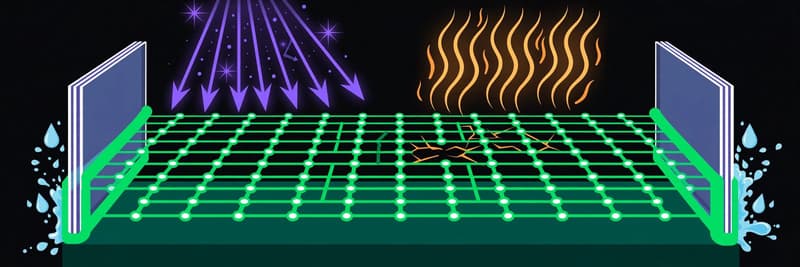
Perovskite vs Silicon Lifespan: The 25-Year Output Math
The comparison that matters is output after 25 years, because that is the life a solar project is financed against. The table below puts the sourced figures side by side, with the perovskite column showing the best lab result alongside the warranted product.
| Measure | Mainstream silicon | Perovskite tandem (Oxford PV) | Perovskite lab best (NREL CPMAC) |
|---|---|---|---|
| Module efficiency | 21-23% | 25% (Centaur 2) | 26% (cell) |
| Warranty | 25 years | 10 years | Not a product |
| Median degradation | 0.5% per year (NREL field review) | Not published | 2% over 2,100 hours at 65C |
| Output after 25 years | About 88% | Unwarranted beyond year 10 | About 66% (Joule Post arithmetic, see text) |
| First commercial shipment | Decades ago | September 2024 | Not shipped |
The silicon column rests on the National Renewable Energy Laboratory’s review of nearly 2,000 degradation rates from fielded systems, which reported a median of 0.5 percent per year for crystalline silicon. Joule Post arithmetic turns that rate into a 25-year figure: a panel losing 0.5 percent a year keeps about 88 percent of its original output after 25 years, and at the same rate it would take about 45 years to fall to 80 percent. Our guide to solar panel degradation rates works through the NREL figures in full.
The perovskite column needs a conversion, because lab tests run in continuous light at high temperature rather than in rooftop years. Joule Post arithmetic, with assumptions stated: 2,100 hours of continuous one-sun light at 65C equals about 1.2 years of peak sun, using 1,750 peak sun hours a year as a rough planning figure. Losing 2 percent over 1.2 sun-years is about 1.7 percent per sun-year, more than three times silicon’s 0.5 percent. At 1.7 percent a year, a panel would keep about 66 percent of its output after 25 years, against 88 percent for silicon. That is a laboratory rate read as a field rate, which overstates the damage because continuous 65C light is far harsher than a rooftop year, and the Princeton result points the other way. The honest reading is that the lab data brackets the answer between roughly 25 and 30 years, while the warranty says 10.
What the 15-Year Warranty Gap Costs a Buyer
The warranty gap is a financing problem before it is a durability problem. A solar project borrows money against 25 years of electricity sales, and a lender treats unwarranted years as risk. A 10-year warranty on a 25-year asset means 15 years of output carry no manufacturer backing, so the lender either charges more, lends less, or asks for a corporate guarantee. Oxford PV’s roadmap answers this directly: 15 years on the 2026 Centaur 3, then 20 years in 2027, which closes the gap to five years and then to zero if the schedule holds.
For a homeowner the math is simpler. A rooftop system is usually bought outright or financed over 10 to 15 years, which fits inside the current warranty, and the efficiency advantage of 25 percent against 21 to 23 percent means fewer panels for the same output. The risk is resale: a roof installed in 2026 and sold in 2036 holds a panel whose warranty has expired, while a silicon roof installed the same year still carries 15 years of cover. Our guide to installer bankruptcy and warranties covers what happens when the company behind a warranty disappears.
How Manufacturers Are Closing the Gap
Encapsulation is the first line of defence, and it is already standard on the shipping product. Oxford PV builds its tandem modules as glass-glass panels with sealed edges, which keeps moisture and oxygen away from the perovskite layer far better than a plastic backsheet. The 25.6 percent shingle module the company reported in June 2026 uses the same glass-glass construction with edge sealing, in a 491 W rooftop format and a 546 W bifacial format. Glass on both faces adds weight and cost, and it is the price of keeping water out for decades.
Chemistry is the second line, and it moves faster than packaging. The NREL salt layer and the Princeton capping layer both attack the interface where degradation starts, and both are compatible with existing production lines. A related line of work uses self-healing treatments that repair the perovskite crystal after damage, which Joule Post covered in our report on a 30.77 percent tandem cell with a healing treatment. None of these is a product yet. Our guide to how solar panels work explains the silicon baseline that perovskite has to beat, cell by cell.
Frequently asked questions
How long do perovskite solar panels last?
The only shipping perovskite tandem module, Oxford PV’s Centaur 2, carries a 10-year warranty. Laboratory tests suggest longer life is possible: a Princeton accelerated aging test predicted 30 years of outdoor operation for a capped perovskite cell, and an NREL-led team held degradation to 2 percent after 2,100 hours at 65C. No perovskite panel has yet operated outdoors for 25 years, so the warranted figure is 10 years and the lab figure is 25 to 30.
Why is the perovskite warranty only 10 years when silicon gets 25?
Silicon has 25 years of field data behind its warranty, and perovskite does not. Oxford PV shipped its first commercial tandem modules in September 2024, so the longest real-world record is about two years. The 10-year warranty reflects what the company can stand behind with test data today, and the roadmap raises it to 15 years on the 2026 Centaur 3 and 20 years in 2027.
What makes perovskite panels degrade?
Moisture, heat, oxygen and ultraviolet light all attack the perovskite crystal and the interfaces between layers. Moisture breaks down the crystal structure, heat accelerates chemical reactions, oxygen reacts with the material under light, and UV damages the layers over time. Glass-glass encapsulation with sealed edges keeps moisture and oxygen out, and interface treatments such as the NREL CPMAC salt layer slow the chemical damage.
Will perovskite panels reach a 25-year warranty?
Probably, and the schedule is public: Oxford PV targets a 20-year warranty in 2027, after the 15-year Centaur 3 in 2026. Whether the industry reaches 25 years depends on accelerated aging tests being accepted as proof of field life, which is exactly what the Princeton test was designed to provide. Until a manufacturer prints 25 years on a datasheet, buyers should treat the lab figures as promising rather than proven.
Sources
- Oxford PV, Perovskite PV technologies, accessed 9 November 2026
- Oxford PV, Centaur Series product factsheet, 2025
- pv Europe, “Oxford PV: Inside the Brandenburg factory where perovskite went commercial,” 1 October 2026
- pv magazine, “Oxford PV achieves 25.6% efficiency for perovskite-silicon tandem module based on shingled design,” 18 June 2026
- American Ceramic Society, “Accelerated aging test suggests decades-long performance is possible for new perovskite solar cell,” 2024
- NREL, “NREL-Led Research Effort Adds Salt, Boosts Performance of Perovskites,” 4 February 2026
- pv magazine, “Inverted perovskite solar cell based on ionic salt achieves 26% efficiency,” 5 May 2025
- NREL, “C60-based ionic salt electron shuttle for high-performance inverted perovskite solar modules,” Science, 17 April 2025