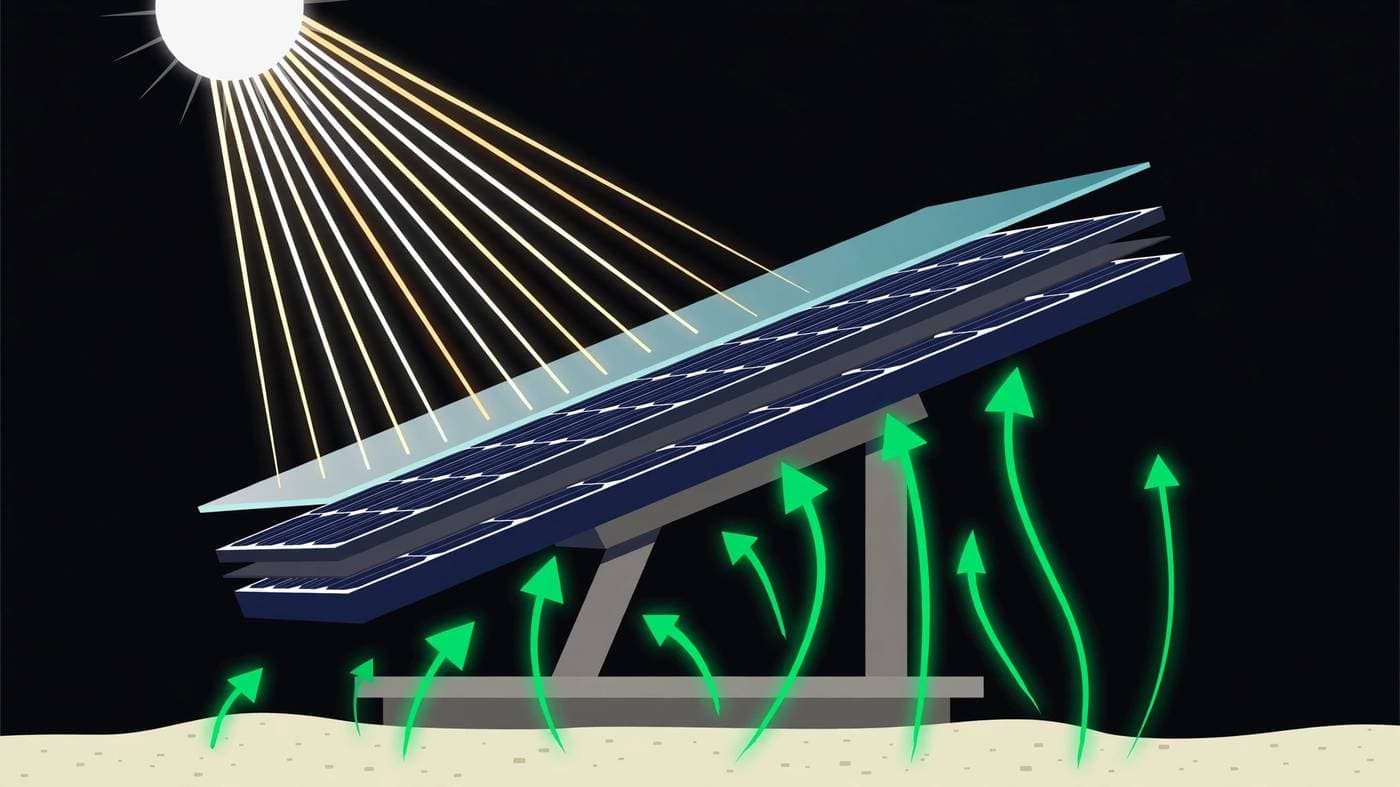
- Bifacial panels add 5% to 30% more energy than one-sided panels, but the gain depends almost entirely on the ground beneath them and how high they sit above it.
- Peer-reviewed modeling puts the gain below 10% over low-reflectivity ground and as high as 30% with bright ground and panels raised one metre.
- On a dark asphalt roof the rear face earns almost nothing, so the premium buys little. Elevated ground mounts over pale gravel or snow are where bifacial panels pay.
Bifacial solar panels: Modules with light-absorbing cells on both faces, so the rear face converts sunlight reflected off the ground into extra electricity. The gain depends on ground reflectivity, mounting height, and the panel’s bifaciality factor, the ratio of rear-side to front-side efficiency.
The nameplate rating is the first thing to understand, because it quietly assumes a world that many roofs do not provide. A bifacial panel carries two ratings. The front is rated under standard test conditions at 1,000 W/m2 of sunlight. The rear rating, called bifacial nameplate irradiance, adds rear-side light of 135 W/m2, which is 13.5% of the front-side level, under the IEC TS 60904-1-2 test method. That rear light has to come from somewhere, and on a real installation it comes from the ground. A panel lying flat on dark shingles sees almost no reflected light, so its rear rating describes power it will never produce.
Bifaciality is the number that describes how well the rear face converts whatever light reaches it. The US National Renewable Energy Laboratory defines it as the ratio of rear-side to front-side short-circuit current, and manufacturers typically claim a factor of 0.8 to 0.9, meaning the rear face converts 80% to 90% as efficiently as the front under the same light. That sounds generous until the light itself is counted. Reflected light is a fraction of direct sunlight, and the panel can only convert what arrives.
How a bifacial panel turns reflected light into watts
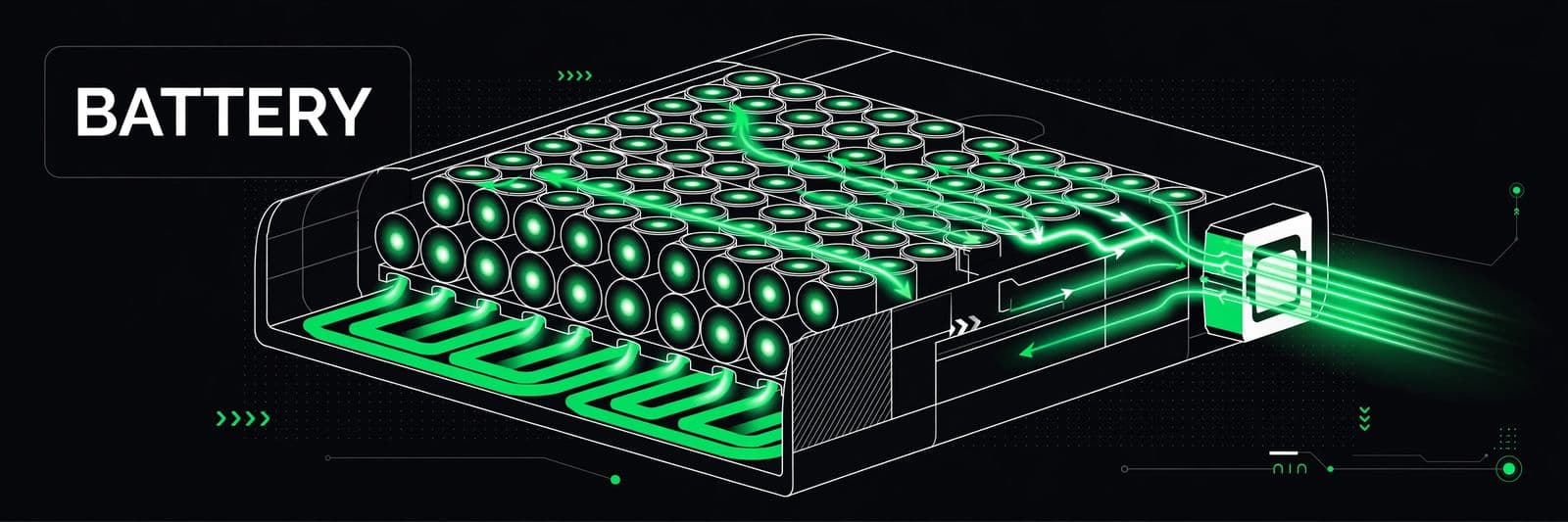
A conventional monofacial panel has an opaque backsheet. A bifacial panel replaces the backsheet with glass or a transparent polymer, so light reaching the rear face hits working cells. The cells are the same silicon as in a one-sided panel, usually n-type TOPCon, and the front face performs the same as a comparable monofacial module. The extra energy comes entirely from the rear.
The rear face needs two things: light and air. Light arrives as ground-reflected irradiance, which rises with surface reflectivity and panel height, because a higher panel sees more sunlit ground and less of its own shadow. Air matters because the rear face also sheds heat, and a panel mounted flush against a roof runs hotter and produces less. Bifacial panels are usually built glass-on-glass, which makes them heavier than opaque-backsheet panels.
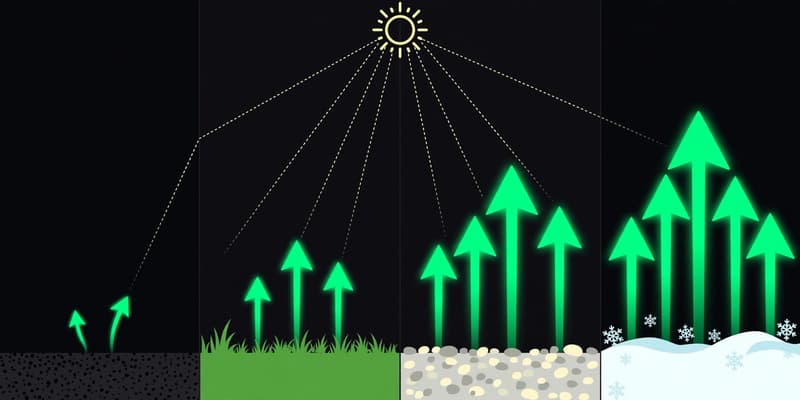
Albedo decides the gain: snow pays, asphalt does not
Peer-reviewed modeling by researchers at Purdue University and the National Renewable Energy Laboratory, published in Applied Energy in 2018, mapped bifacial gain across the world. With ground albedo of 0.25, the gain stayed below 10% everywhere. Raising the albedo to 0.5 and elevating the modules one metre above the ground pushed the gain as high as 30%. The same study found that vertical, east-west-facing bifacial modules outperform tilted south-facing ones by up to 15% below 30 degrees latitude at an albedo of 0.5. The ground and the mounting decide the outcome. The panel alone does not.
The table below pairs surface albedo values from a 2024 peer-reviewed paper on albedo modeling with the gain bands from the Purdue and NREL study. Fresh asphalt reflects about 4% of sunlight. Fresh snow reflects 80% to 85%. That twenty-fold difference in reflected light is the whole story of bifacial panels.
| Ground surface | Albedo (fraction reflected) | What the rear face sees |
|---|---|---|
| Fresh asphalt | 0.04 | Almost nothing; gain near zero |
| Dry soil | 0.10 to 0.15 | Very little; well below 10% |
| Green grass | 0.25 to 0.30 | Modest; gain below 10% |
| Desert sand | 0.40 | Useful; gain approaching the middle of the range |
| Fresh concrete | 0.55 | Strong; gain toward the top of the range with elevation |
| Fresh snow | 0.80 to 0.85 | Maximum; gain up to 30% with panels raised one metre |
Snow deserves a closer look because it is the best case and the most seasonal. A bifacial array in a snowy region gains twice: the snow reflects strongly, and the rear face warms the module from behind, which helps melt snow off the front. Our report on solar panels in winter snow covers how cold weather and snow affect output in detail. The gain disappears with the snow, so a buyer in a snowy climate should size the system on the annual average. The January peak is the wrong baseline.
Bifacial panels cost more than one-sided panels, but the premium has fallen fast. BloombergNEF figures reported by GlobalSpec put the bifacial premium at 10% to 20% in 2023, down from 30% to 50% five years earlier. Bifacial modules accounted for about 50% of global solar installations in 2023, according to the International Technology Roadmap for Photovoltaics. They are now the default for utility-scale projects, where ground mounts and bright ground are the norm. The residential market is a different question.
| Feature | Bifacial panels | Monofacial panels |
|---|---|---|
| Light capture | Front and rear faces | Front face only |
| Energy gain over monofacial | 5% to 30%, depending on ground and mounting | Baseline |
| Module price premium | 10% to 20% (2023, BloombergNEF) | Baseline |
| Construction | Glass on both faces, heavier | Opaque backsheet, lighter |
| Best site | Elevated ground mount over pale gravel, concrete, or snow | Any roof, including dark shingles |
| Worst site | Flush on a dark asphalt roof | No bad site for the panel itself |
The breakeven test is simple arithmetic. A bifacial panel that costs 15% more than a one-sided panel needs its rear face to add more than 15% more energy for the cost per watt to fall. If the rear face adds 5%, the buyer pays more per watt. If it adds 25%, the buyer pays less per watt and the premium was worth it. That is a Joule Post calculation from the BloombergNEF premium range and the Sun et al. gain bands. Put in annual energy terms, a 10 kW array producing an illustrative 15,000 kWh a year from its front faces gains 750 kWh at 5% and 3,750 kWh at 25%, a Joule Post illustration using the same gain bands. The 15,000 kWh baseline is an assumption made for illustration. It is not a measured figure.
Degradation does not change the verdict much. Solar panels lose output slowly with age, and our report on the solar panel degradation rate puts the typical figure near 0.5% a year. A bifacial panel degrades at roughly the same rate as a one-sided panel of the same cell type, so the rear-face gain persists over the system’s life. What does change the verdict is the roof. A buyer who needs to know how many panels fit a roof should read our guide on how many solar panels a home needs, because a bifacial panel on a dark roof is simply an expensive monofacial panel.
Mounting height matters as much as the ground
Elevation is the cheapest way to buy more rear-side light. Raising the modules one metre above the ground lets reflected light reach the rear face instead of being blocked by the panel’s own shadow, and the Purdue and NREL modeling found that one metre of elevation combined with an albedo of 0.5 lifts the gain to 30%. The effect has diminishing returns past about 1.5 metres, and taller racks cost more in steel and wind loading, so one metre is the practical sweet spot. Carports and pergolas get the height for free, which is why they are among the best residential sites for bifacial panels.
Tilt and orientation matter too. The same modeling found that vertical, east-west-facing bifacial modules outperform tilted south-facing ones by up to 15% below 30 degrees latitude at an albedo of 0.5, because the vertical faces catch morning and evening sun on opposite sides. At higher latitudes the advantage reverses. Flat commercial roofs with white membranes are another strong site, since the membrane reflects far more light than a dark roof and the panels sit high enough for the rear face to see it.
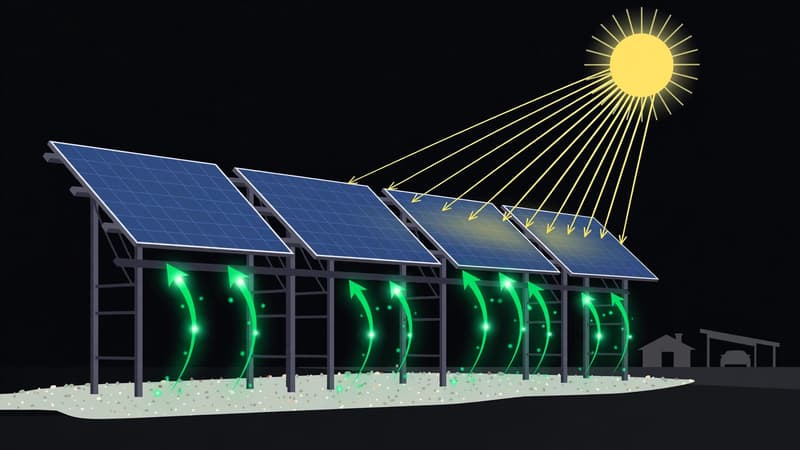
What a 25% gain does to a ground-mount payback
The payback question has a different answer for a ground mount than for a roof. On a ground mount over pale gravel, a 25% energy gain against a 15% module premium cuts the cost of each kilowatt-hour the system produces, which shortens the payback period. On a dark roof, a 5% gain against the same premium lengthens it. The panel is identical in both cases. The site decides whether the premium is an investment or a surcharge, and no datasheet can answer that question without knowing what lies under the array.
Two installation rules follow from the evidence. First, mount bifacial panels elevated over light, reflective ground such as gravel, snow, or a white membrane, and keep at least a metre of clearance where the site allows it. Second, do not install them flush against dark asphalt shingles, where the rear-side gain drops to near zero. Both rules come from the same physics: the rear face can only convert light that reaches it, and asphalt at 0.04 albedo sends almost none back. A buyer with a dark roof who still wants bifacial panels should ask the installer for tilted racks with an air gap, or a reflective surface beneath them.
Cleaning matters more for bifacial panels than for one-sided ones, because dirt on the rear glass blocks the reflected light the buyer paid extra to capture. Our guide on whether solar panels need cleaning covers how often to wash them. Warranty terms match one-sided panels of the same brand, and our explainer on solar panel warranties covers what the performance guarantee actually promises. The decision rule stays simple: bright ground plus height means yes, dark roof plus flush mounting means no, and anything in between deserves a modeled estimate for the specific site before money changes hands.
Frequently asked questions
Are bifacial solar panels worth it?
They are worth it on elevated ground mounts over bright surfaces such as pale gravel, concrete, or snow, where the rear face can add 20% to 30% more energy. They are poor value flush-mounted on a dark asphalt roof, where the gain falls near zero while the premium still applies.
Can you use bifacial solar panels for residential installations?
Yes, where the mounting allows it. Ground mounts, carports, pergolas, and flat roofs with white membranes are good residential sites. A standard pitched roof with dark shingles is the worst site, because the rear face sees almost no reflected light.
Bifacial vs monofacial solar panels: which should I choose?
Choose bifacial when the ground albedo is high and the panels can sit at least a metre above it, since the gain then exceeds the price premium. Choose monofacial for a dark pitched roof, a tight budget, or any site where the rear face cannot see the ground.
Do bifacial panels work better in snow?
Yes. Fresh snow reflects 80% to 85% of sunlight, the highest albedo of any common surface, and the rear face warms the module, which helps melt snow off the front. The gain is seasonal, so size the system on the annual average.
Sources
- Sun, Khan, Deline and Alam, Optimization and performance of bifacial solar modules: A global perspective, Applied Energy, 2018 (via OSTI, US Department of Energy)
- Albedo Reflection Modeling in Bifacial Photovoltaic Modules, 2024 (peer-reviewed)
- Marion, Deline and MacAlpine, Methods and Conditions for Rating Bifacial PV Modules, National Renewable Energy Laboratory, 2016
- GlobalSpec, Bifacial Solar Panels: Are They Worth the Hype?, November 17, 2025 (reporting BloombergNEF and ITRPV figures)
- GridSpecLab, Bifacial Solar Panels Explained: Why We Use Them (mounting guidance, cross-checked against Sun et al. 2018 and the albedo values above)