
- Liquefying hydrogen takes 8 to 10 kWh per kilogram, which is roughly a quarter to a third of the 33.3 kWh that kilogram holds as chemical energy.
- Compressed gas at 700 bar suits vehicles and short trips, liquid hydrogen suits ships and aircraft, and ammonia and liquid organic carriers suit long-distance trade.
- Pipelines move hydrogen for €0.07 to €0.23 per kg per 1,000 km (euros), far below the €0.60 to €1.20 per kg a three-day tube-trailer trip costs in container depreciation alone.
Hydrogen storage: the methods used to hold hydrogen gas in a usable form and move it from producer to user, since hydrogen is the lightest element and takes up far more space than the energy it carries at normal temperature and pressure.
A hydrogen molecule is the smallest molecule in common industrial use. It slips through seals that hold methane without trouble, and it weighs almost nothing, which sounds like an advantage until a tank has to hold it. The tank, the insulation, or the chemical carrier around the hydrogen often weighs far more than the fuel itself, and that single fact shapes every storage decision that follows. Hydrogen storage is therefore a contest between pressure, cold, and chemistry, and each route pays its bill in a different currency: energy, money, or complexity.
The choice matters because hydrogen is only useful if it arrives where it is needed in usable form. A kilogram produced by an electrolyser beside a wind farm has no value to a steel plant a thousand kilometres away until someone compresses it, liquefies it, or locks it into a chemical carrier. The US Department of Energy frames the problem plainly: hydrogen carries the highest energy per unit of mass of any fuel, yet its energy per unit of volume at ambient temperature and pressure is very low. Everything in this guide follows from that tension. For the production side of the story, see our comparison of PEM and alkaline electrolysers, the two machines that produce most green hydrogen today.
Contents
- Hydrogen storage starts with a physics problem
- Compressed hydrogen gas at 350 and 700 bar
- Liquid hydrogen at minus 253 degrees
- Ammonia and LOHC carry hydrogen as chemistry
- Moving hydrogen by pipeline, truck and ship
- Why the €0.07 pipeline rate changes hydrogen trade
- Choosing a storage route for each job
- Frequently asked questions
Hydrogen storage starts with a physics problem
The US Department of Energy lists three families of hydrogen storage. Physical storage holds hydrogen as a compressed gas at 350 to 700 bar (5,000 to 10,000 psi) or as a liquid at cryogenic temperatures, with a boiling point of minus 252.8 degrees Celsius at ambient pressure. Materials-based storage holds hydrogen on the surfaces or inside the structure of a solid, through reversible adsorption or absorption, or through a chemical reaction that cannot easily run backwards. The first two families carry almost all hydrogen in use today, while materials storage remains largely a research field.
The volume problem is easy to put in numbers. At ambient conditions hydrogen gas has a density of about 0.09 kg per cubic metre, so one kilogram fills roughly 11 cubic metres, a volume larger than a small garden shed. That figure is Joule Post arithmetic from the standard density of 0.09 kg per cubic metre. Squeezing that gas to 700 bar or cooling it to a liquid shrinks the volume by orders of magnitude, and liquid hydrogen is about 790 times denser than gaseous hydrogen, according to Burckhardt Compression. Storage technology is the art of buying back that volume at an acceptable price in energy and equipment.
Scale adds a second pressure. The International Energy Agency published the sixth edition of its Global Hydrogen Review in June 2026, tracking production, demand, policy, infrastructure, and trade, with new analysis of what low-emissions hydrogen can acceptably cost and a special focus on African supply chains. The review treats infrastructure as a central question because production capacity alone does not create a market. A hydrogen plant with no affordable way to store and move its output is a stranded asset, and storage is the bridge between production and demand.
Compressed hydrogen gas at 350 and 700 bar
Compressed gas is the oldest and simplest form of hydrogen storage. The gas is forced into a pressure vessel, and it stays there until a valve releases it. The Department of Energy gives the working range as 350 to 700 bar. The lower end serves buses, trucks, and stationary storage, where tank size matters less. The upper end, 700 bar, serves passenger cars, where every litre of tank space competes with cabin and luggage room. Pressure is the cheapest way to add energy density, since compression uses far less energy than liquefaction, and the gas can be used directly without a warming or conversion step.
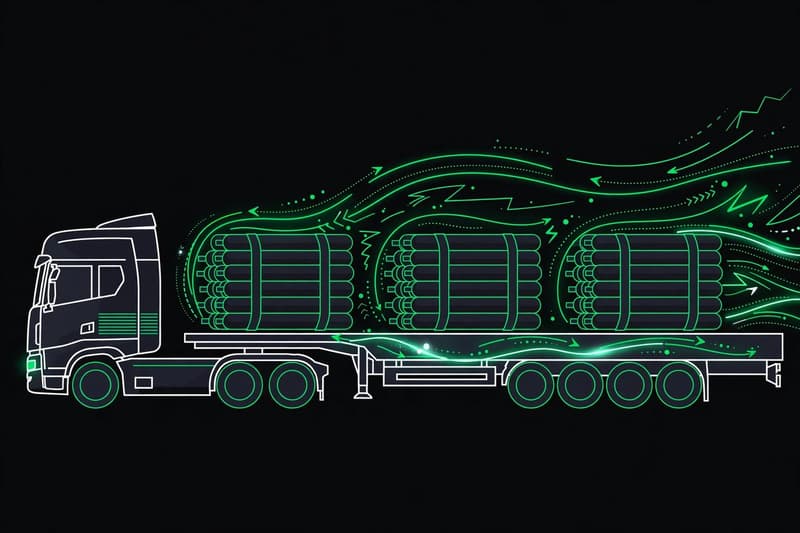
For road transport, compressed hydrogen travels in tube trailers: bundles of high-pressure cylinders mounted in 20-foot or 40-foot containers, filled at 200 to 700 bar. Burckhardt Compression puts the depreciation cost of those containers at €0.20 to €0.40 per kg per day of round trip (euros). A trailer that takes three days to deliver its load and return therefore carries €0.60 to €1.20 per kg in container depreciation alone, before fuel, driver, and tolls. That figure is Joule Post arithmetic from the Burckhardt daily rate, and it explains why tube trailers serve regional deliveries rather than continental hauls.
Compressed gas also suits storage that cycles daily. A refuelling station keeps hydrogen at high pressure so vehicles can fill in minutes. A factory with a steady hydrogen demand keeps a buffer of compressed gas to smooth out supply interruptions. The weakness is volume: even at 700 bar, hydrogen holds far less energy per litre than liquid fuels, so long-distance transport by truck carries mostly steel and very little fuel. That weakness is exactly what liquid hydrogen and chemical carriers exist to fix.
Liquid hydrogen at minus 253 degrees
Liquid hydrogen is hydrogen cooled below its boiling point of minus 252.8 degrees Celsius, a temperature only about 20 degrees above absolute zero. At that temperature the gas condenses into a liquid about 790 times denser than the gas, which makes it the most compact way to store pure hydrogen. Rockets have used it for decades for exactly that reason, and it remains the leading candidate for long-haul aviation and shipping, where tank volume is the binding constraint.
The price of that density is energy. Liquefying hydrogen at scale takes around 8 to 10 kWh per kg, according to Burckhardt Compression. Hydrogen holds 33.3 kWh per kg on a lower heating value basis, so the arithmetic is stark: 8 divided by 33.3 gives 24 percent, and 10 divided by 33.3 gives 30 percent. Liquefaction alone consumes roughly a quarter to a third of the energy in the hydrogen it produces. That is Joule Post arithmetic from the Burckhardt liquefaction figure and the standard lower heating value of 33.3 kWh per kg. No other mainstream storage step takes such a large first cut.
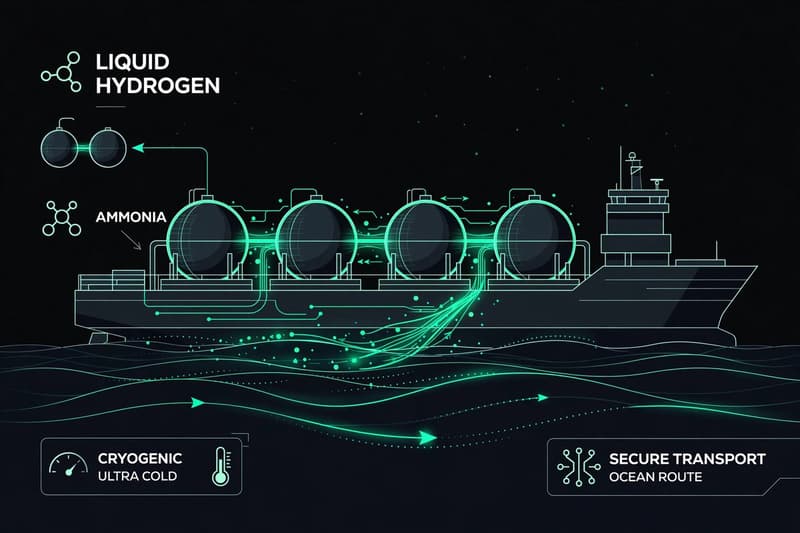
Liquid hydrogen also demands constant care. Insulated tanks slow heat leaking in from the surroundings, yet some heat always arrives, and the liquid slowly boils away as gas that must be vented or recaptured. This boil-off loss grows with storage time, which makes liquid hydrogen better suited to fuel that moves quickly than to fuel that sits for months. The tanks themselves are vacuum-insulated, double-walled vessels, and they cost far more per kilogram stored than a steel gas cylinder. Liquid hydrogen therefore wins where its density advantage is worth paying for, and loses where time or cost dominates.
Ammonia and LOHC carry hydrogen as chemistry
Chemical carriers sidestep the pressure and cold problem by binding hydrogen into a different molecule that is easier to handle. Ammonia is the most developed of these. It contains 17.8 percent hydrogen by mass, and it liquefies at minus 33 degrees Celsius at normal pressure or at 8.6 bar at 20 degrees Celsius, conditions far gentler than liquid hydrogen. Liquefied ammonia holds about 121 kg of hydrogen per cubic metre. Ships already carry ammonia around the world as fertiliser feedstock, so ports, tanks, and safety rules exist today. Our deep dive into the fuel explains the full picture in green ammonia explained.
The catch is that ammonia must be cracked back into hydrogen and nitrogen at the destination, a catalytic process that needs heat and equipment. Ammonia is also toxic, so handling rules are strict. Where the end user can burn ammonia directly, in a ship engine or a power turbine, the cracking step disappears, and the carrier becomes the fuel. That is the logic behind projects such as the RWE and Kawasaki hydrogen gas turbine at Lingen, where hydrogen-derived fuels feed power generation directly.
Liquid organic hydrogen carriers, known as LOHCs, take a different approach. An oil-like liquid such as dibenzyltoluene absorbs hydrogen at the production site and releases it at the destination when heated to 250 to 320 degrees Celsius with a catalyst. The carrier stays liquid at ambient pressure throughout, so it can move through ordinary fuel tanks, pipelines, and ships. Dibenzyltoluene stores 6.2 percent hydrogen by weight, and its dehydrogenation step needs about 11 kWh per kg of hydrogen released. Against the 33.3 kWh lower heating value, that is about 33 percent of the energy in the hydrogen, which is Joule Post arithmetic from the BBA Consultants figures. The spent carrier must then be shipped back for reuse, which adds a return leg that ammonia avoids.
Materials storage, the third family in the Department of Energy taxonomy, stores hydrogen inside metal hydrides or on high-surface-area solids. These systems can hold hydrogen at low pressure with high volumetric density, yet they remain heavy, costly, or slow to charge and discharge at commercial scale. They are worth watching, since a solid-state store would remove the pressure vessel and the cryogenic plant in one move, but no materials system yet competes with compressed gas or liquid hydrogen on cost for large volumes.
Moving hydrogen by pipeline, truck and ship
Transport cost decides which storage method wins, and the numbers differ by orders of magnitude. Burckhardt Compression estimates pipeline transport at €0.07 to €0.23 per kg per 1,000 km (euros). That rate covers moving hydrogen as a gas through a dedicated or converted pipeline, and it is the cheapest option over land wherever a pipeline exists or can be built. The cost falls further as volumes rise, since a pipeline is a fixed asset whose cost spreads across every kilogram it carries.
Tube trailers sit at the other end of the scale. At €0.20 to €0.40 per kg per day in container depreciation, a three-day round trip costs €0.60 to €1.20 per kg before any other expense. Compare that with the pipeline rate: €0.60 buys about 2,600 km of pipeline transport at the high pipeline rate of €0.23 per kg per 1,000 km, and €1.20 buys about 17,100 km at the low rate of €0.07. That comparison is Joule Post arithmetic, and it shows that a single three-day truck trip costs as much in container depreciation alone as moving the same hydrogen thousands of kilometres by pipe. Trucks still win for small volumes and places without pipelines, yet the economics push every large, steady flow toward pipe.
Ships carry hydrogen across oceans in two forms: as liquid hydrogen in cryogenic tankers, or as ammonia in conventional chemical carriers. Liquid hydrogen ships are new and few, while ammonia ships number in the hundreds and already serve global fertiliser trade. LOHC cargoes can travel in ordinary product tankers, since the carrier is a stable liquid at ambient temperature. The pattern is consistent: the further hydrogen travels, the more the storage method looks like an ordinary liquid fuel, because ordinary liquid fuel infrastructure is cheap and proven.
| Route | How hydrogen is held | Energy penalty | Best distance | Best use case |
|---|---|---|---|---|
| Compressed gas, 350 to 700 bar | Gas in pressure vessels | Low: compression only | Up to a few hundred km | Vehicles, refuelling stations, daily buffer storage |
| Liquid hydrogen, minus 253 degrees Celsius | Cryogenic liquid in insulated tanks | High: 8 to 10 kWh per kg, about 24 to 30 percent of the 33.3 kWh lower heating value | Long distance where volume matters | Rockets, aircraft, ships, high-volume export |
| Ammonia carrier | Hydrogen bound as NH3, liquid at minus 33 degrees Celsius or 8.6 bar | Moderate: synthesis plus cracking to release hydrogen | Intercontinental | Shipping, fertiliser, direct combustion in turbines and engines |
| LOHC, dibenzyltoluene | Hydrogen bound in an oil-like liquid at ambient pressure | High at release: about 11 kWh per kg of hydrogen, about 33 percent of the lower heating value | Long distance, seasonal storage | Industrial users with waste heat, routes with existing fuel infrastructure |
Why the €0.07 pipeline rate changes hydrogen trade
The pipeline figure is the single most important number in hydrogen storage, because it sets the price of moving the fuel at all. At €0.07 to €0.23 per kg per 1,000 km, moving hydrogen 1,000 km by pipeline adds roughly 2 to 8 percent to the cost of hydrogen produced at, say, €3 per kg, using Joule Post arithmetic on a €3 reference production cost chosen for illustration. That is a rounding error beside production cost. Moving the same kilogram by tube trailer for three days adds €0.60 to €1.20 per kg in container depreciation alone, which is 20 to 40 percent of that same €3 reference kilogram. The storage and transport choice can therefore matter more than the production method for the delivered price.
That arithmetic also explains the geography of the hydrogen economy now taking shape. Regions with cheap renewable power and a pipeline to demand can export hydrogen as a gas, while regions separated by ocean will export it as ammonia or LOHC, accepting the conversion penalty in exchange for access to cheap ships. Solar-rich regions illustrate the point: solar panels produce the electricity that electrolysers turn into hydrogen, as explained in how solar panels work, and the storage route then decides whether that hydrogen reaches a buyer. The International Energy Agency review for 2026 tracks exactly this build-out of infrastructure and trade, including its special focus on African supply chains, where long distances to demand make carrier choice decisive.
Storage also shapes the competition with batteries. Batteries store electricity directly and return it with high efficiency, which makes them the better choice for short-duration storage and most vehicles. Hydrogen wins where storage must last weeks or months, or where energy must move in bulk across continents. Our guide to battery energy storage sets out the battery side of that comparison. The two technologies divide the storage problem by duration and distance rather than competing head to head.
Choosing a storage route for each job
There is no single best way to store hydrogen, because the right answer depends on distance, volume, speed of use, and the equipment at the destination. A refuelling station needs compressed gas at 700 bar, since vehicles fill from high-pressure dispensers. A steel plant beside a pipeline needs nothing more than a connection and a buffer tank. An island nation importing fuel needs ammonia ships and cracking plants. A chemical plant with waste heat at 250 to 320 degrees Celsius can release hydrogen from LOHC almost for free, since the heat would otherwise be discarded.
| Cost step | Published figure | Joule Post arithmetic | Result |
|---|---|---|---|
| Liquefaction energy | 8 to 10 kWh per kg (Burckhardt Compression) | 8 / 33.3 and 10 / 33.3, against the 33.3 kWh per kg lower heating value | 24 to 30 percent of the energy in the hydrogen |
| Tube-trailer container depreciation, 3-day round trip | €0.20 to €0.40 per kg per day (Burckhardt Compression) | 3 days x €0.20 and 3 days x €0.40 | €0.60 to €1.20 per kg |
| Pipeline transport, 1,000 km | €0.07 to €0.23 per kg (Burckhardt Compression) | €0.60 / €0.23 and €1.20 / €0.07 | A 3-day truck trip equals 2,600 to 17,100 km by pipeline |
| LOHC dehydrogenation energy | About 11 kWh per kg of hydrogen at 250 to 320 degrees Celsius (BBA Consultants) | 11 / 33.3, against the 33.3 kWh per kg lower heating value | About 33 percent of the energy in the hydrogen |
The practical rule is simple to state and hard to execute: keep hydrogen as a gas where pipelines reach, liquefy it where volume is the constraint, and convert it to ammonia or LOHC where oceans intervene. Each conversion step takes its cut, and the cheapest hydrogen is often the hydrogen that crosses the fewest boundaries between forms. Project developers who map the full chain, from electrolyser to end user, before choosing a storage method will find that the storage decision is really a transport decision, and the transport decision is really a geography decision.
Frequently asked questions
How is hydrogen stored as a liquid?
Hydrogen is stored as a liquid by cooling it below its boiling point of minus 252.8 degrees Celsius at ambient pressure, then holding it in vacuum-insulated, double-walled tanks. Liquefaction takes around 8 to 10 kWh per kg, roughly a quarter to a third of the 33.3 kWh lower heating value of the hydrogen itself, and some liquid slowly boils away during storage.
Is hydrogen easily transportable?
Hydrogen is harder to transport than natural gas because it holds very little energy per unit of volume at ambient conditions. Pipelines move it cheaply at €0.07 to €0.23 per kg per 1,000 km, yet tube trailers cost €0.60 to €1.20 per kg for a three-day trip in container depreciation alone. Long-distance trade usually converts hydrogen to ammonia or an LOHC so it can travel as an ordinary liquid.
How does hydrogen get from the producer to the consumer?
Hydrogen reaches consumers through pipelines as compressed gas, through tube trailers as compressed gas, through cryogenic tankers as liquid hydrogen, or through chemical carriers such as ammonia and LOHCs shipped as liquids. The route depends on distance and volume: pipelines for steady regional flows, trucks for small local deliveries, and ships carrying ammonia or LOHC for intercontinental trade.
Why is hydrogen stored at 700 bar?
Hydrogen is stored at 700 bar because pressure is the simplest way to pack more energy into a fixed tank volume. The US Department of Energy lists 350 to 700 bar as the physical storage range for compressed gas, and 700 bar serves vehicles, where tank space is scarce and driving range depends directly on how much hydrogen the tank holds.
Which hydrogen storage method is cheapest?
Pipelines are the cheapest way to move hydrogen over land, at €0.07 to €0.23 per kg per 1,000 km. Compressed gas is cheapest for short distances and daily use, liquid hydrogen is cheapest where volume matters most despite its 8 to 10 kWh per kg liquefaction cost, and ammonia is cheapest for ocean trade because existing chemical tankers already carry it worldwide.
Sources
- US Department of Energy, Hydrogen Storage, updated 13 October 2026
- Burckhardt Compression, The Hydrogen Economy: How Much Does It Cost to Pack and Deliver Hydrogen?
- International Energy Agency, Global Hydrogen Review 2026, published 18 June 2026
- BBA Consultants, Hydrogen Carriers: Ammonia vs LOHC Explained, 2025
- Brückner et al., Evaluation of Industrially Applied Heat-Transfer Fluids as Liquid Organic Hydrogen Carrier Systems, ChemSusChem, 2014
- Engineering Toolbox, Higher Calorific Values of Common Fuels, lower heating value of hydrogen 33.3 kWh per kg