- Both use 55 kWh of electricity per kilogram of hydrogen at system level, per the US Department of Energy, so efficiency does not settle the choice.
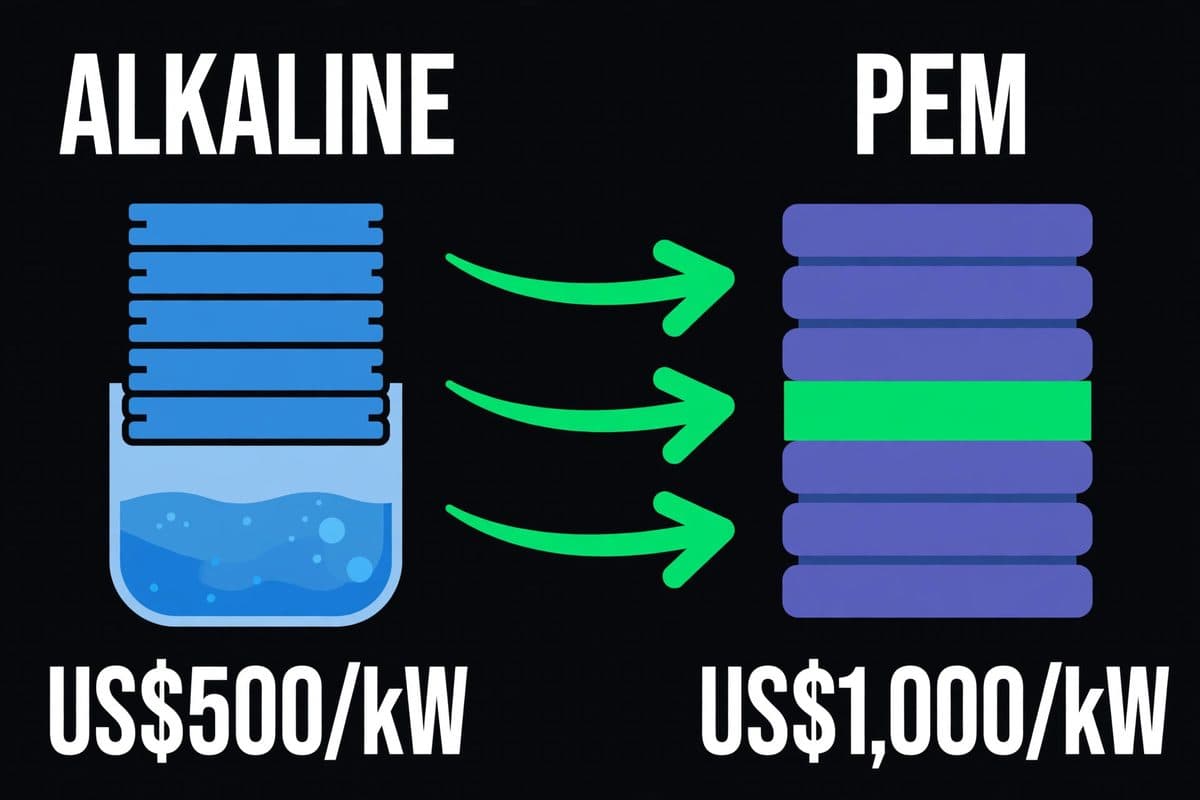
- Alkaline systems cost about half as much per kilowatt as PEM, US$500 against US$1,000 uninstalled, with stacks lasting 60,000 hours against 40,000.
- PEM earns its premium only where low-load operation, fast ramping or high-pressure output carries real value.
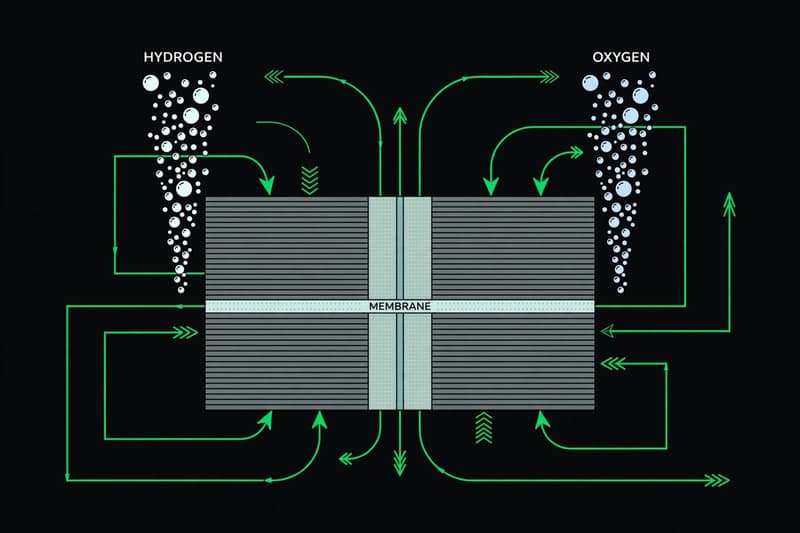
PEM vs alkaline electrolyzer: two ways to split water into hydrogen and oxygen using electricity. A PEM electrolyzer uses a solid polymer membrane with precious-metal catalysts, while an alkaline electrolyzer uses a liquid potassium hydroxide solution with nickel electrodes. The choice shapes a project’s cost, stack lifetime and flexibility.
Any PEM electrolyzer vs alkaline electrolyzer decision is a capital allocation choice before it is an engineering one. The two machines do the same job, but they price very differently across a project life: one demands more money up front and at every stack change, while the other needs patience when renewable power dips. The right pick depends on the power profile, electricity prices, and planned operating life.
Alkaline electrolysis is the older of the two, in commercial use for decades, while PEM scaled up with the renewable hydrogen build-out. Global deployment hit a record 4 GW in 2025, up from nearly 300 MW five years earlier, per the International Energy Agency.
PEM electrolyzer vs alkaline electrolyzer on cost and efficiency
The US Department of Energy publishes technical targets for both technologies, updated 29 May 2026. At 2022 status, an alkaline system costs US$500 per kW uninstalled against US$1,000 per kW for PEM, and the stack alone costs US$250 per kW against US$450. Stack lifetime is 60,000 operating hours for alkaline and 40,000 for PEM. System electricity use is identical at 55 kWh per kilogram of hydrogen, and stack use is identical at 51 kWh per kilogram. Hydrogen production cost sits above US$2 per kg for alkaline and above US$3 per kg for PEM, at electricity at or below US$0.03 per kWh and availability above 90%.
The Department’s tables exclude installation, engineering, procurement, construction and permitting, so the gap widens once installation is added. A separate Department cost record dated 20 May 2024 models PEM at an installed capital cost of about US$2,000 per kW, roughly double the uninstalled figure, with a levelized cost of clean hydrogen of about US$5 to US$7 per kg in 2022 dollars, without subsidies, at electricity near US$0.03 per kWh and capacity factors of 50 to 75%.
| Measure (DOE 2022 status) | Alkaline | PEM |
|---|---|---|
| Uninstalled system cost | US$500/kW | US$1,000/kW |
| Stack cost | US$250/kW | US$450/kW |
| Stack lifetime | 60,000 hours | 40,000 hours |
| System electricity use | 55 kWh/kg | 55 kWh/kg |
| Load range (peer-reviewed assessment) | Commonly cited 15 to 100% | Theoretically 5 to 120% |
| 2026 cost target | US$250/kW | US$250/kW |
Load ranges come from a 2025 peer-reviewed comparison; the Department targets US$250 per kW and 80,000-hour stacks for both by 2026.
The stack replacement bill that decides lifetime cost
A stack is a consumable, and replacements are where PEM’s cost disadvantage compounds. Take a plant running 8,000 hours a year for 20 years, 160,000 hours in total. An alkaline stack lasting 60,000 hours needs replacing twice, after 60,000 and 120,000 hours. A PEM stack lasting 40,000 hours needs replacing three times. That is Joule Post arithmetic from the Department’s lifetime figures.
The bill follows the same pattern. Two alkaline replacements cost 2 times US$250 per kW, or US$500 per kW over the plant life. Three PEM replacements cost 3 times US$450 per kW, or US$1,350 per kW. On a 100 MW plant, that is US$50 million against US$135 million in stack replacements alone.
What the US$500 per kW gap means for a 100 MW project
A 100 MW plant at the Department’s uninstalled figures costs US$50 million for alkaline equipment and US$100 million for PEM, a US$50 million difference. Installation roughly doubles the equipment figure for PEM, based on the Department’s installed baseline of about US$2,000 per kW.
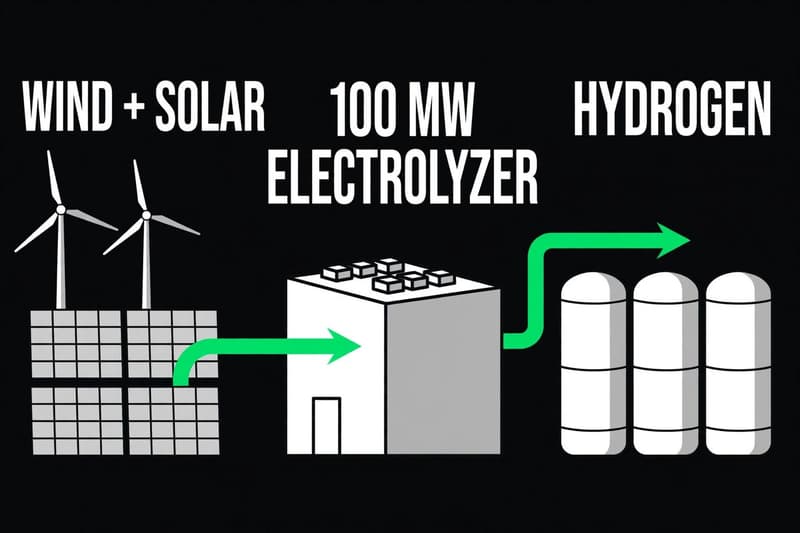
Flexibility is PEM’s answer to that gap. In a hybrid wind and solar profile, suppose about 5% of the year’s energy arrives when output sits between 5% and 20% of nameplate power, the band alkaline cannot use while PEM keeps running. That 5% share is an illustrative assumption. A 100 MW plant at a 50% capacity factor produces about 438,000 MWh a year, or about 7,960 tonnes of hydrogen. Five percent more output is about 400 tonnes a year, worth about US$0.8 million a year at US$2 per kg, the Department’s 2026 hydrogen cost target. That is about US$0.10 per kilogram across total production, or about US$16 million over 20 years. That is Joule Post arithmetic from the Department’s figures and the stated assumption.
That US$16 million sits next to a US$50 million upfront gap and about US$85 million in extra stack replacements. Flexibility would need to be worth roughly eight times this estimate to cover both. That is the core finding: for a typical hybrid wind and solar profile, PEM’s low-load advantage is real but small next to the capital cost difference. The math changes only for far more variable profiles or where the offtaker pays for fast response. Electricity also dominates the hydrogen cost in either case: at US$0.03 per kWh, the 55 kWh per kilogram system use alone costs US$1.65 per kilogram. The same logic applies to the wider choice between making hydrogen and storing electricity, which our comparison of long-duration storage technologies and costs examines in detail.
Three project types justify paying PEM’s premium. First, variable renewable profiles. PEM can in theory run down to 5% of rated load and ramp faster than 10% per second, against an alkaline ramp rate estimated at 0.17 to 0.33% per second, according to the 2025 peer-reviewed comparison. Alkaline cold starts take 30 to 60 minutes in theory; PEM can cold start within 5 minutes. Second, space and pressure. PEM runs at higher current density, 2.0 amps per square centimetre against 0.5 for alkaline, and its hydrogen leaves the system pressurised, which can remove a compression stage. Third, sites where the offtaker values responsiveness, such as grid services or hydrogen turbines that follow power demand. RWE and Kawasaki are testing that kind of hydrogen-capable gas turbine at Lingen, a 34 MW project.
Alkaline keeps the advantage where power is steady and scale is large: hydropower-fed plants, grid-connected projects, and industrial hydrogen. Green ammonia, which converts hydrogen into a shippable fertilizer feedstock, is one of the largest likely buyers of low-cost hydrogen.
The China factor in electrolyzer prices
Geography changes the cost picture. The International Energy Agency estimates Chinese alkaline electrolyzers cost US$500 to US$1,100 per kW in 2025, against US$1,900 to US$2,500 per kW outside China. China hosts nearly 70% of global electrolyzer manufacturing capacity. But cheap equipment does not automatically mean cheap hydrogen. The Agency notes that using a Chinese stack with locally sourced equipment and European construction cuts total project capital cost by only about 8%.
Frequently asked questions
PEM Electrolyzer vs Alkaline Electrolyzer: Which is Better?
Neither wins outright. Alkaline wins on cost for most projects, with half the uninstalled capital cost per kilowatt and stacks that last 50% longer on the Department’s figures. PEM wins where power is highly variable, space is tight, or fast ramping carries a price. The decision follows the power profile and the offtaker.
What are the Differences Between Alkaline, PEM, and AEM Water Electrolyzers?
The three differ in how they move ions. Alkaline electrolysis passes current through a liquid potassium hydroxide solution. PEM electrolysis uses a solid polymer membrane and precious-metal catalysts. AEM combines alkaline chemistry with a membrane design. Alkaline and PEM are proven at industrial scale, while solid oxide and AEM remain in the early stages of industrial application.
How long does an electrolyzer stack last?
The Department’s 2022 status figures give 60,000 operating hours for alkaline stacks and 40,000 for PEM, with a 2026 target of 80,000 hours for both. At 8,000 operating hours a year, that is about 7.5 years for alkaline and 5 years for PEM. That is Joule Post arithmetic from the Department’s lifetime figures.
Does PEM use less electricity than alkaline?
No. At system level both use 55 kWh per kilogram of hydrogen on the Department’s 2022 status figures. PEM’s advantages are flexibility, ramp rate and output pressure, not electricity consumption.
Sources
- U.S. Department of Energy, Technical Targets for Liquid Alkaline Electrolysis, updated 29 May 2026.
- U.S. Department of Energy, Technical Targets for Proton Exchange Membrane Electrolysis, updated 29 May 2026.
- U.S. Department of Energy, Hydrogen Program Record 24005, Clean Hydrogen Production Cost Scenarios with PEM Electrolyzer Technology, 20 May 2024.
- International Energy Agency, What explains the cost advantage of Chinese electrolysers?, 15 October 2026.
- Assessment of transient and steady-state behavioral dynamics in polymer electrolyte membrane and alkaline electrolysis for hydrogen generation, 2025, Institution of Chemical Engineers (Elsevier).