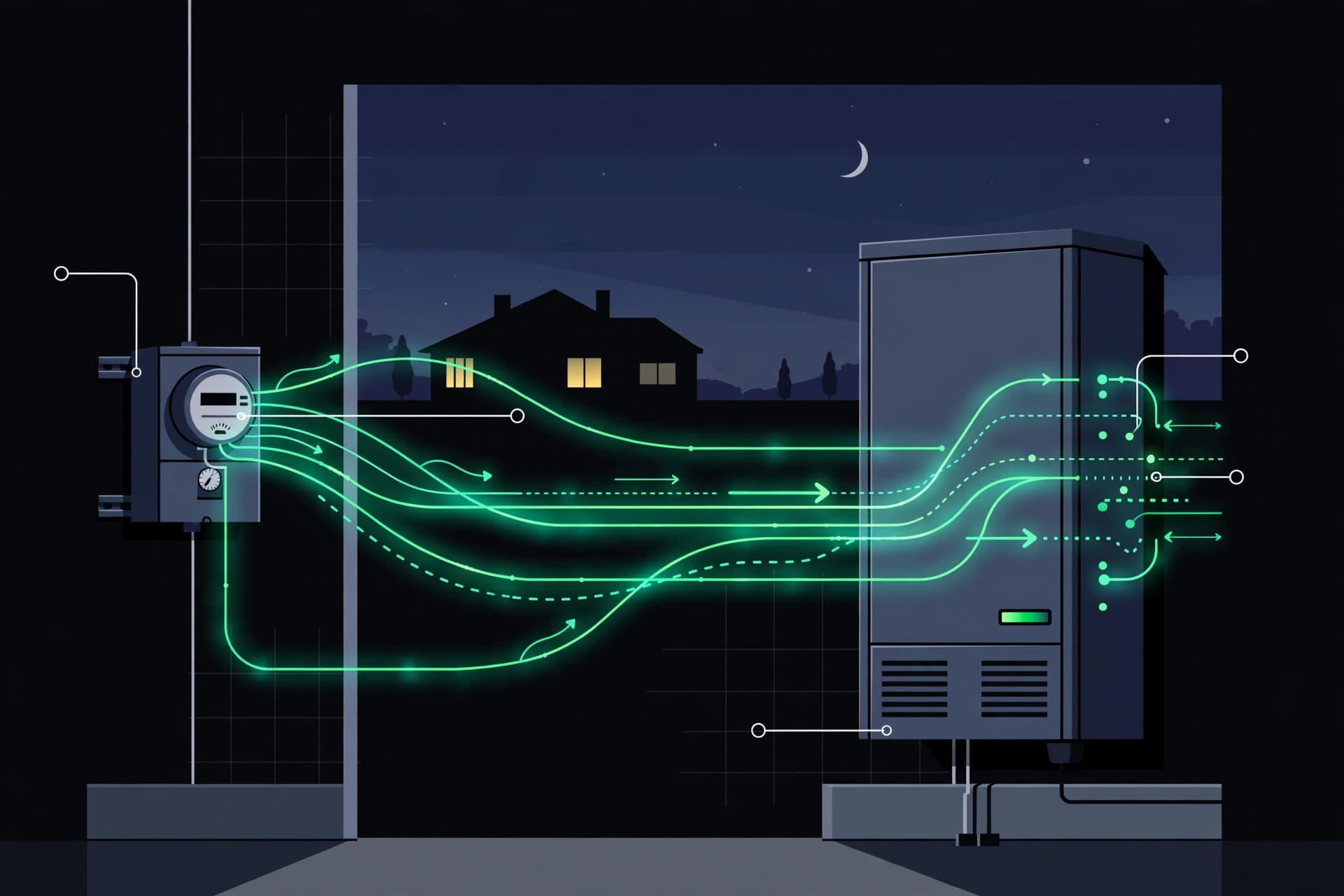
- Yes, you can install a home battery with no solar panels. A standalone battery charges from the grid at cheap off-peak rates and discharges during expensive peak hours, a strategy called time-of-use arbitrage.
- Where time-of-use pricing exists, standalone storage can save roughly $500–$1,500 a year (off-peak $0.10–$0.15/kWh vs. peak $0.40–$0.55/kWh), putting payback at roughly 7–10 years for households that cycle the battery daily on a strong spread; at weaker spreads, payback can stretch well past a decade.
- On flat-rate plans there is almost no bill saving. The value is outage backup. And the 30% federal credit (Section 25D) ended for systems placed in service after December 31, 2025, so 2026 installs pay full price.
Standalone home battery: A rechargeable battery system installed in a home without rooftop solar. It charges from the electrical grid, usually overnight when rates are lowest, and discharges during expensive peak hours to cut your bill, or automatically backs up essential circuits when the grid goes down.
Ask most people what a home battery does and they will tell you it stores solar power. That is only half the story. A home battery without solar panels is a fully supported configuration in 2026: the battery simply charges from the grid instead of from your roof, buying electricity when it is cheap and spending it when it is expensive. The standalone market has grown sharply since 2024 as homeowners chase backup power and bill management independently of panels.
It works. The question is whether the economics work for your house. They turn on three things: your rate plan, your outage risk, and the federal tax credit that quietly expired. The breakdown, with the math shown, follows.
How a home battery without solar panels makes money
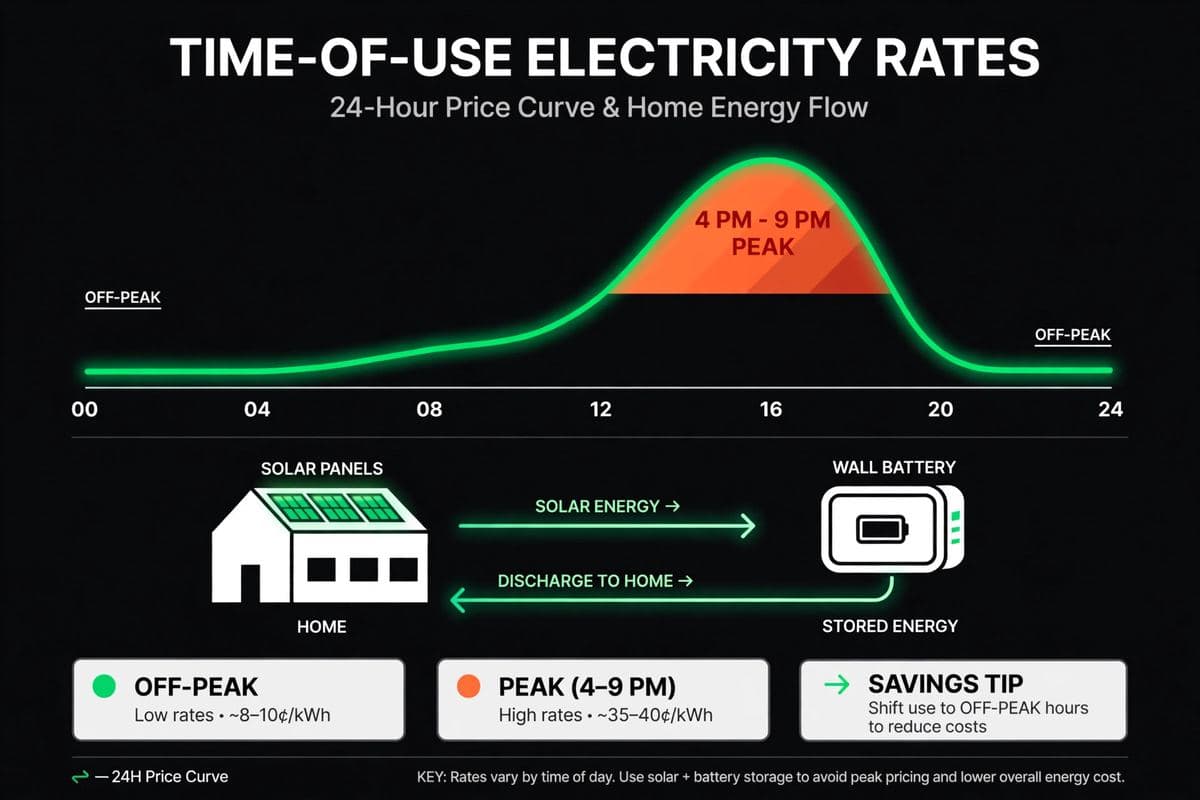
The moneymaking idea is called time-of-use arbitrage, and it is simple enough to explain in one sentence: the battery buys electricity overnight at the off-peak rate and sells it back to your household during the peak window, displacing power you would otherwise buy at the higher price.
EnergyScout’s 2026 market review puts the typical US bands at $0.10–$0.15 per kWh off-peak and $0.40–$0.55 per kWh on-peak, with estimated annual savings of $500–$1,500 for standalone batteries on time-of-use plans. In California, the country’s most mature time-of-use market, peak rates can exceed $0.55/kWh while overnight rates hover around $0.25/kWh, and a 13.5 kWh battery cycling daily saves an estimated $20–$180 per month. That spread is the entire financial case. If your utility charges one flat rate all day, there is no spread to capture, and no bill savings to show for a five-figure purchase.
The payback math, worked out step by step
The numbers, with assumptions stated up front: a 13.5 kWh battery (the Tesla Powerwall 3 class), installed for $13,500, the midpoint of EnergyScout’s $11,500–$15,000 range, cycling once daily, 330 days a year, at 90% round-trip efficiency. Off-peak charging rate: $0.125/kWh (midpoint of the $0.10–$0.15 band). Peak displaced rate: $0.475/kWh (midpoint of the $0.40–$0.55 band). These are US national midbands, not your utility’s actual rates. Substitute yours before trusting the result.
Charging 13.5 kWh of usable energy through a 90%-efficient battery requires drawing 15.0 kWh from the grid (13.5 ÷ 0.90), costing $1.88 per day at $0.125/kWh. Discharging that 13.5 kWh during the peak window avoids buying power at $0.475/kWh, worth $6.41 per day. Net daily gain: $4.54. Over 330 days that is $1,498 a year, squarely at the top of the published $500–$1,500 range, which makes sense: this example assumes a perfect full cycle every day, which real households rarely manage.
| Item | Value |
|---|---|
| Battery class | 13.5 kWh (Tesla Powerwall 3 class) |
| Installed cost | $13,500 (midpoint of EnergyScout’s $11,500–$15,000 range) |
| Off-peak charge rate | $0.125/kWh |
| Peak displaced rate | $0.475/kWh |
| Daily charge cost | $1.88 |
| Daily peak value | $6.41 |
| Net daily gain | $4.54 |
| Annual savings (330 days) | $1,498 |
| Published range (standalone) | $500–$1,500/year |
| Aurora Solar 2026 pricing | ~$1,000–$1,300 per installed kWh |
Payback then equals $13,500 ÷ $1,498 ≈ 9.0 years. That 9.0-year result sits at the top of the published savings range precisely because the example assumes a perfect full cycle every day, which real households rarely manage. On deeper California spreads or a cheaper installed system, the payback shortens toward 7 years. Aurora Solar’s 2026 pricing data, roughly $1,000–$1,300 per installed kWh, implies a similar neighborhood. For comparison, our 50-state analysis found a purchased residential solar system pays back in a median of 16.9 years without the federal credit, while standalone storage on a good rate plan can beat solar on payback, at a much lower upfront cost.
After Section 25D: Why Time-of-Use Rates Still Favor Storage
The single biggest thing that changed for standalone batteries in 2026 is the end of the 30% federal residential clean energy credit (Section 25D) for systems placed in service after December 31, 2025. Batteries of 3 kWh or more were included, so 2026 installs simply pay full price. As our 2026 solar tax credit analysis detailed, that lifted net costs roughly 40% overnight for homeowner-purchased systems while equipment prices barely moved. A $13,500 battery that would have cost $9,450 after the credit now costs the full $13,500, adding two to three years to any payback calculation.
At the same time, the other side of the ledger has been improving. The average US home endured 7.8 hours of outages in 2024, up from 5.4 hours in 2020, and 95% of power interruptions last under 24 hours, squarely within what a 10–14 kWh home battery covers for essential loads (fridge, lights, Wi-Fi, phone charging, medical devices) for 24–36 hours. Modern batteries hand over in under 20 milliseconds, faster than your clocks notice, versus 10–30 seconds for a generator to start. The economic case got harder while the reliability case got stronger. That tension is what every buyer is really deciding.
Who should buy one, and who should not
Three household profiles cover nearly everyone asking this question.
The time-of-use arbitrageur: yes, run the numbers
You are on a time-of-use or time-varying rate plan, common in California, Arizona, Connecticut, Massachusetts, and New York, with a peak-to-off-peak ratio of roughly 2× or more. You do the payback math above with your actual rates, cycle the battery daily, and check whether it lands under about 10 years. If your roof is shaded, north-facing, too old for panels, or you rent, this is your main path to energy bill management: the choice is not battery-versus-solar, it is battery-versus-nothing.
The flat-rate household: almost certainly not, for savings
Your utility charges one rate regardless of hour. There is no spread to arbitrage, so a standalone battery saves you essentially nothing on bills. The purchase price never pays back through electricity savings. If you are considering it anyway, be honest that you are buying outage insurance. Compare it against a $3,000–$8,000 generator (fuel, maintenance, noise, exhaust included) and decide what a silent, instant, zero-maintenance switch is worth to you.
The outage-prone household: yes, as insurance, not an investment
You live where the grid fails repeatedly (wildfire country, storm belts, rural lines) or you run medical equipment or a home business that cannot stop. A 10–14 kWh system covers essentials for 24–36 hours; a 27–40 kWh system (two Powerwalls or equivalent) backs up the whole home including HVAC. Judge this purchase the way you judge insurance: on what the outage would cost you, not on a payback year. Confirm which circuits the installation actually backs up before signing. Not every battery install provides backup.
What a standalone system costs in 2026
Expect $8,000–$20,000 fully installed for a single-battery system this year, with Aurora Solar’s 2026 survey centering the typical range at $8,000–$15,000. Roughly half the cost is the battery unit itself; the rest is labor and electrical work, the smart gateway or panel, permits, and possibly a main panel upgrade ($1,500–$3,000) if your home still has an older 100-amp service. Modular systems like the 5 kWh Enphase IQ Battery 5P start around $7,500 installed and can scale to 60 kWh by stacking, which makes them the cheapest entry point.
One timing note matters: if you plan to add solar eventually (a re-roof first, an approval in progress), the battery can integrate with panels later without replacing equipment. Installing panels first also keeps more incentive doors open. If you want the full picture of how panels and batteries interact, our explainer on how battery storage works and the guide to how solar panels generate electricity are worth reading side by side with this one.
Frequently asked questions
Are solar batteries worth it without solar panels?
Sometimes. It depends entirely on your rate plan. On time-of-use pricing with a strong peak-to-off-peak spread, a standalone battery can save $500–$1,500 a year and pay back in roughly 7–10 years for households that cycle it daily; on thin spreads, payback stretches far longer. On a flat-rate plan, bill savings are near zero and the purchase is better judged as outage insurance.
Can you install a home battery without solar panels?
Yes. Most modern home batteries, including the Tesla Powerwall 3, Enphase IQ Battery 5P, and FranklinWH aPower series, are designed to charge from the grid with no panels attached. The battery charges overnight at cheap off-peak rates and discharges during expensive peak hours or outages.
Is it worth getting a home battery without solar?
The 2026 answer is narrower than it used to be: the 30% federal tax credit ended for systems placed in service after December 31, 2025, so you pay full price. Without solar you are arbitraging a tariff spread rather than storing free energy, so payback is longer. But on the right rate plan or in outage-prone areas, it still holds up.
Can you have battery backup without solar?
Yes. Backup is one of the two jobs a standalone battery does, and the one that needs no rate-plan math. The average US home experienced 7.8 hours of outages in 2024, and a 10–14 kWh battery covers essential loads for 24–36 hours with a switchover under 20 milliseconds. Just verify the install includes a backup gateway and which circuits stay powered.