- Ireland’s RESS 6 auction provisionally backed 1,367 MW of solar across 22 projects, plus 188 MW of onshore wind, enough clean power for more than 450,000 homes.
- Wind undercut solar on price: €99.35 per MWh against €102.42 for solar, a rare inversion in a European renewables auction.
- Almost another gigawatt of solar was turned away, and the results stay provisional until finalisation on 9 December 2026.
EirGrid published provisional figures for the Ireland solar auction RESS 6 on 25 November 2026, the first round decided under the European Union’s Net-Zero Industry Act, with bids ranked on resilience and grid integration as well as price. It is the largest round of the scheme since RESS 2, and it keeps Ireland on course for its 8 GW solar target for 2030, with almost 3.5 GW installed today.
Solar dominated the capacity, taking 1,367.24 MW of the 1,555.29 MW provisionally approved, while wind beat solar on price at €99.35 per MWh against €102.42. A second calculation sharpens the picture: the solar projects’ deemed energy of 1,317.48 GWh against 1,367.24 MW of capacity implies a capacity factor of about 11%, which is the arithmetic of Irish weather rather than a flaw in the auction.
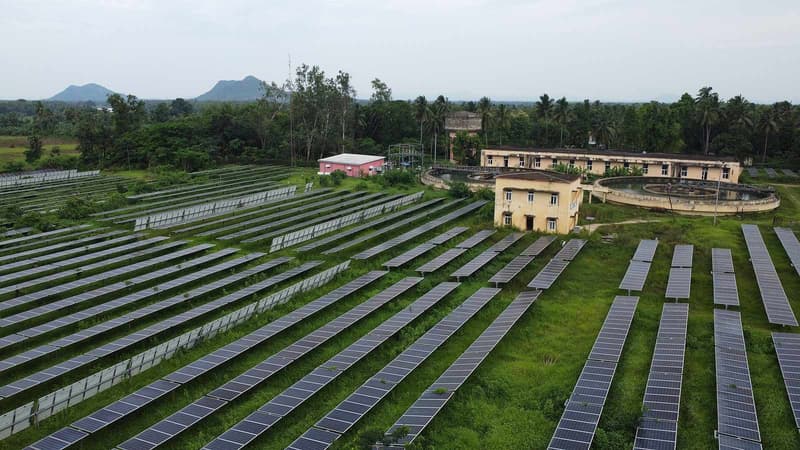
Solar took nearly nine-tenths of the capacity on offer
Solar supplied 22 of the 28 provisionally successful projects and 88% of the approved capacity. Onshore wind managed six projects totalling 188.05 MW. The split continues a pattern visible across the RESS rounds: solar developers enter in volume and deliver at pace, while wind participation has thinned. O’Brien said directly that onshore wind is being “outpaced by solar developments” and that greater wind participation is needed, pointing to regional renewable electricity allocations and faster planning and grid connection as the fix.
| Technology | Capacity approved | Projects | Deemed energy | Weighted average price |
|---|---|---|---|---|
| Solar | 1,367.24 MW | 22 | 1,317.48 GWh | €102.42 per MWh |
| Onshore wind | 188.05 MW | 6 | 576.56 GWh | €99.35 per MWh |
| Total | 1,555.29 MW | 28 | 1,894.04 GWh | — |
The total is about 59% larger than RESS 5, which provisionally approved 860 MW in September 2025. The government release puts the round at more than 1,800 GWh of clean power, and EirGrid’s detailed figures give 1,894.04 GWh. Most of the successful solar projects sit in the east of the country, near County Meath, where Ireland’s first utility-scale solar farm switched on in 2022. Soleire Renewables and Harmony Solar were the most prolific developers by project capacity.
Wind undercut solar on price
The price result is the more surprising half of the auction. Wind’s weighted average offer of €99.35 per MWh came in €3.07 below solar’s €102.42. In most European auctions of the past five years solar has been the cheaper technology, so a wind discount, even a small one, is worth noting. One plausible reading is that Irish wind sites, with strong Atlantic wind resources, can bid keenly, while Irish solar carries the cost of a low capacity factor. The auction offers no project-level breakdown, so that reading stays an interpretation rather than a proven cause.
Support under RESS works as a two-way contract for difference: generators receive support only when market prices fall below the agreed level, and they repay money to electricity customers when market prices run high. Every project must also pay at least €2 per MWh into a Community Benefit Fund. The RESS 6 projects will contribute about €56.82 million over the life of the scheme, or roughly €3.78 million a year, to the communities hosting them.
What €102.42 per MWh says about Irish solar costs
The solar price deserves a comparison rather than a verdict on its own. Britain’s Allocation Round 7 auction, announced on 10 February 2026, cleared solar at £65.23 per MWh (pounds sterling) in 2024 prices. The two prices sit in different currencies, so a direct comparison needs a common unit. On the US-dollar figures published alongside each price, Irish solar comes in at about US$112.1 per MWh against about US$89.0 per MWh for British solar, a gap of roughly 26%. That gap is the cost of Irish conditions: the same panel in Ireland produces about 11% of its rated output over a year, against materially higher yields in sunnier markets, so each megawatt-hour carries more capital cost.
| Auction | Solar price | US-dollar equivalent as published | Solar capacity awarded |
|---|---|---|---|
| Ireland RESS 6, November 2026 | €102.42 per MWh | About US$112.1 per MWh | 1,367 MW |
| Britain AR7, February 2026 | £65.23 per MWh | About US$89.0 per MWh | 4,900 MW |
The comparison also shows why Ireland keeps buying solar despite the higher price. The country has more than 3 GW of solar installed and expects to pass 3.3 GW by the end of 2026, against the 8 GW target for 2030. That leaves about 4.7 GW to build in four years, and RESS 6’s 1.37 GW covers roughly 29% of that gap in a single round. Almost 6.3 GW was contracted under the first five RESS auctions, and the scheme has enabled about 2.35 GW of onshore wind and solar to be energised so far, which means the pipeline from contract to connection still runs well behind the awards.
The gigawatt Ireland turned away
The auction’s sharpest criticism came from the industry it is meant to serve. Solar Ireland chief executive Ronan Power noted that 977.67 GWh of solar was provisionally unsuccessful, just under 1 TWh, and said Ireland had effectively “said no to a further 1 GW of solar capacity”. Four projects did not qualify, all of them solar, and 13 withdrew, six solar and seven wind.
Power’s caution goes beyond the headline. “The priority now must be to turn provisional awards into renewable electricity projects on the ground,” he said. “We should judge the outcome not only by the capacity awarded, but by the capacity that is ultimately built and connected.” His warning points at the framework’s cost and risk for developers, and at the projects that were unsuccessful or withdrew. The minister’s own statement accepts part of the point: delivery rates, planning and grid connection all need to accelerate if the wind shortfall is to close.
What happens next
RESS 6 is the first round to apply non-price criteria under Article 26 of the European Union’s Net-Zero Industry Act. Offers were ranked by a Composite Evaluation Score combining price, resilience and energy-system integration, rather than price alone. EirGrid’s chief operations officer Michael Kelly said the broader approach matters because the grid must safely absorb the new capacity, not simply count it.
The results remain provisional. Finalisation is due on 9 December 2026, with notice of awards scheduled for 11 January 2027. Until then the 1,367 MW is a commitment in waiting, and the test Power set, capacity actually built and connected, will take years to answer. Ireland’s solar build-out has momentum, with a second-largest auction and a clear path to a third of its remaining 2030 gap in one round. The open question is whether the wind pipeline, and the grid that serves both technologies, can keep up.
For readers weighing rooftop solar against the grid-scale build-out, our guide to utility-scale solar farm costs per MW sets out what large projects cost to build, and our coverage of the EU renewable energy permitting deal explains how approval times are being cut across the bloc. The UK’s own record solar year is covered in our report on 270,000 rooftop installations in 2026.
Sources
- Department of Climate, Energy and the Environment (gov.ie), “Minister O’Brien welcomes results of sixth national auction for new onshore wind and solar energy projects”, 25 November 2026. gov.ie
- pv magazine, “Ireland approves 1,367 MW of solar in sixth renewables auction”, 25 November 2026. pv-magazine.com
- UK Parliament (Hansard), “Contracts for Difference: AR7 Solar and Onshore Wind Results”, written statement HCWS1318, 10 February 2026. hansard.parliament.uk
- India Renewable Energy News, “UK Awards Record 4.9 GW Solar Capacity in Latest CfD Auction Round”, 24 November 2026 (US-dollar conversion of the AR7 solar price). indiarenews.in