- Classic net metering credits exports at the full retail rate, while net billing pays avoided cost, commonly 4 to 8 cents per kWh.
- At a 4.5-cent export credit, lifting self-consumption from 35 percent to 80 percent raises annual value for a 9,000 kWh system from about $830 to about $1,377.
- Batteries gain value from the gap between retail and export rates, and grandfathering can lock current rules for 20 years.
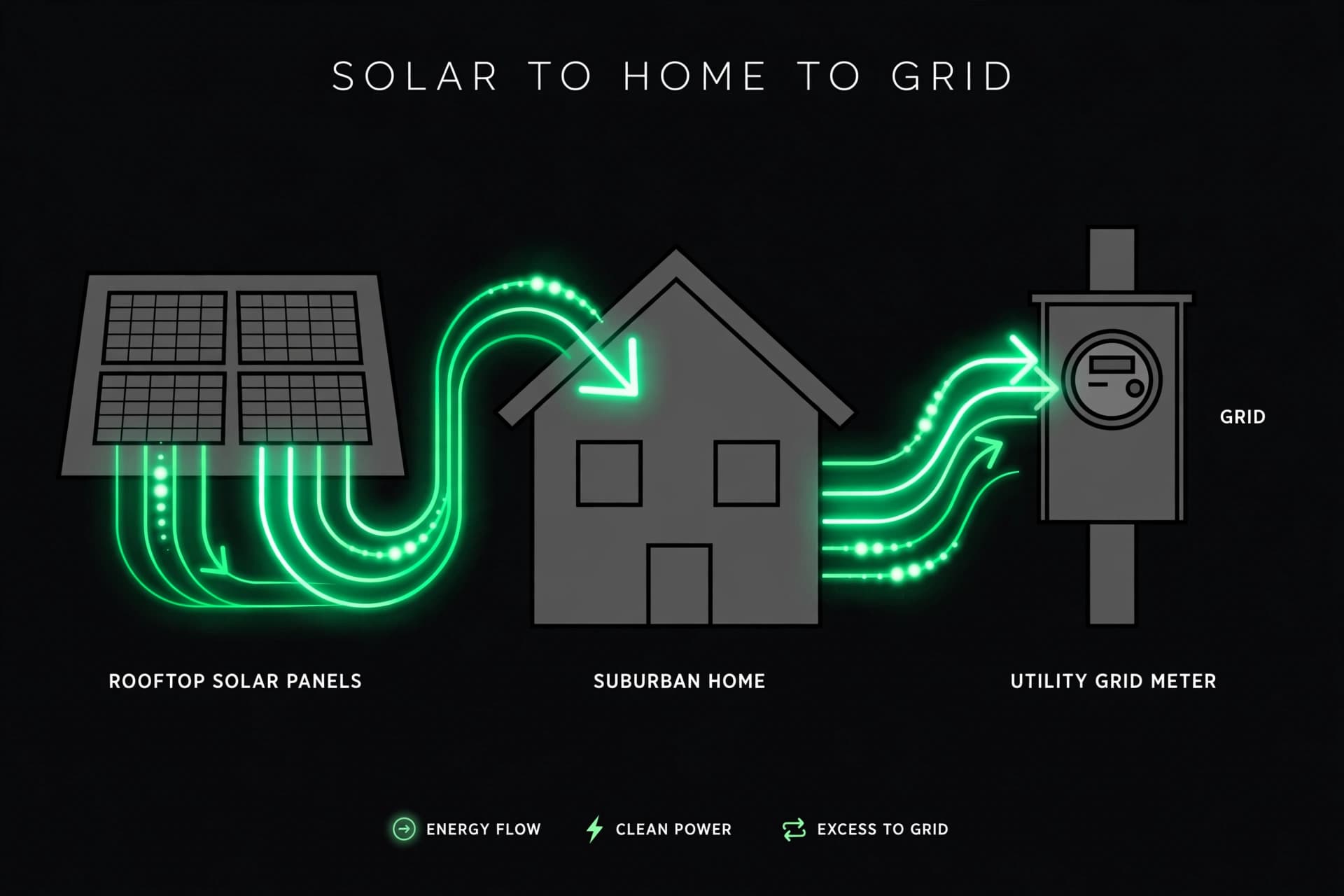
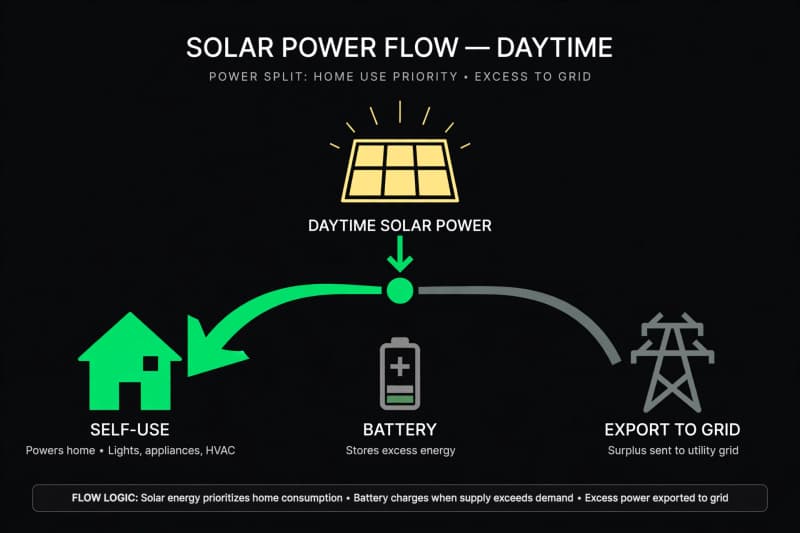
Net metering vs net billing: Under net metering, each kilowatt-hour sent to the grid earns credit equal to the retail electricity price. Under net billing, exports earn a lower wholesale or avoided-cost value, so households gain more by using solar power at home than by exporting it.
The practical response is to use more solar power at home or store it: shifting consumption into daylight hours and adding storage keeps more value than exporting most of the output at the avoided-cost rate.
That shift matters because export value is no longer a fixed reward for producing solar power. Households that use most of their solar electricity at home keep more value than households that export most of it during the middle of the day. The rules vary by utility and state, so the same rooftop system can produce very different annual savings in two neighbouring service territories.
Net metering vs net billing: how the credit is calculated
Under classic net metering, the meter effectively ran in both directions at the retail rate. A kilowatt-hour exported during the day cancelled a kilowatt-hour bought at night, at the same price. The system rewarded total production, and the time of production mattered less than the annual total.
Net billing breaks that symmetry. Exports are credited at the avoided cost rate, which reflects what the utility avoids paying for generation when solar power reaches the grid. According to the EcoEnergyCalc comparison of net metering and net billing, that credit commonly falls between 4 and 8 cents per kWh. The household still pays the full retail rate for grid electricity it uses, so exported power is worth far less than power used at home.
That difference reshapes solar design. South-facing panels that maximise midday exports made sense when exports earned retail credit. Under net billing, west-facing panels, load shifting, and storage can matter more, because they move solar electricity into hours when the household actually uses power. For background on the technology itself, see how solar panels convert sunlight into electricity.
| Feature | Classic net metering | Net billing |
|---|---|---|
| Export credit | Full retail rate, 1:1 | Avoided cost, commonly 4 to 8 cents per kWh |
| What earns most value | Total annual production | Electricity used at home |
| Battery value | Mainly backup power | Backup power plus avoided low export credits |
| Main risk | Policy change at the end of grandfathering | Low export value for midday surplus |
California and Arizona show the size of the change
California’s NEM 3.0 took effect in April 2023 and in the EcoEnergyCalc summary cited above, cut export credits by roughly 75 percent on average for new customers, with the exact credit varying by utility, time and season. The NEM 3.0 export rate therefore sits far below the retail rate that earlier customers received under classic net metering. New California systems still save money, but the savings depend heavily on self-consumption and storage, rather than on exporting large midday surpluses.
Arizona shows a milder version of the same pattern in the examples cited. Arizona Public Service credits excess generation at roughly half the retail rate. That is a smaller cut than California’s, but it still creates a clear incentive to use solar power at home instead of exporting it. Homeowners comparing quotes should check the Federal Trade Commission guidance on solar power for your home before signing, and should ask installers to show savings under the current tariff, not under an older net metering tariff.
For a closer look at the California rules, see how California’s NEM 3.0 rules changed solar payback in 2026.
What a 4.5-cent export credit does to a 9,000 kWh system
The EcoEnergyCalc worked example makes the arithmetic concrete. Take a system that produces 9,000 kWh per year in a market where retail electricity costs 18 cents per kWh and the export credit is 4.5 cents per kWh. At 35 percent self-consumption, the household uses 3,150 kWh at home, worth $567 at the retail rate, and exports 5,850 kWh, worth about $263. Total annual value is about $830, a blended rate of 9.2 cents per kWh produced.
At 80 percent self-consumption, the same system uses 7,200 kWh at home, worth $1,296, and exports 1,800 kWh, worth about $81. Total annual value rises to about $1,377, a blended rate of 15.3 cents per kWh produced. The panels produce the same electricity in both cases. The solar export credit stays at 4.5 cents in both cases. The difference comes entirely from how much solar power the household uses directly.
| Self-consumption | Used at home | Exported | Annual value | Blended rate |
|---|---|---|---|---|
| 35 percent | 3,150 kWh, $567 | 5,850 kWh, $263 | About $830 | 9.2 cents per kWh |
| 80 percent | 7,200 kWh, $1,296 | 1,800 kWh, $81 | About $1,377 | 15.3 cents per kWh |
A Joule Post calculation from those stated figures shows the gap in a second way. A household exporting 5,000 kWh per year would earn $900 at a full 18-cent retail credit, and $225 at a 4.5-cent net billing credit, a gap of $675 per year. Held flat for arithmetic illustration over a 20-year grandfathering window, that annual gap totals $13,500. Rates will change over such a period, so that total is an illustration of scale, rather than a prediction. The point stands in any single year: under net billing, each exported kilowatt-hour leaves most of its retail value on the table.
Why batteries are worth more under net billing
A battery earns its keep under net billing by moving solar electricity from low-value export hours to high-value use hours. The EcoEnergyCalc example puts the gap between retail and export rates at 13.5 cents per kWh, from 18 cents minus 4.5 cents. Shifting 4,000 kWh per year through a battery at that gap is worth about $540 per year in avoided grid purchases, before battery costs, losses, and degradation. Because the avoided cost rate sits well below retail, every kilowatt-hour shifted avoids a full-price purchase and avoids a low-price export at the same time.
Battery sizing still needs care. A battery that is too large may sit partly unused in winter, while a battery that is too small will leave evening loads on grid power. Households should size storage around evening consumption, outage needs, and the export gap in their own tariff. See how to size a home battery for outages for the outage side of that decision.
Grandfathering also changes the calculation. Grandfathering commonly locks the policy in place for 20 years for customers who install before a rule change. A household that qualifies for classic net metering can therefore keep retail export credits long after new customers move to net billing. A household that misses the deadline faces the new export rate for the life of the system. The installation date, the utility tariff sheet, and the written grandfathering end date matter as much as the panel wattage.
How to find out which system applies to you
Start with the electricity bill and the utility tariff sheet, rather than with a sales quote. Look for the export credit in cents per kWh, the retail rate, and any time-of-use periods. Ask the utility or installer for the solar export credit in cents per kWh, and ask for the rate schedule that applies to new systems. In California, the NEM 3.0 export rate for new customers will differ sharply from the rate shown in older marketing material.
Next, check three dates: the date the system is approved for interconnection, the date any grandfathering period ends, and the date the utility can next revise the tariff. Then model savings at the current export credit, and again at a lower export credit, to see how sensitive the payback is to policy. A system that only pays back under retail export credits is a riskier purchase under net billing than a system that pays back through self-consumption alone.
Frequently asked questions
What is the difference between net metering and net billing?
Net metering credits solar exports at the full retail electricity price, so one exported kilowatt-hour offsets one purchased kilowatt-hour. Net billing credits exports at a lower avoided-cost value, commonly 4 to 8 cents per kWh, so using solar power at home is worth more than exporting it.
Does net billing make solar not worth it?
Net billing lowers the value of exports, but it does not remove the value of solar power used at home. Systems with high self-consumption, load shifting, or storage can still save substantial money. The worked example above shows about $1,377 per year at 80 percent self-consumption, compared with about $830 at 35 percent self-consumption, for the same 9,000 kWh system.
How do I find out if I have net metering or net billing?
Check the electricity bill and the utility tariff sheet for the export credit in cents per kWh. Compare that credit with the retail rate: a credit equal to retail points to net metering, while a credit far below retail points to net billing. Confirm the answer with the utility, and ask for the grandfathering end date in writing.
Should I add a battery under net billing?
A battery helps most when the gap between retail and export rates is large and evening consumption is high. At a 13.5-cent gap, shifting 4,000 kWh per year is worth about $540 per year in avoided purchases, before costs and losses. Compare that annual value with the battery price and expected life before deciding.
—