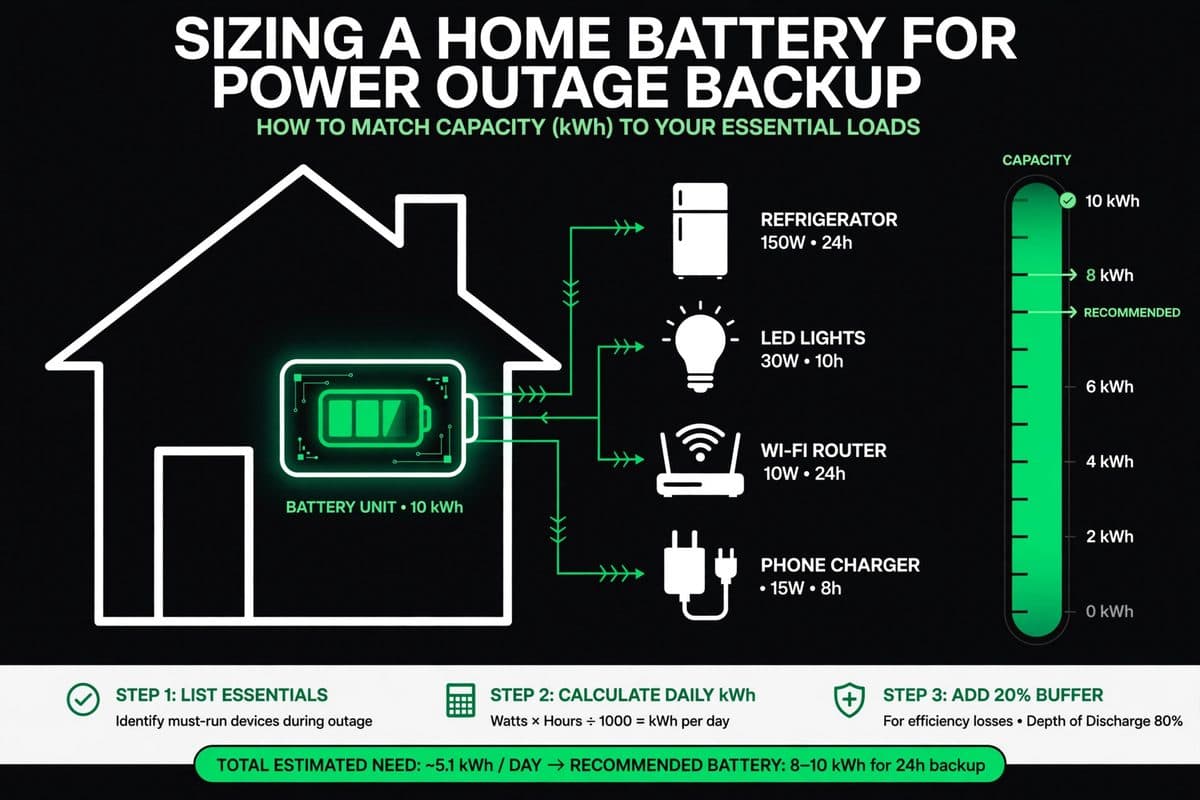
- Two numbers decide what size home battery you need for a power outage: capacity (kWh) sets how LONG backup lasts, and inverter output (kW) sets HOW MANY loads can run at once.
- A 10 kWh battery keeps essential loads (fridge, lights, Wi-Fi) running for roughly a day, but only a few hours if you try to run central air conditioning.
- The average US home uses about 30 kWh per day, but essential loads need only 3–10 kWh/day, so most outage plans are far smaller than people expect.
Usable capacity: The amount of electricity a home battery can actually deliver, measured in kilowatt-hours (kWh). It is always less than the advertised “nameplate” rating because of depth-of-discharge limits, inverter conversion losses, and battery-reserve settings. Modern lithium batteries deliver roughly 90–100% of nameplate as usable energy; older lead-acid units deliver only about 50%. Usable kWh, not nameplate, is the number that sets your backup time.
What size home battery do you actually need for a power outage? Start with the single most common sizing mistake: buying for your whole home’s daily consumption when an outage only needs your essentials. The average US home uses roughly 30 kWh per day, but the loads that must stay on during a blackout (refrigerator, lights, Wi-Fi, phone charging, a few outlets) typically draw only 3–10 kWh per day. Sizing to the first number buys you a system two to three times bigger than you need.
The sizing math itself is straightforward. Backup time equals usable battery energy divided by average backup load. A battery with 9 kWh of usable energy running essential loads at 500 W lasts 18 hours; the same battery at 1.5 kW of load lasts 6 hours, which is the division backup time equals usable energy divided by average load. Two homes with the same battery get very different results: the loads, not the battery, are the variable that matters.
Capacity vs output: the two numbers that size your battery
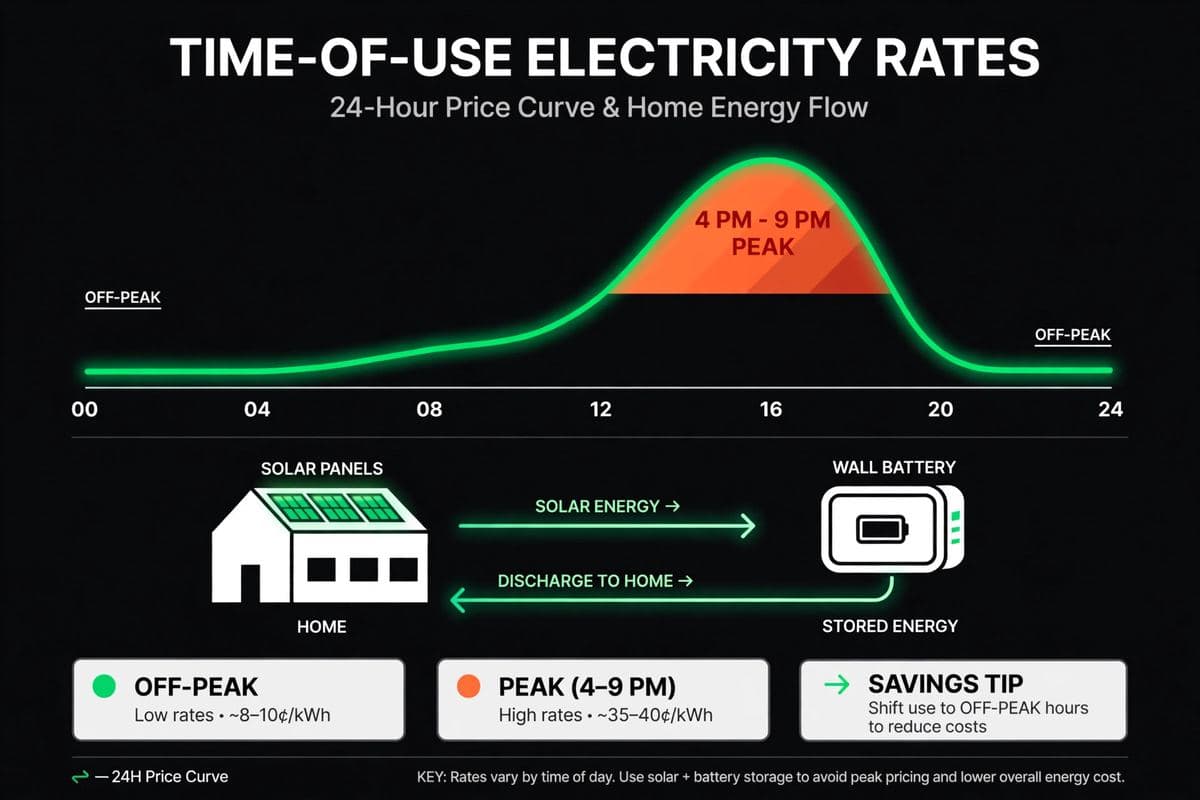
Every home battery carries two headline ratings, and confusing them is the second most common sizing mistake. Capacity, measured in kilowatt-hours (kWh), sets how LONG your backup lasts (the size of the fuel tank). Inverter output, measured in kilowatts (kW), sets HOW MANY loads can run at once (the width of the fuel line). A big tank with a narrow line cannot start your air conditioner’s compressor; a wide line with a small tank runs everything briefly and dies.
The average residential battery today sits around 10–13.5 kWh of capacity, according to EnergySage’s sizing guide. One unit in that range keeps essential loads running through the typical outage; two units (roughly 20–27 kWh) covers overnight comfort loads and buys a full day of family backup; going fully off-grid takes eight to twelve units or more. On the output side, central air conditioning draws 3–5 kW or more continuously and needs a large surge allowance for compressor startup, which is why whole-home backup including HVAC roughly doubles the battery requirement and demands a high-output inverter, not just more kilowatt-hours.
How long does a home battery last in an outage? Worked examples
Take a concrete household: 30 kWh/day total consumption, with essentials running at about 8 kWh/day (roughly 330 W average). A single ~13 kWh-class battery, the size of a Tesla Powerwall 3-class unit, delivers about 12 kWh usable after efficiency and reserve losses, covering those essentials for roughly a day and a half, or comfortably through a typical overnight outage. Double it to ~27 kWh and you approach full-day whole-home coverage without HVAC; add central air conditioning at 3–5 kW continuous draw and the same battery bank shrinks to a handful of hours.
A published sizing table makes the pattern concrete. At 10 kWh of capacity: light essential loads (300 W) run 24–30 hours; moderate loads (800 W) run 9–11 hours; heavy loads (2 kW) run 3.5–4.5 hours. At 30 kWh: the same three load levels run 72+ hours, 28–34 hours, and 11–13 hours respectively. The relationship is linear and unforgiving — every kilowatt of load you add subtracts hours from the same battery.
| Battery size | Light loads (300 W) | Moderate loads (800 W) | Heavy loads (2 kW) |
|---|---|---|---|
| 10 kWh | 24–30 hours | 9–11 hours | 3.5–4.5 hours |
| 30 kWh | 72+ hours | 28–34 hours | 11–13 hours |
| Backup goal | Battery range | What it runs |
|---|---|---|
| Essentials, short outage | 5–10 kWh | Fridge, lights, Wi-Fi, phones |
| Essentials overnight | 10–15 kWh | Above + freezer, TV, security |
| Family comfort, 24 h | 15–25 kWh | Essential panel + some appliances |
| Whole home + HVAC | 30 kWh+ | Most circuits, AC, pumps |
Usable kWh is the only number that counts
A battery labeled 10 kWh rarely delivers 10 kWh. The usable energy comes from a simple formula: battery capacity × usable depth of discharge × inverter efficiency. A 10 kWh unit at 90% depth of discharge and 92% inverter efficiency delivers about 8.3 kWh, and that is the figure your backup-time math must use. Most modern lithium batteries advertise usable capacity at 90–100% depth of discharge; older lead-acid technology only makes about 50% of its nameplate usable, a relic that still confuses comparison shoppers.
Installer settings matter too: the backup reserve, the floor of charge your system holds for outages, comes straight off the usable total. Knowing how lithium chemistries differ helps here, because depth-of-discharge behavior varies by chemistry. And if you are weighing storage for reasons beyond outages, see whether a home battery without solar panels pencils out for your rate plan.
A day of essentials, or a once-a-decade whole-home event
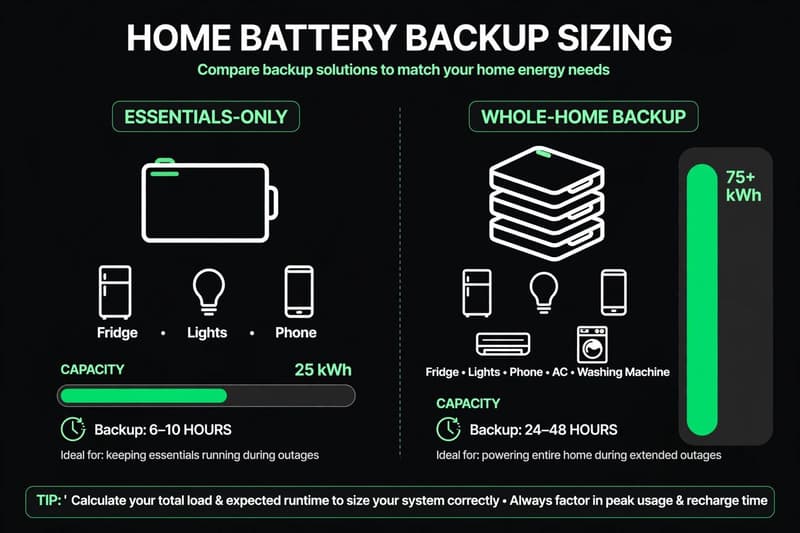
Consider the cost jump: going from essential-load backup (5–10 kWh) to whole-home backup with HVAC (30+ kWh) multiplies the required battery capacity roughly fivefold, and roughly fivefolds the cost, while the outage scenarios most Americans actually experience are the short ones. US outage data consistently shows most interruptions lasting hours, not days. A 10 kWh battery covering essentials for 24–30 hours handles the overwhelming majority of real outages at roughly one-third the price of a whole-home system that only proves its worth in a once-a-decade multi-day event.
The point is to size for the scenario, not the fear. List the loads that must stay on, multiply watts by hours, add a 15–30% reserve margin, and check that your inverter can start the largest motor you plan to run. The basics of energy storage repay a read before you sign, and a quick sanity check of what heavy loads like an EV charger actually draw keeps the essential-loads list honest. The cheapest battery is the one sized to your loads; the expensive one is sized to your anxiety.
Frequently asked questions
How many kWh of battery do I need for a power outage?
For essentials only (fridge, lights, Wi-Fi), 5–10 kWh covers 8–24 hours. For overnight family backup with comfort loads, 10–15 kWh is the practical range. Whole-home backup including HVAC typically needs 30 kWh or more.
Can a 13.5 kWh battery power a whole house during an outage?
It can cover essential loads for about a day and a half, but not a whole house with air conditioning. Whole-home backup with HVAC needs roughly 30 kWh or more, plus an inverter rated for the AC’s 3–5 kW continuous draw and startup surge.
What is the difference between kWh and kW for home batteries?
kWh (kilowatt-hours) is capacity: how much energy the battery stores, which sets backup duration. kW (kilowatts) is power output: how many loads can run simultaneously. You need enough of both: capacity for hours, output for the biggest loads.
Do solar panels recharge the battery during an outage?
Yes, but only if the system is designed for backup operation: a standard grid-tied system shuts down during outages for safety. With a backup-capable inverter and proper islanding equipment, daytime solar can recharge the battery and extend backup across multiple days.
Should I back up essential loads or my whole home?
Essential-load backup is the most common residential choice: longer runtime at lower cost. Whole-home backup costs roughly five times more and mainly pays off for larger homes or multi-day outage exposure. Size to your actual loads and reserve a 15–30% margin.