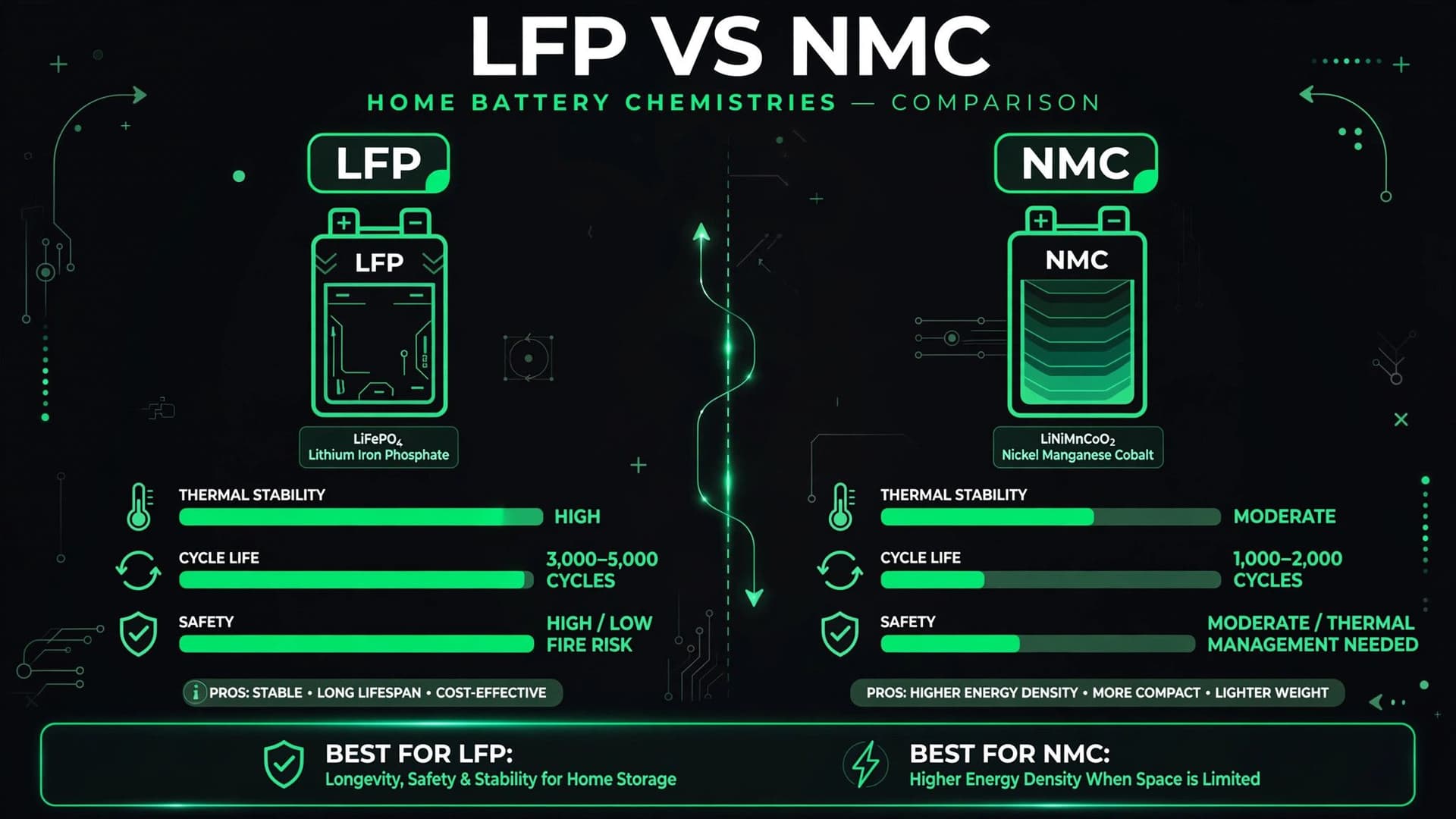
- For home battery backup in 2026, LFP (lithium iron phosphate) is the default pick: its thermal-runaway threshold runs roughly 60–120°C higher than NMC, it releases minimal oxygen on failure, and it delivers 3,000–6,000 cycles against 1,000–2,500 for NMC.
- Warranty coverage settles it: cycling once daily, NMC’s 2,500-cycle ceiling can run out in under seven years, inside a 10-year warranty, while LFP’s range covers the term with years to spare.
- NMC wins only on energy density, so it belongs only in genuinely space-constrained installs. Tesla’s Powerwall, BYD, Enphase and most residential brands have already standardized on cobalt-free LFP.
LFP vs NMC: The two lithium-ion cathode chemistries that appear on home-battery quotes. LFP (lithium iron phosphate) is a cobalt-free chemistry known for heat tolerance and long cycle life; NMC (nickel manganese cobalt) stores more energy per kilogram but runs hotter and ages faster. For a battery mounted on your garage wall, those two differences settle the argument.
Shopping for an LFP vs NMC home battery in 2026 is less of a contest than it looks. The verdict up front: unless your install space is genuinely cramped, buy LFP. It is the safer chemistry, it lasts roughly twice as long under daily cycling, and by 2026 it costs less per stored kilowatt-hour than NMC. Nearly every major residential brand, Tesla, BYD, Enphase and Sungrow, has already made the same call.
That does not make NMC dangerous in any absolute sense. It makes it the wrong tool for a box that sits in your home and cycles every day for a decade. The comparison below breaks down safety, cycle life, and the warranty math most quotes gloss over: what you need to audit any proposal, including the ones still pushing older NMC stock.
LFP vs NMC home battery: the safety gap in actual numbers
Every lithium-ion battery’s thermal behavior and lifespan are governed by the metal oxide structure of its cathode. LFP uses iron and phosphate; NMC uses nickel, manganese and cobalt. That single difference drives what happens when something goes wrong: heat, overcharging, or physical damage.
The numbers: an LFP cathode holds its structure to around 270°C, while an NMC cathode starts decomposing between roughly 150 and 210°C and releases oxygen, which feeds the fire. Under UL 9540A cell-level thermal runaway testing, LFP’s thermal-runaway onset temperature runs roughly 60 to 120 degrees Celsius higher than NMC equivalents, and LFP cells do not release the free oxygen that sustains cathode combustion.
Owner forums, where people run these chemistries in basements and sheds rather than labs, tell the same story in plainer language. One veteran of the DIY Solar Forum’s long-running LFP safety thread notes that LFP “vents below auto-ignition temperature. Requires separate spark to ignite, unlike some chemistries that ‘vent with fire’.” Another member draws the line between car packs and home packs: “LiNMC has the potential for thermal runaway and ignition whereas LiFePO4 on its own does not”, worth remembering when EV-fire headlines spook battery shoppers, since many of those fires involved NMC car packs, not LFP home units.
None of this means professionally installed home batteries are fire-prone. Fire and Rescue NSW recorded only three residential battery-storage fires in 2023 across more than 57,000 installed units. Home storage remains one of the lowest-risk lithium products in the house. Chemistry matters because it sets the margin for error: a safer cathode gives the battery management system more room to intervene before anything becomes dangerous. As one long-time forum moderator summarizes: “LFP, LYFP & LMFP are presently the safest chemistries in use.”
2,500 cycles vs 6,000: the warranty arithmetic
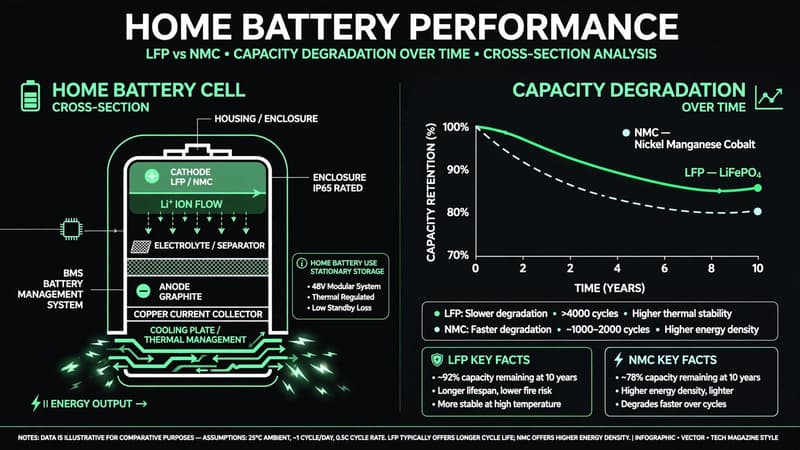
Safety gets the headlines, but cycle life decides the money. At 80% depth of discharge, LFP delivers 3,000 to 6,000+ full cycles; NMC manages 1,000 to 2,500. Translated to calendar years: 10 to 15+ for LFP, 7 to 10 for NMC. Most manufacturers warrant 60 to 70 per cent retained capacity at the end of a ten-year term, a threshold that matters more than it looks, as the next section shows.
Real-world owner data backs the lab figures. In a detailed LiFePO4-vs-NMC forum comparison, one long-time member reports running more than 600 Panasonic NMC cells through 1,000–3,000 near-full cycles over 5–9 years: the worst cells sit at 80% capacity, the best at 95%. That is decent, but the forum’s founder adds the key qualifier: “NMC degrades at a faster rate than LFP when cycled in a similar fashion at the same temperature.” Same use, same temperature, faster fade.
The warranty math installers don’t run for you
No quote includes this comparison. A home battery on a time-of-use plan or backing up solar cycles roughly once a day, about 365 full-equivalent cycles a year. Run the chemistry ratings against that:
- LFP at 6,000 cycles ÷ 365: about 16 years of daily cycling, comfortably past a 10-year warranty.
- NMC at 2,500 cycles ÷ 365: under 7 years: the battery can wear out inside its own 10-year warranty term.
| Metric | LFP | NMC |
|---|---|---|
| Thermal-runaway threshold | ~270°C, minimal oxygen release | ~150–210°C, releases oxygen |
| Thermal-runaway likelihood (abuse test) | ~80% less likely | Baseline |
| Cycle life at 80% depth of discharge | 3,000–6,000+ | 1,000–2,500 |
| Calendar equivalent | 10–15+ years | 7–10 years |
| Daily-cycling warranty arithmetic | 6,000 ÷ 365 ≈ 16 years | 2,500 ÷ 365 = under 7 years |
| Energy density | 90–160 Wh/kg | 150–250 Wh/kg |
| Cobalt content | None | Contains cobalt |
| Cold-weather charging | Needs heating below 0°C | Slightly better in freezing conditions |
This is why the warranty’s fine print beats its headline. Most residential battery warranties terminate at whichever threshold arrives first: the 10-year calendar mark or a total energy throughput cap measured in megawatt-hours (for example, 37.8 MWh on a typical 13.5 kWh unit). Under daily time-of-use cycling, an NMC pack with a lower throughput ceiling can exhaust its warranted megawatt-hours years before the calendar term ends. A daily-cycled NMC unit is exactly the profile that trips a throughput cap. Ask for the datasheet, not the brochure, and check chemistry, cycle rating, and warranty throughput together. The core economic metric is levelized cost per stored kilowatt-hour, not sticker price: a battery that costs 10% more upfront but delivers twice the warranted cycle throughput cuts your lifetime storage cost per kilowatt-hour nearly in half.
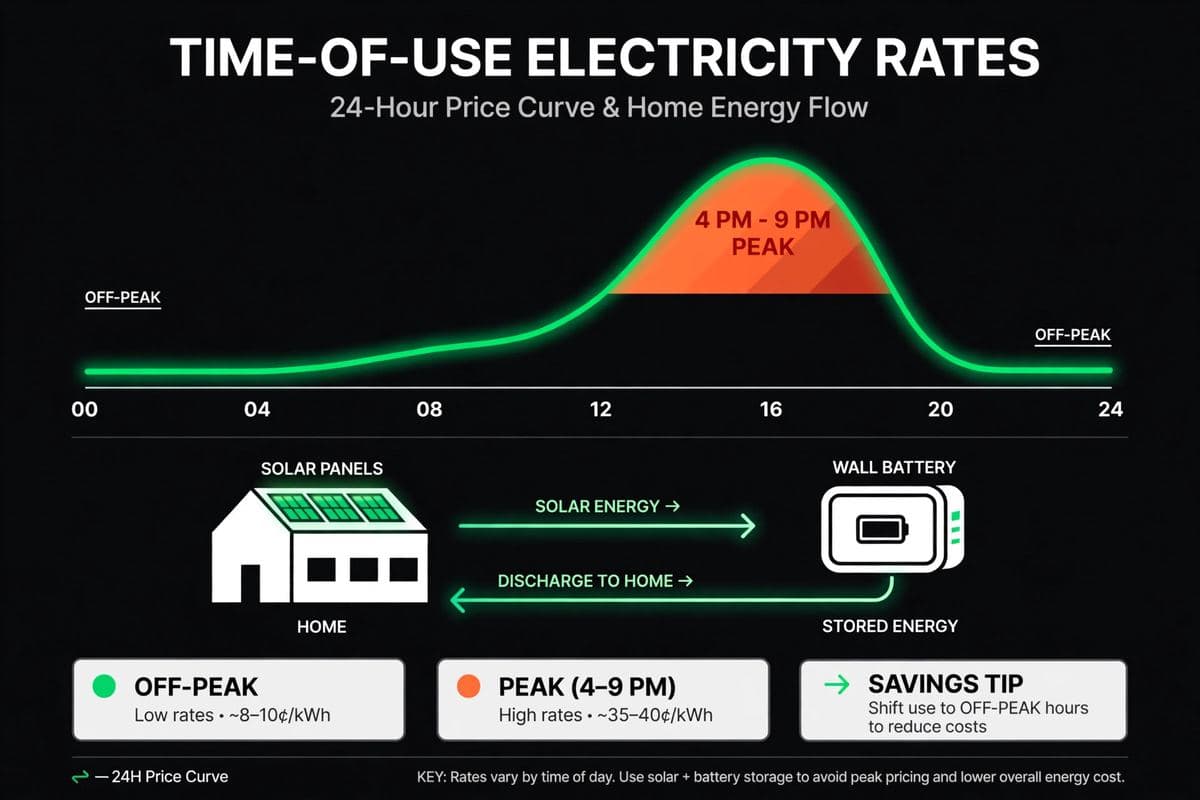
That cost-per-stored-kWh framing is the honest way to compare quotes. If LFP delivers roughly two to two-and-a-half times the cycles at a similar or lower installed price (and in 2026 LFP now costs less per kilowatt-hour than NMC, reversing the position from five years ago), then every kilowatt-hour it stores over its life costs roughly half as much. Standalone batteries that arbitrage time-of-use rates cycle hardest of all, which makes cycle life the dominant variable in that purchase.
The manufacturers already voted; your quote should reflect it
The market verdict is the strongest evidence in this comparison. Tesla moved its Powerwall home-storage range to LFP “precisely because the product sits on a garage wall inside a family home,” and BYD, Sungrow and Sigenergy have done the same. For a deeper look at where each chemistry sits across the storage market, see our explainer on battery energy storage.
That matters for your quote in a concrete way: any 2026 proposal built around NMC is selling you either old stock or a niche product. The question to ask is not “is NMC okay” but “why is this installer quoting a chemistry the manufacturers themselves moved away from for residential use?” Use this baseline vetting rule before signing an installation contract: if a sales representative cannot provide the spec sheet showing the exact cathode chemistry, cycle rating, and megawatt-hour throughput cap, walk away.
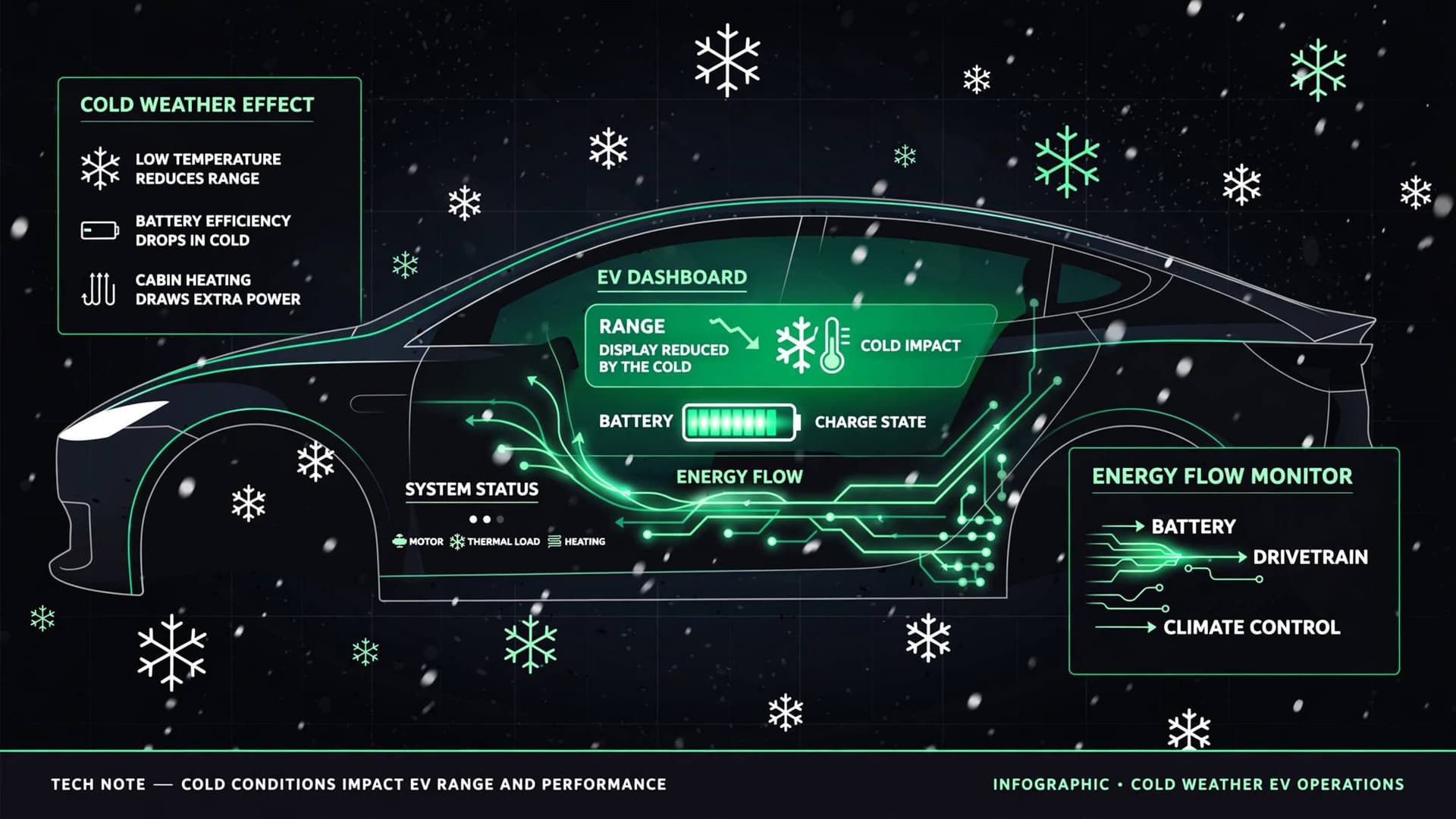
The honest caveat runs the other way: cold. LFP needs heating below 0°C to charge safely, while NMC performs slightly better in freezing conditions. If your battery will live in an unheated shed through northern winters, that is a genuine point for NMC. More practically, it is a reason to budget the small heating pad many cold-climate LFP owners install. Everything else being equal, it does not overturn the verdict. Under California’s NEM 3.0, where batteries now decide solar payback by shifting midday surplus into the expensive evening peak, the daily cycling such setups demand makes LFP’s cycle advantage the whole ballgame.
The verdict: a four-question framework for your quote
Run any battery proposal through these four questions before you sign:
- Is space genuinely constrained? NMC’s one real advantage is energy density: 150–250 Wh/kg against 90–160 for LFP. Unless you are fitting the unit into a narrow side passage where a smaller cabinet is the only option, the compactness advantage rarely justifies the shorter life. Default to LFP.
- What are the cycle rating and warranty throughput? Get the manufacturer datasheet. Compare the cycle rating against your expected cycling (daily cycling ≈ 365 cycles/year) and check whether a throughput cap can expire before the calendar warranty.
- Where will it be installed? Even the safest chemistry must meet local installation codes: location, clearances, and accredited installation keep any battery safe. Confirm the exact mounting spot before signing.
- Can the installer name the chemistry? If they cannot tell you the cell chemistry, cycle rating and warranty throughput, walk away. Every reputable product publishes these figures.
Once the chemistry question is settled, the next decision is capacity: our outage-sizing guide walks through how many kilowatt-hours different backup goals actually need.
Frequently asked questions
LFP vs NMC: Which Is the Best Choice for Home Battery Backup?
LFP. Its thermal-runaway threshold runs roughly 60–120°C higher than NMC with minimal oxygen release, it delivers 3,000–6,000 cycles versus 1,000–2,500, and it is cobalt-free. NMC is the pick only for genuinely space-constrained installs where its higher energy density is the deciding factor.
What is the difference between LFP and NMC battery chemistry for home storage?
The cathode metals differ: LFP uses iron and phosphate, NMC uses nickel, manganese and cobalt. That difference drives safety (LFP tolerates far more heat before failure), lifespan (LFP cycles roughly twice as long), size (NMC packs more energy per kilogram), and price (LFP now costs less per kWh and far less per stored kWh over its life).
How safe are LiFePO4 batteries for installation inside the home?
They are among the safest lithium chemistries available, with UL 9540A testing showing a thermal-runaway onset roughly 60 to 120 degrees Celsius higher than NMC, and professionally installed residential storage recorded only three fires across 57,000+ units in NSW in 2023. They still must be installed to code, with proper clearances and a qualified installer.
Is NMC being phased out of residential storage?
Effectively, yes. Tesla, BYD, Enphase, Sungrow and Sigenergy have standardized residential ranges on LFP, and new NMC residential shipments are now the exception. NMC remains dominant in electric vehicles, where every kilogram of pack weight costs driving range, a trade-off that does not apply to a stationary box on a wall.