- Out-of-warranty EV battery replacement costs US$5,000 to US$22,000 in 2026, with Tesla quotes running US$15,000 to US$22,000.
- Only about 2.5% of EVs ever need a replacement, and the rate drops below 1% for cars built from 2016 onward.
- A remanufactured pack or a module-level repair can cut the bill by 30 to 50% versus a new OEM pack.
EV battery replacement cost: what a garage charges to take out a failed or degraded high-voltage traction battery and fit another one, including parts, labor, and taxes, after the factory warranty has run out. The total depends on the size of the unit, the car model, and whether the work uses a new, refurbished, or repaired unit.
A 2020 Tesla Model 3 owner who received a service-center quote of US$15,799 for a new pack faced a bill equal to more than half the car’s current used value. That single invoice, published by Recurrent Auto, captures the real shape of EV battery replacement cost in 2026: rare, expensive, and heavily dependent on which model you drive and whether you accept the dealer’s first number. The bill is not a fixed price. It moves with pack size, labor, and the route you choose, and the gap between the cheapest and dearest option for the same car can exceed US$8,000.
Most owners will never see this bill. Recurrent Auto tracked more than 20,000 electric cars in a 2024 study and found that only about 2.5% had ever needed a battery replacement outside of major recalls. The risk concentrates in the oldest cars: pre-2015 models showed a 13% replacement rate, while cars built from 2016 onward sat below 1%. Knowing the numbers before you buy a used EV, or before your warranty expires, turns a feared five-figure shock into a line item you can plan around.
EV battery replacement cost by model in 2026
Pack size sets the price. Recurrent Auto puts the total Tesla replacement bill at US$15,000 to US$22,000 outside warranty, and its model-by-model research shows where each car lands in that band. A Model S carries a battery cost of US$12,000 to US$15,000 before labor, taking the total to US$20,000 to US$22,000. A Model 3 receipt from 2020 totaled US$15,799, split into a US$13,500 battery and US$2,299 in labor. A Model Y, which shares much of its hardware with the Model 3, comes in near US$15,000. MotorWatt’s April 2026 guide, which aggregates dealer quotes and community data, puts the current OEM pack for a 75 kWh Model 3 Long Range at about US$10,000 to US$12,000 installed, a sign that prices have eased since that 2020 receipt.
The pattern holds across brands. MotorWatt’s 2026 ranges run US$4,000 to US$9,000 for small 20 to 30 kWh packs such as an early Nissan Leaf, US$7,000 to US$14,000 for mid-size 40 to 60 kWh packs such as a Chevrolet Bolt, US$10,000 to US$18,000 for large 75 to 100 kWh packs, and US$15,000 to more than US$25,000 for flagship packs above 100 kWh, such as a Rivian R1T. Labor adds US$500 to US$2,500 per job, depending on the shop and the pack design.
| Vehicle | Pack size | Installed cost, 2026 | Source of figure |
|---|---|---|---|
| Tesla Model S | 100 kWh | US$20,000 to US$22,000 | Recurrent Auto |
| Tesla Model 3 | 75 kWh | US$10,000 to US$12,000 (OEM pack); US$15,799 on a 2020 receipt | MotorWatt; Recurrent Auto |
| Tesla Model Y | 75 kWh | About US$15,000 | Recurrent Auto |
| Nissan Leaf (early) | 24 to 30 kWh | US$4,000 to US$9,000 | MotorWatt |
| Chevrolet Bolt | 60 kWh | About US$12,000 (midpoint) | MotorWatt |
| Hyundai Ioniq 5 Long Range | 82 kWh | About US$16,000 (midpoint) | MotorWatt |
| Rivian R1T | 135 kWh | About US$22,500 (midpoint) | MotorWatt |
Two details in the table deserve attention. First, the 2020 Model 3 receipt works out to US$180 per kWh for the battery alone, well above the US$111 per kWh that BloombergNEF’s battery price survey recorded as the global pack average by the end of 2024. Retail replacement pricing lags the wholesale cost curve by years. Second, the range within a single model can be wide, because trim, pack size, and whether the car needs a full pack or a partial repair all change the quote. A second quote from an independent shop is worth the phone call.
The 8-year warranty floor and the California extension
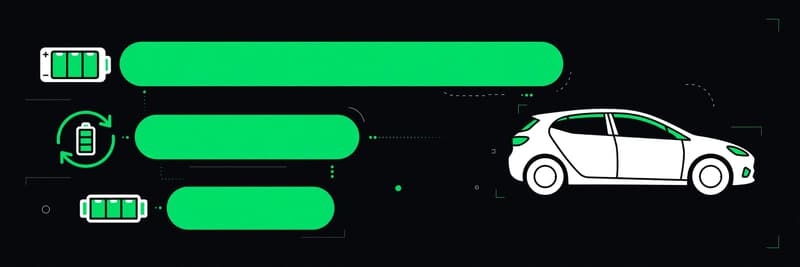
Before any owner pays out of pocket, the warranty deserves a check. Federal rules treat the traction battery as an emissions-related component and require at least 8 years or 100,000 miles of coverage on every new EV sold in the United States. Tesla’s own terms run 8 years or 100,000 miles on Standard Range Model 3 and Model Y cars, 8 years or 120,000 miles on Long Range trims, and 8 years or 150,000 miles on Model S and Model X. Most manufacturers promise a repair or replacement if capacity falls below about 70% of the original rating inside the warranty window, and Recurrent Auto reports the same 70% trigger for Tesla.
California goes further. The state’s emissions warranty rules extend coverage to 10 years or 150,000 miles for qualifying vehicles, and the same standard applies in states that adopt California’s rules. Kelley Blue Book notes that, beginning with the 2026 model year, California requires EV batteries to retain at least 70% of their range for 10 years or 150,000 miles. A used EV bought in a state with the longer warranty may still carry coverage that a buyer in another state would not get, so the car’s first registration state matters as much as its odometer. Owners shopping for a used EV should read our guide to how long EV batteries last and the used EV battery health check before signing.
A US$20,000 battery bill against a US$57,862 used Model S
The question that decides whether a replacement is worth paying is the bill measured against the car. Joule Post arithmetic: iSeeCars’ October 28, 2026 pricing study put the average used Tesla Model S at US$57,862 in September 2026. A US$20,000 to US$22,000 battery bill equals about 35% to 38% of that value. The math is harsher on the volume seller. The same study put the average used Model 3 at US$28,931, so the US$15,799 receipt from 2020 equals about 55% of the car’s current value, while a current OEM pack at US$10,000 to US$12,000 equals about 35% to 41%. A replacement that costs half the car only makes sense when the rest of the car, body, motors, and electronics, has years of life left.
The cost curve works in the owner’s favor over time. BloombergNEF’s survey tracked pack prices from US$732 per kWh in 2010 to US$111 per kWh by the end of 2024, an 85% fall in fourteen years, and the same survey projected about US$80 per kWh by 2026 and US$60 per kWh by 2030. Joule Post arithmetic: at US$111 per kWh, the cells in a 75 kWh pack cost about US$8,325, which is about 38% below the US$13,500 battery-only portion of that 2020 Model 3 receipt. An owner who can wait, drive on reduced range, or repair a single module instead of replacing the pack buys time while the curve keeps falling. The same study put the average used EV at US$32,533 in September 2026.
Three cheaper routes before you pay for a new pack
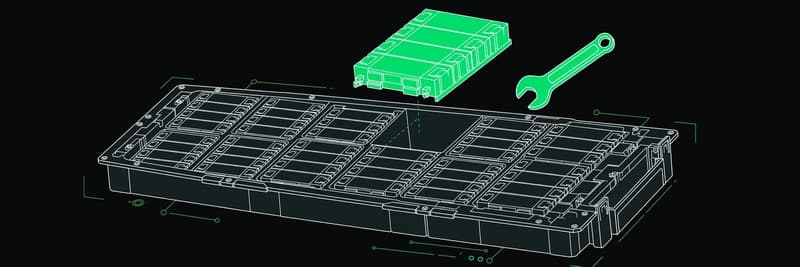
A failed pack rarely means a new pack at dealer prices. The first route is module-level repair. A pack is built from modules, and when diagnostics isolate the failure to one module, independent shops can replace that module while keeping the rest of the pack. Recurrent Auto notes that third-party shops such as The Electrified Garage and Gruber Motor Company do extensive work on Tesla batteries, and that a repaired pack or a previously used pack is a real option for out-of-warranty owners. The saving comes from paying for the failed part rather than the whole assembly.
The second route is a remanufactured EV battery pack. MotorWatt reports that third-party remanufactured packs undercut OEM prices by 30 to 50%, with Greentec Auto offering refurbished units from US$115 per kWh and re/cell selling refurbished Model 3 packs at US$6,995 to US$8,999 with a two-year warranty. Joule Post arithmetic: a re/cell pack at US$6,995 against a current OEM Model 3 pack near US$10,000 saves about 30%, and the same pack against the US$15,799 receipt saves about 56%. A remanufactured pack suits an older car whose remaining service life is shorter than a new pack’s warranty.
The third route is timing. Pack prices fall most years, so an owner whose car still drives can often defer the decision. The trade is real: range keeps shrinking while you wait. But for a second car or a short commute, six to twelve months of waiting can move the quote by hundreds of dollars as cheaper cells reach the repair market.
How to keep your pack out of the shop
Prevention costs nothing and pays the most. Geotab’s 2026 fleet analysis of about 22,700 EVs found average degradation of about 2.3% of capacity per year, up from 1.8% in its 2024 study. The practical response is a daily charge limit near 80%, with 100% reserved for the night before a long trip, and DC fast charging kept for road trips rather than routine use. Keeping the car plugged in while pre-conditioning the cabin also spares the pack.
Annual health checks close the loop. A state-of-health report, from a tool such as Recurrent’s report or an OBD-II reader, tracks capacity year over year and catches a weak module before it strands the car. Buyers of used EVs should insist on one before paying, and owners nearing the end of warranty should get one while a claim is still possible. Charging habits are covered in more detail in our guide to Level 2 home charger installation costs, which also covers the smart charging features that keep a pack in its healthy band.
Frequently asked questions
How much does a Tesla battery replacement cost?
Outside warranty, Recurrent Auto puts a Tesla battery replacement at US$15,000 to US$22,000. A Model 3 receipt from 2020 totaled US$15,799, a Model Y runs near US$15,000, and a Model S totals US$20,000 to US$22,000. Current OEM packs for a 75 kWh Model 3 run about US$10,000 to US$12,000 installed, according to MotorWatt’s April 2026 guide.
How much does EV battery replacement cost in 2026?
MotorWatt’s April 2026 guide puts the typical out-of-pocket range at US$5,000 to US$22,000, depending on pack size. Small 20 to 30 kWh packs run US$4,000 to US$9,000, mid-size 40 to 60 kWh packs run US$7,000 to US$14,000, and large 75 to 100 kWh packs run US$10,000 to US$18,000, with labor adding US$500 to US$2,500.
What is the latest update on out-of-warranty battery replacement cost?
The 2026 picture is cheaper packs and more third-party options. Pack prices fell to US$111 per kWh by the end of 2024, remanufactured packs undercut OEM prices by 30 to 50%, and only about 2.5% of EVs have ever needed a replacement, according to Recurrent Auto’s 2024 study of more than 20,000 cars.
Does the warranty cover a battery that has lost range?
It covers the battery if capacity falls below the stated threshold, commonly about 70% of the original rating, inside the warranty window. Federal rules require at least 8 years or 100,000 miles of coverage, and California extends that to 10 years or 150,000 miles for qualifying vehicles. Gradual loss above the threshold is normal wear and is not covered.
Sources
- Tesla Battery Replacement Costs Compared, Recurrent Auto, published June 24, 2024
- EV Battery Replacement Cost 2026: Real Prices by Brand, MotorWatt, updated April 2026
- Hybrid and EV Battery Warranty, Kelley Blue Book, published March 19, 2025
- What Does an EV Battery Warranty Cover? Complete Guide (2026), EVBattery.us, 2026, citing California Code of Regulations section 1962
- Used EV Prices Are On The Rise, CarPro, published November 3, 2026, reporting iSeeCars’ October 28, 2026 used EV pricing study
- How Long Do Electric Car Batteries Last?, Geotab, 2026 fleet analysis