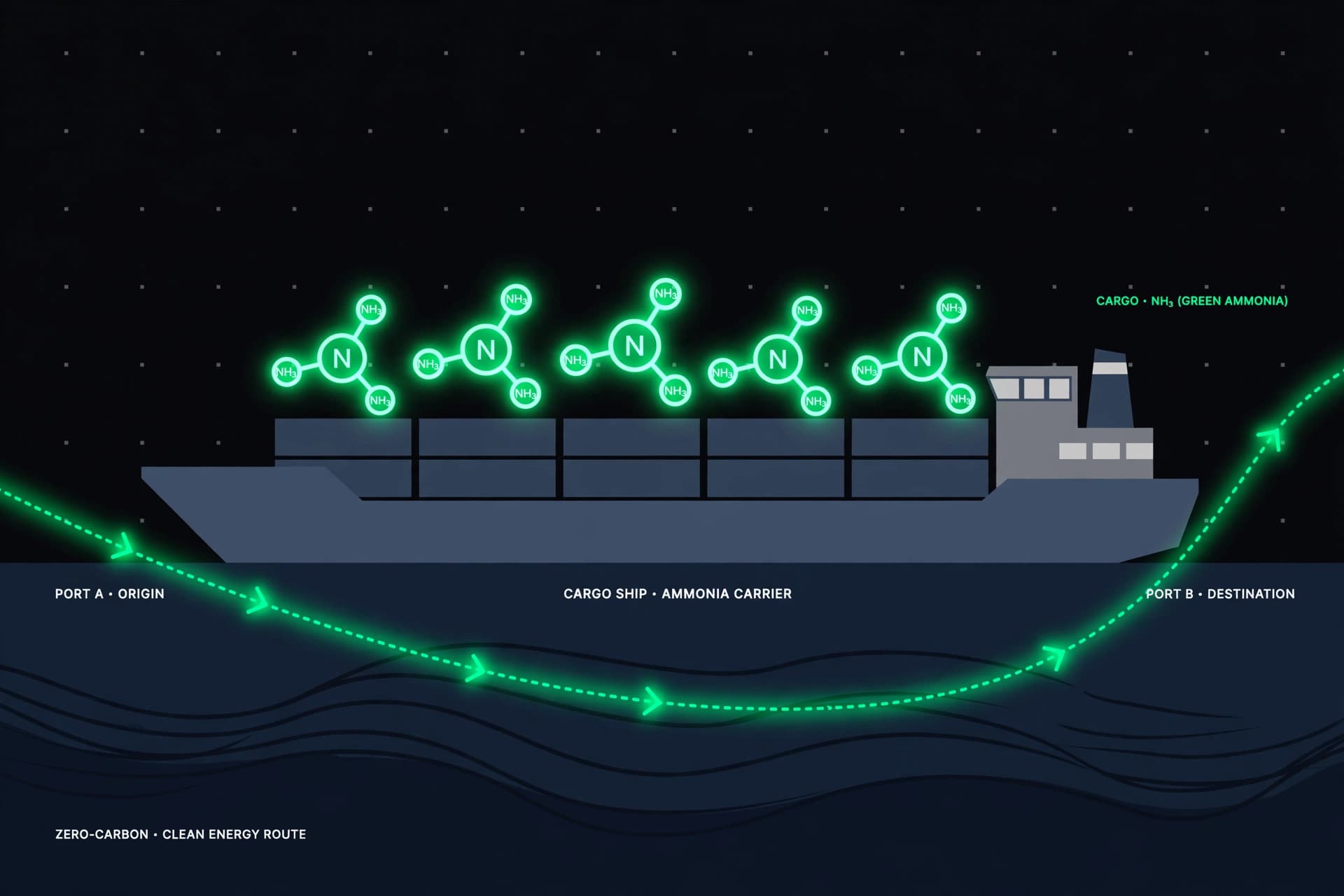
- Green ammonia is ammonia made from renewable electricity and water, and it turns hydrogen into a liquid that ships at minus 33C instead of minus 253C.
- The IEA puts shipping over 10,000 km at USD 2 to 3 per gigajoule for ammonia, against USD 14 to 19 for liquid hydrogen.
- Cracking ammonia back into hydrogen at 600C reaches 87.55% energy efficiency at best, so the cheapest hydrogen from ammonia is often hydrogen that is never cracked at all.
Green ammonia: Ammonia (NH3) made by combining nitrogen from the air with hydrogen produced by splitting water with renewable electricity. Unlike conventional ammonia, which starts with hydrogen from natural gas or coal, green ammonia carries no fossil carbon into the molecule, which is what makes it useful as a clean fuel and a hydrogen carrier.
The question of why hydrogen travels the world as ammonia has a sharper answer than the shipping bill alone. Green ammonia explained in one sentence is a trade: renewable hydrogen packed into a molecule that ships like propane, at the price of an energy-hungry unpacking step at the far end. Ammonia carries three hydrogen atoms locked to one nitrogen atom, and releasing them means heating the gas to around 600C in a cracker. Peer-reviewed analysis puts the best crackers at 87.55% energy efficiency, so roughly an eighth of the energy goes to the round trip before the hydrogen does any work.
The trade only works because ammonia already moves around the world at enormous scale. The US Department of Energy puts world ammonia production at 180 to 200 million metric tons a year, moving by pipeline, rail, truck and ship through ports that have handled the chemical for a century. The IEA adds that intercontinental ammonia transport already runs on chemical and semi-refrigerated LPG tankers, so the ships, terminals and safety codes for a green ammonia trade largely exist before the first green cargo loads. That existing network is the real advantage: liquid hydrogen would need a new cryogenic fleet built from scratch.
- How green ammonia is made from renewable electricity
- Why liquid hydrogen is so expensive to ship
- How ammonia packs more hydrogen into each liter
- What the USD 2 to 3 per gigajoule transport cost means for hydrogen trade
- Cracking ammonia back to hydrogen costs energy
- Green ammonia as a shipping fuel and fertilizer feedstock
- The toxicity and safety problem ammonia cannot dodge
- Frequently asked questions
How green ammonia is made from renewable electricity
Making green ammonia takes two mature steps and one new one. First, electrolysers split water into hydrogen and oxygen using renewable electricity. Second, the hydrogen reacts with nitrogen pulled from the air in the Haber-Bosch process, the same high-temperature, high-pressure synthesis that has produced fertilizer ammonia for more than a century. The US Department of Energy puts Haber-Bosch efficiency at about 60 to 66% when the hydrogen comes from steam methane reforming, and lower when it comes from electrolysis, which is one reason green ammonia costs more to produce than the grey kind.
The color labels matter here because they describe the hydrogen, not the ammonia molecule. Grey ammonia starts with hydrogen from natural gas or coal. Blue ammonia adds carbon capture to that fossil route. Green ammonia uses renewable electricity and water as the only sources for its hydrogen, in the Department of Energy’s wording, and carries no fossil carbon into the molecule. Joule Post’s guide to the hydrogen color system sets out how the labels map to emissions.
Cost is the constraint. The IEA estimates electrolytic hydrogen production costs in 2030 at USD 13 to 19 per gigajoule in regions with excellent wind and solar resources, and electrolytic ammonia at USD 22 to 33 per gigajoule, while natural gas with carbon capture comes in at USD 8 to 16 per gigajoule for hydrogen and USD 12 to 24 for ammonia. Ammonia costs more than hydrogen per unit of energy because it is made from hydrogen, with an extra synthesis step on top. The Department of Energy makes the same point directly: ammonia will never cost less than the hydrogen it is made from. Green ammonia only wins when the saving on transport and storage outweighs that production penalty.
Electrolysers also earn their keep only when they run often, so the utilisation of the wind and solar farms feeding them sets the economics of the whole plant. Joule Post’s explainer on capacity factor shows why a renewable plant that runs at a low share of its nameplate output produces expensive electricity, and the same arithmetic applies to every green ammonia project choosing a site.
The climate case for switching production is large on its own. The IEA’s ammonia roadmap puts ammonia production at around 2% of total final energy consumption and 1.3% of CO2 emissions from the energy system. The Department of Energy puts the average at 2.8 metric tons of CO2 per metric ton of ammonia produced, falling to 1.6 metric tons in the best natural gas plants. Green ammonia made with renewable electricity removes that production emission at the source, before any discussion of ships or crackers begins.
Why liquid hydrogen is so expensive to ship
Hydrogen is the lightest element, and that lightness is the whole shipping problem. As a gas it takes up so much volume that moving it means either compressing it to hundreds of bar or chilling it into a liquid, and both routes cost energy. The International Renewable Energy Agency puts the liquefaction temperature below minus 252.8C and estimates that 30 to 40% of the hydrogen’s energy content goes into the liquefaction process itself, against 15% for compressing the gas. A ship carrying liquid hydrogen then has to keep its cargo at that temperature for the whole voyage, and IRENA notes that ships either accept significant evaporation on the way or invest in complex cryogenic systems.
The bill for that cold chain shows up in the IEA’s numbers. Moving fuel by ship over 10,000 km costs USD 14 to 19 per gigajoule for liquid hydrogen, a figure that covers liquefaction, the ship and the losses along the way. There is also almost no fleet to do it, while ammonia has moved on ordinary chemical tankers for decades. A buyer choosing liquid hydrogen is therefore paying for the coldest industrial supply chain in the world and for ships that barely exist yet.
Pipelines avoid some of this pain over land, and the IEA notes that pipeline transmission of hydrogen and ammonia is mature and a relatively small share of overall supply cost. But pipelines do not cross oceans, and the hydrogen trade that matters most runs between continents: from sunny and windy regions with cheap renewable power to industrial buyers in Japan and Europe. For those routes the choice is a ship, and the ship decides the carrier.
How ammonia packs more hydrogen into each liter
Ammonia’s advantage as an ammonia hydrogen carrier starts with the molecule. NH3 is one nitrogen atom holding three hydrogen atoms, and hydrogen makes up more than 17% of its mass. In liquid form it holds more than 121 kg of hydrogen per cubic metre, more than 4 kWh of energy per liter and more than 5 kWh per kilogram, according to the US Department of Energy. The International Renewable Energy Agency states the same comparison in plain terms: liquid ammonia has greater density than hydrogen, which makes it easier to store and transport in containers.
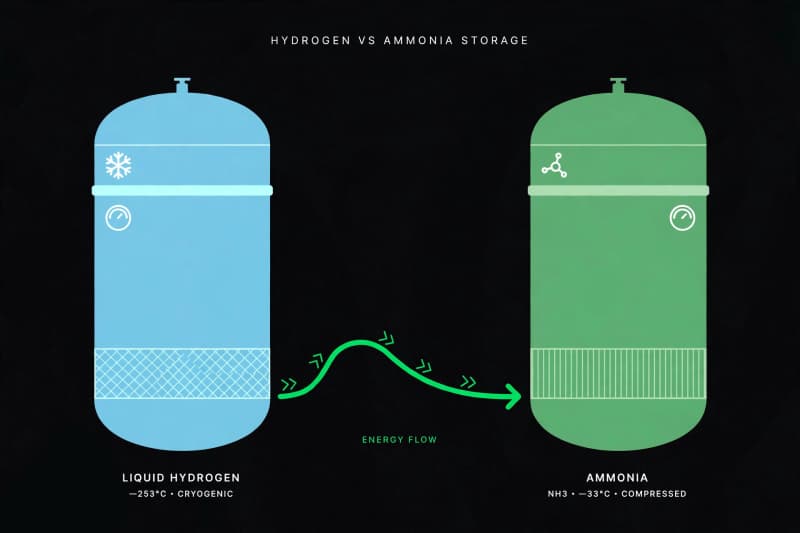
The second advantage is the temperature. Ammonia liquefies at minus 33C at atmospheric pressure, or at about 10 bar at room temperature, which is the same kind of refrigeration a propane terminal already provides. Hydrogen needs minus 253C, a temperature that demands specialised insulation, materials that resist hydrogen embrittlement and constant energy input to stay cold. The 220-degree gap between the two boiling points is the physical reason one fuel ships on ordinary tankers and the other needs a cryogenic expedition.
Put the two together and the carrier math favors ammonia on every leg of the journey except the last one. The liquid is denser, the refrigeration is ordinary, the ships exist, and the ports already know the cargo. The catch sits at the destination, where the hydrogen has to come back out, and that step decides whether the carrier saves money or burns it.
| Carrier | Liquefaction temperature | Energy spent on liquefaction | Shipping cost over 10,000 km | Delivered cost in 2030 | Cracking step needed |
|---|---|---|---|---|---|
| Liquid hydrogen | Below minus 252.8C | 30 to 40% of energy content | USD 14 to 19 per GJ | USD 22 to 35 per GJ | None |
| Green ammonia | Minus 33C, or 10 bar at room temperature | Modest refrigeration load | USD 2 to 3 per GJ | USD 14 to 27 per GJ | Yes, 600C cracker |
The table leaves out one row that matters: the energy spent making the ammonia in the first place. Synthesising ammonia from hydrogen consumes energy, and the Haber-Bosch step runs at roughly 60 to 66% efficiency. The fair comparison is therefore the full chain, production plus transport plus cracking, against liquid hydrogen’s production plus liquefaction plus shipping. The IEA ran that comparison, and its totals settle the question.
What the USD 2 to 3 per gigajoule transport cost means for hydrogen trade
The IEA’s full-chain numbers give ammonia the win on delivered cost. Total supply costs in 2030, including production and marine transport, come to USD 22 to 35 per gigajoule for hydrogen and USD 14 to 27 per gigajoule for ammonia. Ammonia’s most expensive case, USD 27, sits below hydrogen’s most expensive case, USD 35, and its cheapest case, USD 14, sits well below hydrogen’s cheapest, USD 22. The carrier that costs more to produce still arrives cheaper, because the shipping saving is bigger than the production penalty.
Joule Post arithmetic on the IEA ranges makes the point sharper. At the low end of the ranges, ammonia costs USD 9 more per gigajoule to produce (USD 22 against USD 13) and saves USD 11 on shipping (USD 14 against USD 3). At the high end, it costs USD 14 more to produce (USD 33 against USD 19) and saves USD 17 on shipping (USD 19 against USD 2). At both ends of the range, the transport saving outweighs the production penalty, which is why the delivered-cost comparison comes out in ammonia’s favor even before cracking is counted.
Trade routes are already forming around that arithmetic. The IEA’s analysis covers three supply chains for 2030: importing low-carbon fuels to Japan, importing low-carbon ammonia to Indonesia, and using domestically produced low-carbon hydrogen in India. Japan’s interest is the clearest signal, since its power sector is testing ammonia co-firing in coal plants and its industry needs imported fuel. The pattern that emerges is a hub-and-spoke trade in hydrogen shipped as ammonia, in which sunny and windy exporters ship to industrial importers, a pattern that mirrors today’s fertilizer trade more than today’s LNG trade.
Scale is the warning label on that vision. The IEA calculates that co-firing 60% ammonia in a coal power fleet of just 10 gigawatts, about ten large coal plants, would mobilise an amount almost equivalent to all the ammonia traded worldwide today. The energy trade would therefore need to grow far beyond the fertilizer trade it borrows its ships from. Ports, cracking plants and ammonia-fuelled ships would all have to scale together, and the IEA is explicit that transport volumes of ammonia, while already traded, are small compared with what the power sector alone would need.
For readers tracking the build-out, the project pipeline shows the direction of travel, with export plants sited beside the cheapest wind and solar power. Joule Post covered one such deal in NTPC’s green ammonia supply agreement with buyers in Japan, Korea and Germany. Wind power is the usual electricity source for those export plants, and how wind turbines convert wind into electricity sets the ceiling on how cheap that power can get.
Cracking ammonia back to hydrogen costs energy
Ammonia cracking hydrogen back out of the molecule is the step that decides whether the route makes sense for a given buyer. The reaction splits ammonia into nitrogen and hydrogen at high temperature over a catalyst, and the heat has to come from somewhere. A 2025 techno-economic analysis in Applied Energy modelled the options and found that high-temperature crackers running at 600C reach a maximum energy efficiency of 87.55%, while lower-temperature crackers at 450C manage 82.16% to 86.75%. The best available cracker therefore returns about seven-eighths of the energy fed into it as hydrogen, and the rest goes to heat and separation.
Separation adds its own cost. The hydrogen coming out of a cracker is mixed with nitrogen and traces of unconverted ammonia, and fuel cells need high-purity hydrogen. The same Applied Energy analysis found that pressure swing adsorption gives the lowest levelised cost of hydrogen from cracking, at USD 2.81 per kilogram, even though it is more energy-intensive than the alternatives. A buyer who needs fuel-cell-grade hydrogen therefore pays twice: once for the heat to crack the ammonia and once for the purification step that follows.
The way around the cracking penalty is to skip it. Ammonia can be burned directly in a power plant, and the IEA reports that co-firing up to 20% ammonia in coal plants has already succeeded at small scale, with larger test projects under development. It can also feed solid oxide fuel cells, which take ammonia directly, and the Applied Energy analysis found that a cracker integrated with a solid oxide fuel cell reaches 69.55% system efficiency with a levelised cost of electricity of USD 0.145 per kilowatt-hour. And it can fuel ships directly, which removes the cracking step from the largest single use case entirely. The cheapest hydrogen from ammonia is the hydrogen that is never cracked, and the end use decides how much of the chain’s energy survives.
Green ammonia as a shipping fuel and fertilizer feedstock
Fertilizer is where green ammonia starts, because it is where ammonia already goes. The IEA’s ammonia roadmap puts the fertilizer share at around 70% of production, and a peer-reviewed analysis of production data put 2020 output at 183 million metric tons, with about 70% used in agriculture. Replacing the fossil hydrogen in that fertilizer with renewable hydrogen cuts emissions without building a single new ship or cracking plant, which is why fertilizer is the first market for every green ammonia project and the anchor customer that makes the plants bankable.
Green ammonia shipping fuel is the second market, and it may end up the larger one. The Department of Energy’s hydrogen office describes ammonia as one of the best options the maritime community has for decarbonising shipping, and the fuel’s appeal is the same as its appeal as a carrier: it is liquid at ordinary refrigeration temperatures, it carries no carbon to emit at the point of use, and the bunkering infrastructure resembles what ports already operate. Engine makers are adapting large marine diesels to burn it, and the first ammonia-fuelled vessels are moving from design to construction.
The third market is power generation, where ammonia’s role is narrower. Co-firing ammonia in coal plants lets existing plants cut emissions while keeping their capacity, and the IEA’s analysis found that a Japanese coal plant co-firing 60% low-carbon ammonia in 2030 would generate at a cost 30% above energy market value at baseload but only 15% above it at peak load, when electricity prices are higher. That is a niche, not a revolution: ammonia power makes sense where plants are young, alternatives are scarce and carbon prices are high, which points to East and Southeast Asia rather than to grids with cheap renewables and storage. Readers weighing storage options should compare the numbers with battery chemistries, where batteries return far more of the energy put into them but store it for hours rather than months.
Drivers face the same choice between hydrogen and batteries at a smaller scale, and the trade-offs rhyme with the shipping story: hydrogen wins on range and refuelling speed, batteries win on efficiency and infrastructure. Joule Post’s comparison of hydrogen cars versus battery EVs works through that decision for passenger vehicles.
The toxicity and safety problem ammonia cannot dodge
Ammonia’s safety record is good and its chemistry is unforgiving, and both facts are true at once. The gas is toxic, corrosive and pungent, and a leak in a populated area is a serious emergency rather than a nuisance. The Department of Energy is candid about it, noting that ammonia is toxic while also recording that the industry has an excellent safety record, with few fatalities and far fewer fire deaths than fossil fuels. The IEA makes the same point in its own way, calling for health and safety risks from handling hydrogen and ammonia to be addressed directly as the trade scales.
The risk changes character as ammonia moves from fertilizer terminals into fuel markets. A fertilizer port handles ammonia with trained crews, established procedures and limited public exposure. A shipping fuel trade puts ammonia on more vessels, in more ports, handled by more crews, and a power plant trade puts it beside population centers that never chose to host a chemical terminal. None of that makes the trade unworkable, but it means safety regulation, crew training and emergency planning have to scale at the same speed as the cargo volumes, and that permitting is likely to decide project timelines as much as economics.
The comparison with hydrogen is instructive rather than reassuring. Hydrogen’s danger is fire: it burns invisibly across a wide range of concentrations and leaks through the smallest gaps. Ammonia’s danger is poisoning: it announces itself with a smell long before it reaches lethal concentrations, which is why its safety record is as good as it is. Neither fuel is safe in the ordinary sense, and the industry’s job is to manage a known hazard rather than to pretend it does not exist.
Sources:
- IEA executive summary on low-carbon fuels in the power sector
- IEA Ammonia Technology Roadmap
- US Department of Energy H2IQ Hour on ammonia as an energy carrier
- IRENA on liquefied hydrogen storage
- Wen et al., techno-economic analysis of ammonia to hydrogen pathways, Applied Energy 2025
- Low-carbon ammonia production for resilient and sustainable agriculture, PMC
Frequently asked questions
What is green ammonia?
Green ammonia is ammonia made from hydrogen produced by splitting water with renewable electricity, combined with nitrogen from the air. It contains no fossil carbon, unlike conventional ammonia made from natural gas or coal, and it works as a clean fuel and as a way to ship hydrogen.
Why is hydrogen transported as ammonia?
Liquid hydrogen must be chilled below minus 252.8C, which consumes 30 to 40% of its energy content, and shipping it 10,000 km costs USD 14 to 19 per gigajoule. Ammonia liquefies at minus 33C, ships on existing LPG tankers, and costs USD 2 to 3 per gigajoule over the same distance, according to the IEA.
Can ammonia be used directly as a fuel?
Yes. Ships can burn it in adapted marine engines, power plants can co-fire it with coal at shares up to 20% in small-scale tests, and solid oxide fuel cells can take it directly. Direct use avoids the cracking step entirely, which is why it is often the cheapest route.
How efficient is ammonia cracking?
High-temperature crackers at 600C reach a maximum energy efficiency of 87.55%, according to a 2025 analysis in Applied Energy, while lower-temperature crackers at 450C reach 82.16% to 86.75%. Purifying the hydrogen to fuel-cell grade adds further cost, with the lowest levelised cost at USD 2.81 per kilogram.
Is ammonia safe to transport?
Ammonia is toxic and corrosive, and leaks are a serious hazard, but the fertilizer industry has shipped it for a century with an excellent safety record, according to the US Department of Energy. The challenge is scaling that record from fertilizer terminals to fuel ports and power plants.