- Wind turbines are designed for about 30 years of service, and the United States fleet installed in the 1990s and 2000s is now reaching that point.
- Owners can extend a project with a partial repower, rebuild it with fewer larger machines in a full repower, or remove the turbines and restore the land.
- Decommissioning cost US$114,000 to US$195,000 per turbine gross in 2019 to 2021 estimates, falling to US$67,000 to US$150,000 net after salvage value.
Wind turbine lifespan: The period a machine is built and certified to run before its owner must pick a new course, about three decades for onshore machines in the United States. At that point the turbine can keep running with repairs, gain new parts, be replaced, or be removed.
Wind turbine lifespan is a scheduling question as much as an engineering question. Turbines installed during the first large build-out of American wind power are now old enough that owners must decide what happens next, and the decision involves the tower, the foundation, the lease, the grid connection, and the local tax base at the same time. The United States Department of Energy guide on end of service, published in 2023 and using data as of October 2022, puts the scale in plain terms. More than 70,000 land-based turbines with combined capacity of nearly 138 GW were installed across the country by October 2022. A share of that fleet has already been repowered, and more is expected to follow through 2026.
The arithmetic behind the timing is straightforward. A 30-year design life means a turbine installed in 1996 reaches the end of its expected service in 2026, and a turbine installed in 2005 reaches it in 2035. Calculated from the guide figures, the more than 14 GW already fully or partially repowered by October 2022 represents about 10 percent of the nearly 138 GW fleet. Analysts cited in the guide expected an additional 16 GW of full or partial repowers through 2026. That is a large amount of work in a short window, and it explains why repowering and decommissioning have moved from a footnote in project planning to a central part of wind development.
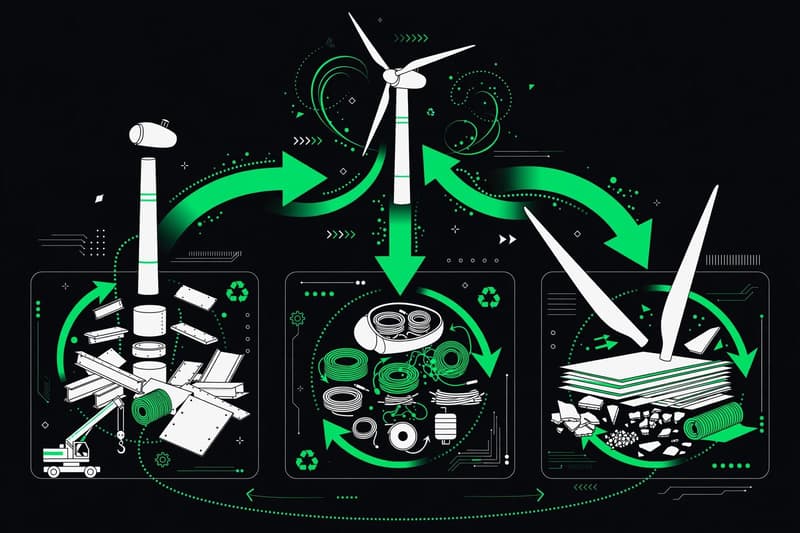
Owners do not face a single yes or no choice. The guide describes three main paths: partial repower, full repower, and decommissioning. Each path has a different cost, a different timeline, and a different effect on the land and the community around the project. The right choice depends on the age and condition of the machines, the remaining value of the towers and foundations, the terms of the land leases, and the price the project can earn for its electricity.
Contents
- A 30-year wind turbine lifespan, with parts that wear out sooner
- How old the United States wind fleet is now
- Partial repower keeps the tower and changes the working parts
- Full repower replaces the turbine with fewer larger machines
- Wind turbine decommissioning and land restoration take 6 to 24 months
- What 14 GW of wind repowering means for the next decade of United States wind
- Most of a turbine by mass is recyclable metal
- Blade waste is small beside total United States waste
- Decommissioning costs, salvage value, and landowner payments
- Frequently asked questions
A 30-year wind turbine lifespan, with parts that wear out sooner
The expected service life of wind turbines is approximately 30 years, according to the United States Department of Energy Wind Energy End-of-Service Guide. Foundations and towers are expected to meet that timeline. Blades, gearboxes, generators, and smaller hardware may need repair or replacement earlier. That split matters for owners because the most expensive and hardest to move parts of a project are the ones built to last the full period, while the parts that spin, flex, and carry load wear faster and can be swapped.
A turbine that reaches 30 years has not necessarily failed. The design life is the period the machine was engineered and certified to operate under expected loads. A turbine can still turn after that period ends. Owners can keep a turbine running past that point with inspection, repair, and replacement of worn components, a practice known as wind turbine life extension. The guide treats life extension as one of the end-of-service options alongside repowering and decommissioning. The choice turns on whether the cost of continued maintenance and the output of an older, smaller machine still make sense beside the revenue from a newer machine on the same site.
Wind turbine design life also shapes the way projects are financed and permitted. A project built with a 30-year horizon has leases, grid agreements, and decommissioning plans written around that period. When the period ends, those documents come due for renewal or closure. Owners, landowners, and local governments then negotiate again, often under rules and market conditions that have changed since the project was first built. Readers who want the offshore side of the same question can read our companion guide on offshore wind turbine lifespan, repowering, and decommissioning, which covers the different conditions machines face at sea.
How old the United States wind fleet is now
As of October 2022, over 70,000 land-based wind turbines with combined capacity of nearly 138 GW were installed across the United States, according to the Department of Energy guide. That fleet was built in waves. Early projects from the 1990s were small by current standards. The large build-out of the 2000s and 2010s added far more capacity, and those machines are now moving through their second decade of service. The result is a steady stream of projects reaching the age where partial repower becomes worth considering, followed a decade later by projects reaching full end of service.
The guide records that more than 14 GW of United States projects had already been fully or partially repowered by October 2022, with analysts expecting an additional 16 GW of full or partial repowers through 2026. Calculated from those figures, the repowered share stood at about 10 percent of the fleet, and the expected additions through 2026 would more than double that cumulative total. The numbers show that repowering is already a routine part of the American wind industry.
Fleet age also affects how the industry thinks about spare parts and service crews. A turbine model that is 15 years old may have limited parts support, and a gearbox or blade replacement for that model can cost more than the same work on a newer machine. At the same time, the towers and foundations of those projects still have value, and the grid connection and access roads are already in place. Those sunk assets push owners toward partial repower first, because it reuses the most valuable existing infrastructure while replacing the parts that limit output.
Partial repower keeps the tower and changes the working parts
A partial repower upgrades blades, gearboxes, hubs, main shafts, and bearings while keeping the towers and foundations, according to the Department of Energy guide. The work replaces the components that wear out or limit performance and leaves the structure in place. That approach costs less than a full rebuild and finishes faster, and it can raise output from a site that already has permits, leases, and a grid connection.
In 2021, partially repowered turbines were 9 to 16 years old, with a median age of 10 years, the guide reports. That timing is worth noting. Owners were not waiting for the full 30-year design life to end. They were acting at roughly one third of the way through it, when new blades or a new gearbox could add years of productive service. A partial repower takes a few months, according to the guide, which limits lost generation during the work and keeps the project earning while the upgrade proceeds in stages.
Partial repowers are also the primary reason blades retire early. In 2021, 2,307 blades from 12 projects were retired due to partial repowering, the guide states. Those blades were removed because a longer or more efficient blade, fitted to the same tower, could produce more electricity. That trade is central to the blade waste question, and it is covered in more detail in our report on what happens to old wind turbine blades. Blade retirement is often a business decision tied to an upgrade.
Full repower replaces the turbine with fewer larger machines
A full repower replaces turbines and foundations, often with significantly larger machines, according to the guide. The old machines come down, new foundations go in, and new turbines go up in their place. The result is usually a project with far fewer turbines and more capacity, because a single modern machine can produce several times the output of the smaller machines it replaces.
The guide gives a 2020 example that shows the scale of the change. In that project, 343 turbines totalling 120 MW were replaced with 50 new turbines totalling 148 MW. Calculated from those figures, the turbine count fell by about 85 percent while capacity rose from 120 MW to 148 MW, an increase of about 23 percent. Fewer machines means fewer foundations, fewer access points, and less maintenance per megawatt, while the larger rotors capture more wind at the same site. No projects were fully repowered in 2021, the guide notes, which shows that full repowers arrive in waves tied to project age, equipment availability, and market conditions rather than on a steady annual schedule.
A full repower with site restoration can take nearly two years, according to the guide. That is far longer than a partial repower, and it requires more planning. Foundations must be removed or cut down, new foundations must cure, cranes must be brought in, and the site must be restored. During that period the project produces little or no electricity, so owners weigh the lost revenue against the decades of higher output that follow. The economics also change for landowners, because fewer, larger turbines can reduce the number of compensated landowners while raising royalties per landowner, a point the guide raises and which is discussed further below.
| Path | What changes | What stays | Timeline in the guide | 2021 age or scale |
|---|---|---|---|---|
| Partial repower | Blades, gearboxes, hubs, main shafts, bearings | Towers and foundations | A few months | Turbines 9 to 16 years old, median 10 years |
| Full repower | Turbines and foundations, often with larger machines | Site, grid connection, access roads | Nearly 2 years with site restoration | 2020 example: 343 turbines at 120 MW replaced by 50 turbines at 148 MW; no full repowers in 2021 |
| Decommissioning | Turbines removed, site restored | In-ground components below 3 to 5 feet may remain where standards allow | 6 to 24 months | Cost US$114,000 to US$195,000 per turbine gross in 2019 to 2021 estimates |
| Life extension | Worn parts repaired or replaced as needed | Existing turbine, tower, and foundation | Ongoing maintenance | Option alongside repowering and decommissioning |
The comparison above uses only figures from the Department of Energy guide. It leaves out one factor that owners weigh heavily: the remaining life of the tower and foundation. A partial repower makes sense when those structures have years of service left. A full repower makes sense when the tower itself limits the size of machine the site can carry, or when the foundation has reached the end of its useful life. The choice is therefore a structural decision first and a commercial decision second.
Wind turbine decommissioning and land restoration take 6 to 24 months
Decommissioning takes 6 to 24 months depending on turbine size and count, according to the guide. The work includes removing the blades, nacelle, tower, and electrical equipment, then dealing with the foundation and restoring the surface. Foundations can have a 32-foot radius and a 20-foot depth, the guide states. Most standards allow in-ground components below 3 to 5 feet to remain, so crews typically remove the foundation to that depth, backfill, and restore the topsoil and vegetation.
The timeline varies because a small project with a handful of turbines can be cleared in months, while a large project with dozens of machines needs more crane time, more trucks, and more restoration work. Access roads may be removed or left in place depending on the landowner agreement and local rules. Underground wiring is usually left in place or removed according to the same agreements. The land is then returned to farming, grazing, or other prior use, subject to the restoration standard in the lease or permit.
Decommissioning also raises a practical question that owners plan for years in advance: who pays, and what happens if the owner cannot. Project owners pay the cost, according to the guide, and financial assurance in the form of a bond, guarantee, or letter of credit may be required. That assurance is meant to protect landowners and local governments from a project left standing after its owner has gone. The cost figures behind that requirement are set out in the section on costs and landowner payments below.
What 14 GW of wind repowering means for the next decade of United States wind
The repowering figures in the guide point to a structural shift in American wind power. More than 14 GW had already been repowered by October 2022, and analysts expected an additional 16 GW through 2026. Taken together, that is 30 GW of projects whose machines were upgraded or replaced within a few years, on a fleet of nearly 138 GW. The work is concentrated in the oldest projects, which were built with the smallest machines, so the capacity gain per site can be large even when the turbine count falls.
That shift changes what the fleet looks like. A site that once held dozens of small turbines can hold a smaller number of tall machines with longer blades. The visual effect is real, and it is one reason repowering can draw local attention even when the project itself is not new. Our guide to wind turbine noise, decibel levels, and setback distance covers the sound and spacing questions that come up when turbine size changes, and our comparison of onshore and offshore wind costs puts the economics of larger machines in a wider context. Larger machines also change the maintenance picture, because fewer machines mean fewer service visits per megawatt, while each individual machine is larger and needs heavier lifting equipment when a major component fails.
The other change is in the supply chain. Repowering creates steady demand for blades, gearboxes, and cranes, and it creates a steady stream of used components and retired blades that need a destination. That is why recycling capacity and blade disposal have become part of the repowering conversation rather than an afterthought. A project that replaces its blades at year 10 in a partial repower will need a plan for those blades, just as a project that decommissions at year 30 will need a plan for the whole machine.
For the grid, repowering is a way to add capacity without finding a new site. The grid connection, the access roads, and the local workforce are already there. A full repower that lifts a site from 120 MW to 148 MW, as in the 2020 example in the guide, adds 28 MW without a new interconnection queue. That matters in regions where new grid connections take years. It also means that the pace of repowering will shape how much wind capacity the United States adds in the coming decade, alongside new greenfield projects.
Most of a turbine by mass is recyclable metal
About 85 percent to 90 percent of a wind turbine mass, excluding foundation, underground wiring, and infrastructure, is easily recyclable metal such as steel, aluminium, copper, and iron, according to the guide. Only 6 percent to 14 percent is composite material, including blades, nacelle covers, and rotor covers. That split is the starting point for any honest discussion of turbine recycling. Most of the machine by weight goes back into the metals stream through established scrap markets. The hard part is the composite share, and blades are the largest piece of it.
Including infrastructure, the guide breaks down the mass of a land-based project as 75 percent foundations, 2 percent cables, and 23 percent the turbine itself. Foundations are concrete and steel, and they are dealt with at decommissioning by removal to the depth required by the applicable standard, as described above. Cables are a small share by mass. The turbine share is where the metals and composites sit, and it is the share that moves off site on trucks when a machine is removed.
Blade recycling has moved from pilot scale to operating facilities. The Veolia blade recycling facility in Louisiana, Missouri, had mechanically recycled more than 100 blades by fall 2020, according to the guide, with capacity for 3,000 blades per year. Mechanical recycling grinds the composite into material that can be used in other products, including cement production. Other approaches, including chemical recycling and reuse of blade sections in structures, were under development at the time the guide was published in 2023. The guide does not present any single method as the settled answer, and the capacity figure above is a snapshot from fall 2020.
Durability is part of the same story. Turbines are built to survive severe weather, and the engineering behind that survival is covered in our article on how wind turbines survive hurricanes. A machine that can stand through a storm for decades still has a finite design life, and the end of that life is when the recycling and disposal questions arrive in volume.
Blade waste is small beside total United States waste
Blade waste is often discussed as if it were a large share of American waste. The guide puts it in context with national figures. Less than 50,000 tons of blade waste were landfilled in 2018, the guide states, equal to 0.017 percent of combined United States municipal solid waste and construction and demolition waste in that year. Projected blade waste of 200,000 to 370,000 tons per year by 2050 would still be less than 0.15 percent of the 2018 combined waste total, according to the guide. Blades are not hazardous waste, the guide states.
Those percentages do not make blade waste unimportant. A single blade is large, hard to transport, and hard to cut, and a landfill that takes blades needs space and equipment for them. The point of the comparison is scale. Blade waste is a visible and growing stream, and it deserves a recycling plan, while remaining a small fraction of the waste the United States produces each year. The growth in the projection, from under 50,000 tons in 2018 to 200,000 to 370,000 tons per year by 2050, reflects the fleet reaching end of service in larger numbers, plus the blades retired early through partial repowers.
The early retirement point deserves emphasis. Partial repowers are the primary reason blades retire early, the guide states, and in 2021, 2,307 blades from 12 projects were retired due to partial repowering. That is a direct link between a commercial decision to upgrade and a waste stream that needs handling. Owners who plan a partial repower therefore need a blade destination in the same plan as the new blades, whether that destination is mechanical recycling, reuse, or landfill where no recycling route is available.
Decommissioning costs, salvage value, and landowner payments
Decommissioning cost estimates from 2019 to 2021, covering 8 projects, put the gross cost at US$114,000 to US$195,000 per turbine, according to the guide. Net cost after salvage value was US$67,000 to US$150,000 per turbine. Salvage value comes mainly from the recyclable metals in the turbine, and it narrows the gap between gross and net cost. The range is wide because turbine size, site conditions, distance to scrap markets, and restoration standards all affect the final bill.
Project owners pay the decommissioning cost, the guide states. Financial assurance, in the form of a bond, guarantee, or letter of credit, may be required to cover that cost if the owner cannot. The form and amount of assurance depend on the lease and the permitting authority. Landowners and local governments should check the specific agreement for their project rather than assuming a single national rule, because the guide describes the practice and the instruments used.
Repowering can change landowner lease payments and tax revenues, according to the guide. Fewer, larger turbines can reduce the number of compensated landowners while raising royalties per landowner. A landowner whose turbine is removed in a full repower may lose a lease payment, while a neighbour whose land hosts a new, larger machine may gain one. Tax revenue can shift in the same way, because the assessed value of the project changes with the new equipment. Those effects are local and specific to each project, and they are a reason repowering plans often involve fresh negotiation with landowners rather than a simple renewal of old terms.
The cost figures above are estimates from 2019 to 2021, and they are stated in United States dollars. Costs since then will reflect changes in labour, transport, crane availability, and scrap metal prices, none of which the guide quantifies for later years. Readers should treat the range as a benchmark from that period.
Frequently asked questions
How long do wind turbines last on average?
The expected service life of wind turbines is approximately 30 years, according to the United States Department of Energy guide published in 2023. Foundations and towers are expected to meet that timeline, while blades, gearboxes, generators, and smaller hardware may need repair or replacement earlier. Owners can extend service with maintenance and part replacement, or choose a partial repower, a full repower, or decommissioning when the design life ends.
How long do wind turbines last in the ocean?
The Department of Energy guide cited in this article covers land-based wind turbines and gives an expected service life of approximately 30 years for those machines. It does not give a separate figure for offshore turbines. Offshore machines face salt water, waves, and harder access for maintenance, so their service life is a separate question that needs its own source. Our companion guide on offshore wind turbine lifespan, repowering, and decommissioning covers the offshore side in more detail.
How long do wind farms last?
A wind farm lasts as long as its turbines and its agreements allow. The turbines are designed for about 30 years, and the project can continue past that point if the machines are maintained, partially repowered, or fully repowered with new machines. A wind farm ends when its owner decommissions the turbines and restores the land, a process that takes 6 to 24 months depending on turbine size and count, according to the Department of Energy guide.
How much does it cost to decommission a wind turbine?
Decommissioning cost estimates from 2019 to 2021, covering 8 projects, put the gross cost at US$114,000 to US$195,000 per turbine, according to the Department of Energy guide. Net cost after salvage value was US$67,000 to US$150,000 per turbine. Project owners pay, and financial assurance in the form of a bond, guarantee, or letter of credit may be required. Costs vary with turbine size, site conditions, and scrap metal value.
What happens to wind turbine blades after decommissioning?
About 85 percent to 90 percent of a wind turbine mass, excluding foundation, underground wiring, and infrastructure, is easily recyclable metal, while only 6 percent to 14 percent is composite, including blades, according to the Department of Energy guide. Blades can be mechanically recycled, reused, or landfilled. The Veolia facility in Louisiana, Missouri, had mechanically recycled more than 100 blades by fall 2020, with capacity for 3,000 blades per year. Blades are not hazardous waste, and blade waste landfilled in 2018 was less than 50,000 tons, or 0.017 percent of combined United States municipal solid waste and construction and demolition waste.
Sources
- Wind Energy End-of-Service Guide, United States Department of Energy / National Renewable Energy Laboratory, 2023. Data as of October 2022 unless otherwise noted.